Statement Released by Four Political Prisoners Regarding Delay in Granting Furloughs to Political Prisoners
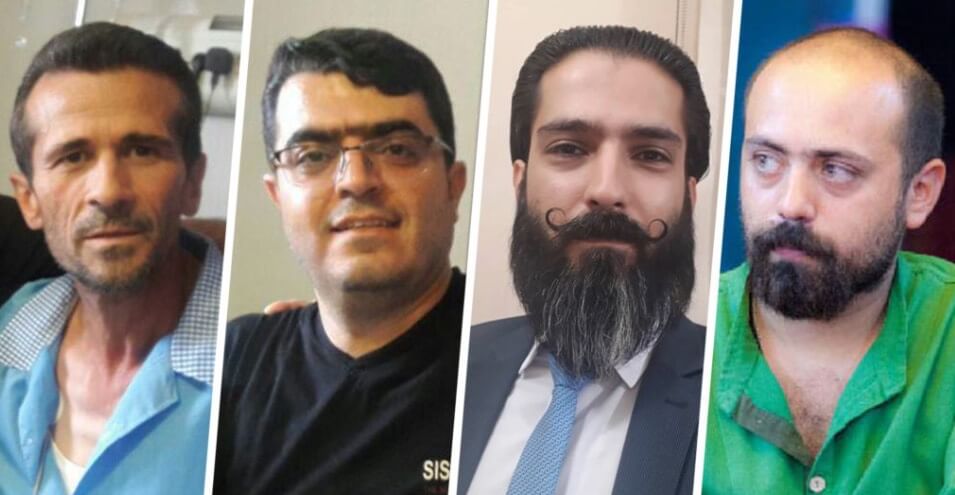
Amir Salar Davudi, a practicing attorney and member of the Central Bar Association, Ismail Abdi, a teachers’ union activist, Jafar Azimzadeh, a labor rights activist, and Majid Asarpai, a political prisoner at Evin Prison, released a statement in response to the process of granting furloughs to political prisoners.
According to the Free Union of Iranian Workers’ Telegram channel, these political prisoners released this statement on Thursday, March 12th, referring to the new circular issued by Ibrahim Raisi, head of the judiciary, regarding an order to grant limited furloughs to a group of imprisoned convicts. They stated that the serious and irreparable dangers resulting from delays and prolongation in the administrative and judicial process of sending prisoners on furlough, and in particular any obstruction in granting furloughs to political prisoners, are the responsibility of the two executive and judicial branches and the entire state authority.
According to these political prisoners, given the mandatory use of all prisoners of shared health services and kitchen facilities in the prison, the likelihood of rapid transmission of coronavirus from one person to other prisoners in one ward increases significantly. On the other hand, given the lack of medical equipment and health facilities and despite the spread of this virus in Iranian prisons, there is a possibility at any moment that the death toll from this virus in Iranian prisons could be several times higher than in environments outside prison.
In another section of this statement, it states: “We are witnessing serious delays in implementing this circular by the prosecutor and judges overseeing the prison, especially regarding political prisoners.” On Wednesday, February 26th, Ibrahim Raisi, head of the judiciary of the Islamic Republic, issued a new circular ordering limited furloughs for a group of imprisoned convicts under certain conditions; a circular that states in one of its provisions that political prisoners convicted on charges of “action against national security” with sentences exceeding 5 years are exempt from being sent on furlough. This is while most political prisoners charged with the aforementioned offense have sentences exceeding 5 years.
The U.S. State Department has repeatedly and in various cases condemned violent conduct and widespread suppression of protesters, repeated and continuous violations of the rights of Iranian citizens, and continuous cover-ups by the ruling regime of that country.
Mike Pompeo on Friday, March 1st, in a meeting of the House Foreign Affairs Committee, given the history of cover-ups by officials of the Islamic Republic, said that the Iranian regime is unwilling to provide information about the spread of coronavirus and “I am concerned they may be hiding important information.”
This is the second time the U.S. Secretary of State has expressed concern about possible concealment by Iranian officials. Mike Pompeo on Tuesday, February 25th at a press conference at the U.S. State Department had warned that America is concerned about concealment by Islamic Republic officials regarding the spread of coronavirus.
The United States had previously announced that it had issued waivers from Iran sanctions and allowed for the transfer of some humanitarian services, with the Central Bank of Iran authorized to carry out financial transfers.
Source: Voice of America