Publication of Historical Amnesty International Letter; Officials of Islamic Republic Government Were Aware of 1988 Executions
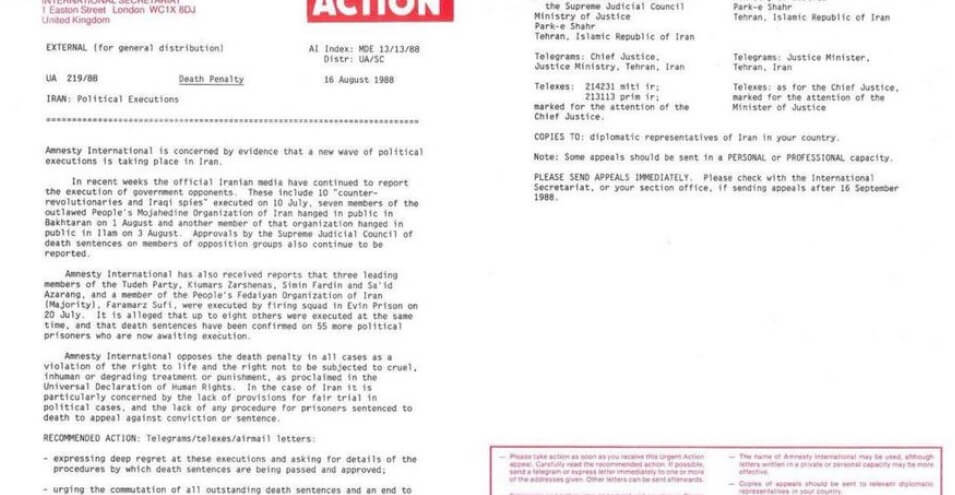
Coinciding with the anniversary of widespread executions of political prisoners in Iran in 1988, Raha Bahremini, a researcher at Amnesty International, published an image of a historic Amnesty International letter to Iranian authorities on Twitter, showing that government officials were aware of the implementation of these executions.
Amnesty International in this letter dated August 16, 1988, addressed to Abdolkarim Mousavi Ardabili, expressed concern about the execution of several members of the Mujahedin-e Khalq organization, three members of the Tudeh Party and several members of the People’s Fadaiyan organization, and the imminent execution of dozens of other political prisoners.
In 1988 and by order of Ayatollah Khomeini, the Islamic Republic reviewed the files of several thousand political prisoners, many of whom had been previously tried, and sentenced many of them to execution.
Officials of the Islamic Republic refrain from providing exact figures of those executed, but Ayatollah Hossein-Ali Montazeri wrote in his memoirs that the number of those executed was between 2,800 and 3,800 people. However, opponents of the Islamic Republic say the number of executions was much higher than this figure.
Raha Bahremini wrote in a Twitter message accompanying the publication of this letter: “It was a shocking discovery and showed that government, judicial officials and also ambassadors of the Islamic Republic were informed of the executions at least as of August 16, but the policy of the Mousavi government’s Foreign Ministry was denial. And today at the height of immorality they say they did not know.”
This letter, which was sent to the office of the then head of the judiciary and Iran’s Justice Minister, shows that government officials including the then president, Ali Khamenei, and prime minister, Mir-Hossein Mousavi, were aware of the widespread executions of political prisoners.
Ali Khamenei, who is now the leader of the Islamic Republic, appointed Ibrahim Raisi in recent years, one of the faces of the judicial committee of these executions known as the “death committee,” as head of the judiciary.
Mir-Hossein Mousavi, who has been under house arrest since 2010, had previously said he was unaware of these executions. He also said elsewhere that after the executions began, he heard about them from Mr. Khamenei in a meeting of leaders but his duty was to defend the system. Akbar Hashemi Rafsanjani, the then speaker of the Islamic Consultative Assembly, also spoke in defense of the executions.
Ms. Bahremini further wrote in Twitter messages the reactions of some ambassadors and diplomats of the Islamic Republic at the time to the executions, showing that Foreign Ministry officials were also aware of the widespread executions.
The only opposition among officials of the Islamic Republic came from Ayatollah Montazeri, the then deputy leader of the Islamic Republic, who told members of the judicial committee during a meeting that history would remember them as “the greatest criminals.”
Four years ago, the official website of Ayatollah Hossein-Ali Montazeri released an audio file of his remarks about the execution of political prisoners in 1988, in which Mr. Montazeri objected to these executions.
He made these remarks on August 24, 1988 in a gathering of the judicial committee including Morteza Eshraqi (prosecutor), Hossein-Ali Nairi (religious judge), Ibrahim Raisi (deputy prosecutor), Mostafa Pourmohammadi (intelligence representative in Evin), and demanded a halt to the executions. Ayatollah Montazeri was dismissed from his position as deputy leader by Ayatollah Khomeini in the spring of the following year.
Amnesty International two years ago also published a report titled “Blood-Soaked Secrets of the 1988 Massacre: Crimes Against Humanity That Continue,” and while referring to the concealment of burial sites of thousands of executed political prisoners by the Republic, called on the United Nations to conduct independent investigations into extrajudicial killings and widespread disappearances of opponents that have remained unpunished for three decades.
Source: Voice of America