Informal Martial Law in Iran on the 40th Day Commemoration of November Protests Deaths
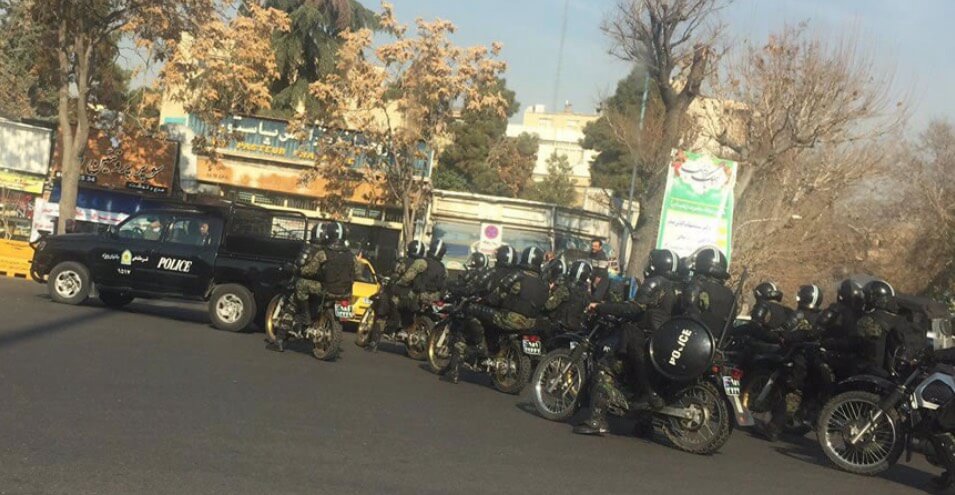
Ceremonies marking the 40th day of death for a number of those killed in Iran’s November protests were held on Saturday across different cities of the country, while internet has been disrupted nationwide since two days earlier, and streets of various cities took on a security appearance with the presence of Special Guard forces.
Net Blocks, an internet monitoring organization, reported on Thursday that 95 percent of Rightel mobile network internet in Iran has been cut off, and this mobile network’s internet access level has reached five percent after four consecutive drops. According to this organization’s announcement, mobile internet disruption in parts of Iran began from Wednesday, December 2nd.
ILNA news agency, citing “an informed source” at Iran’s Ministry of Communications and Information Technology, announced on Wednesday that “upon the order of security authorities,” international traffic on mobile phone lines in Alborz, Kurdistan, Zanjan and Fars provinces was cut off on that day.
Although this report was denied by Jamal Hadian, head of public relations at the Ministry of Communications, ILNA news agency had reported the possibility of increasing the number of provinces that “would be subjected to international traffic cuts on mobile phone lines.”
Previously, the unprecedented nationwide internet shutdown in Iran during November protests was accompanied by severe censorship of protest news and casualties of these protests.
The judicial and security authorities of the Islamic Republic refrain from providing official statistics of deaths and arrests in November, but on Thursday, various cities such as Behbahan, Rasht, Karaj, Isfahan, Langarud, Malard witnessed ceremonies marking the 40th day of deaths from the first day of November protests.
Simultaneously, some mobile phone users received the message: “Dear fellow countryman, according to Article 512 of the Islamic Penal Code, whoever incites or instigates people to war and killing each other with the intention of disrupting national security, regardless of whether it results in murder and looting or not, shall be sentenced to one to five years imprisonment. Let us be careful not to become the enemy’s tool.”
Despite internet disruptions, however, videos released from Tehran, Tabriz, Rasht, Isfahan, Behbahan, Shiraz, Arak, Qazvin, Andimeshk, Zahedan, Mahshahr, Abadan, Marivan, Kermanshah and other cities report a kind of informal martial law accompanied by the heavy presence of Special Guard forces, security forces, special motorcycle units, armored vehicles, water cannons, and masked individuals on the streets and helicopters in some areas. Simultaneously, family members of some detainees have been summoned and questioned.
An informed source told the Campaign that Mohammad Shahbazi, brother of Amene Shahbazi who died on Sunday, November 27th from a bullet wound to her neck, was summoned to Karaj security police and questioned. According to this source, the Amene Shahbazi family, under security pressure, was forced to hold the 40th day ceremony for her death one day later on Friday instead of Thursday.
In the village of Gorab Zarmikh in Rasht, the father of Navid Bahoodi, a 23-year-old young man who was killed in Qods city by a bullet fired from behind during the 40th day ceremony for his son’s death, was summoned by security forces. Reports indicate the arrest of a number of participants in this ceremony and their transfer to Rasht Information Detention Center. Jeleh Javaheri, Farugh Samieenia, Kaveh Mozaffari, Ahmad Zahedi, Houman Tahriri, Faraz Roshan, Fahimeh Kameli, Amir Eslami, Sara Zaherkardaar, Azar Jafari and Mahrukh Roustaye are among those arrested at Navid Bahoodi’s 40th day memorial according to Bidarzooni website.
Dozens have been arrested at Behesht-e Sakineh cemetery in Karaj, and security forces have beaten people with batons. Cambiz Nowruzzadeh, a civil activist, and Hoorieh Farajzadeh Tarani, sister of Shahram Farajzadeh Tarani who was killed on Ashura 2009, were among those arrested on Thursday at Behesht-e Sakineh. Rahehleh Farajzadeh Tarani wrote on her personal Twitter: “My sister Hoorieh Farajzadeh Tarani was arrested this August for the ‘crime’ of signing a letter in Mashhad, they released her, then she went to hospital and has been repeatedly threatened for the ‘crime’ of visiting families of the deceased, and today she was arrested again for the ‘crime’ of attempting to hold a memorial for our martyr brother Shahram. Pay attention to her ‘crimes’.”
Ms. Farajzadeh Tarani wrote in another tweet: “My sister was arrested at the entrance of Behesht-e Sakineh. She was going there to commemorate our beloved Shahram and Poya. Seeking justice is not a crime, it is a duty, and we will not stop demanding justice for our late brother Shahram and other victims in the path of justice and freedom.”
In videos released from Behesht-e Sakineh in Karaj, slogans such as “Death to the dictator, all these years of crime death to this rule, our pain is in you people join us, long live Iran and we did not lose to compromise and praise the killer leader” are chanted. There is no information about the number of detainees and where they are being held.
Dariush Mehrjouei, Rokshan Bani-Etemad, Jafar Panahi, Mohsen Amir-Yousefi and Reza Dormishian are artists who, despite the severe security atmosphere at Behesht-e Sakineh in Karaj, made their presence.
In Tehran and in areas such as Setarkhane, Sadeghieh and Tehran Pars which witnessed November protests, a heavy security atmosphere has prevailed since Wednesday, December 4th.
Simultaneously with the 40th day of deaths of victims of November 98 protests, a number of children of victims of Islamic Republic government violence, by issuing a statement supporting the mothers and fathers of the killed, declared to them: “Dear mothers and fathers, in the past 40 years, there has been no day in the history of suffering people of Iran when a man, woman, girl or boy has not fallen to oppression and inhumanity to dust and blood. Unfortunately, in this November, the monster of repression took the lives of your loved ones. We have also experienced what you are experiencing today in the past and know that the only way to be freed from the catastrophe that has befallen our dear nation and continues to suppress and kill its children in groups is the solidarity of the people and the pursuit of the struggle for human rights of all Iranians.”
In this statement signed by Parasto Forouhar, Nazanin Puyandeh, Sohrab Mokhtar, Lale and Ladan Boroumand, Francine Bashtiyar, Shahin Sadeghasadeh Milani, Azadeh Pourzand and Enaam Dohwari, it was stated that “on the 5th of Dey, wherever we are, from beyond the time and place that separates us from you, we will stand with you for justice, in silence by raising the images and names of your children, we will honor their memory by lighting a candle.”
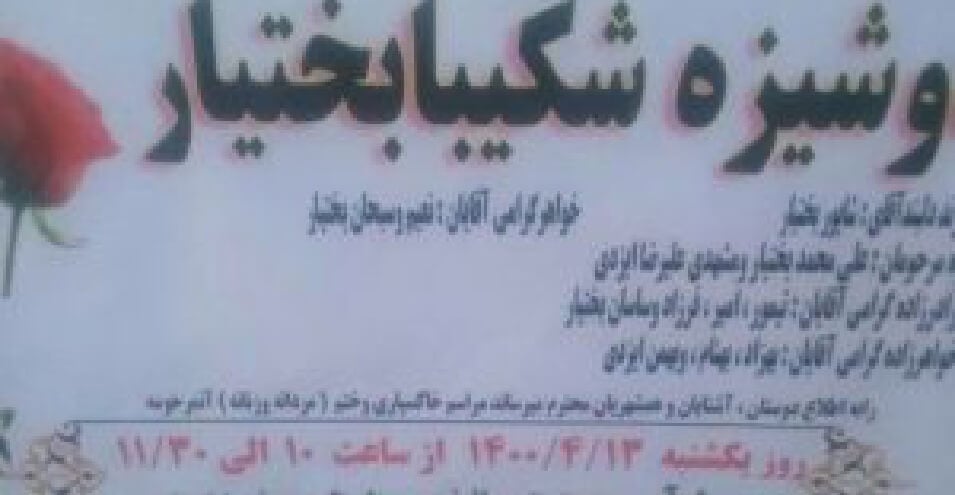
Previously, a number of mothers and family members of political and civil victims who died in the past 40 years, by issuing a call, designated December 5th as a day to pay tribute to the deaths of November 98, and called the suppression of recent protests a “crime against humanity.” Manouchehr Bakhtiari, father of Poya Bakhtiari, a 27-year-old young man who died from a direct bullet shot on Saturday, November 25th in Mehr city of Karaj, by posting a photo of himself and his son on his personal Instagram, invited the people, the Bakhtiari tribe, and all domestic and foreign journalists and IRIB and Jam-e Jam networks to participate in the 40th day ceremony for his son’s death on Thursday, December 5th at plot 26 of Behesht-e Sakineh cemetery in Karaj city.
However, Manouchehr Bakhtiari, three days before the ceremony, along with Nahid Shirpisheh, mother of Poya Bakhtiari, and several other family members were arrested, and on Thursday, while Poya Bakhtiari’s family members remain in detention, special unit personnel, by positioning themselves at Behesht-e Sakineh, did not allow other family members and relatives to be present at his grave at Behesht-e Sakineh.
Source: Human Rights Campaign