Increase in Number of Refugees Traveling from Turkey to Greece
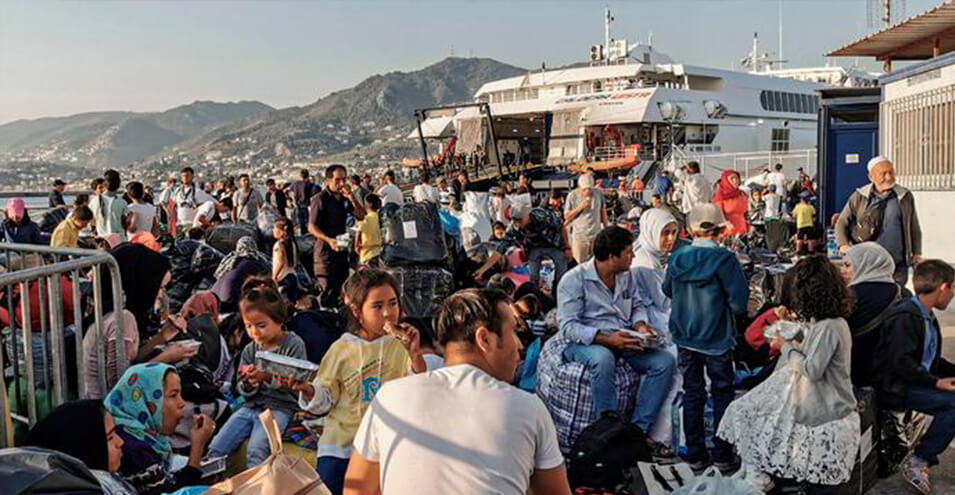
The number of refugees traveling from Turkey to Greece through the Aegean Sea has increased. In the past two days, 800 people have entered Greece through this route. Criticism by human rights advocates regarding the situation of refugees on Greek islands has also intensified.
On Wednesday, November 8 (October 30), Greece’s official news agency reported, citing the country’s coast guard, that the number of refugees leaving Turkey and heading to Greece through the northern Aegean Sea is increasing.
Just in the past two days, 800 refugees have entered the city of Alexandroupolis.
Traveling this route is considerably less risky than crossing the strait between Greece and Turkey in the eastern Aegean Sea.
Moreover, refugees crossing Greece’s land borders are no longer covered by the European Union’s migration agreement with Turkey.
According to this document, which was signed in 2016, only refugees who entered Greek islands through the eastern Aegean can be returned to Turkey, and only if their asylum applications have been rejected.
In recent months, the number of refugees on Aegean islands has decreased, and in April their number had reached 14,000. Currently, approximately 35,000 refugees are living in camps on the islands of Lesbos, Chios, Samos, Leros, and Kos.
The number of refugees on these islands has been unprecedented since March 2016, following the signing of the agreement between the European Union and Turkey.
Criticism of Abnormal Conditions in Camps
According to German news agency, the situation in refugee camps on Greek islands has increasingly drawn criticism from human rights organizations, including Amnesty International and Human Rights Watch.
In particular, the conditions at the central reception facility on the island of Samos have been reported as “abnormal.” This shelter was built for 650 people but currently houses approximately 6,000 people.
The situation on the island of Lesbos is also dire. In the “Moria” shelter, which has a capacity of 2,840 people, 14,400 refugees have been accommodated.
Turkey’s president has repeatedly threatened to open the way for refugees to reach the European Union. Recep Tayyip Erdoğan most recently warned the European Union on October 10 that if it does not stop criticizing Turkey’s military offensive in northern Syria, he will send millions of refugees to the European Union.
Bavaria’s Readiness to Assist Border Guards in Greece
On Wednesday, Joachim Herrmann, the interior minister of the German state of Bavaria, who was visiting Greece on an official visit, announced the state’s readiness to assist Greece’s coast guard.
Herrmann emphasized that member states of the European Union should provide support to “Frontex,” the EU’s border guard agency, for better protection of the Union’s borders.
He stressed: “No one is willing for what happened in 2015 to be repeated in Germany.”
In that year, more than one million refugees and migrants entered Germany. Since then, xenophobia in Germany has intensified and far-right extremists have been strengthened.
Source: DW