35 Student Organizations Severely Criticize Corruption, Injustice and Repression
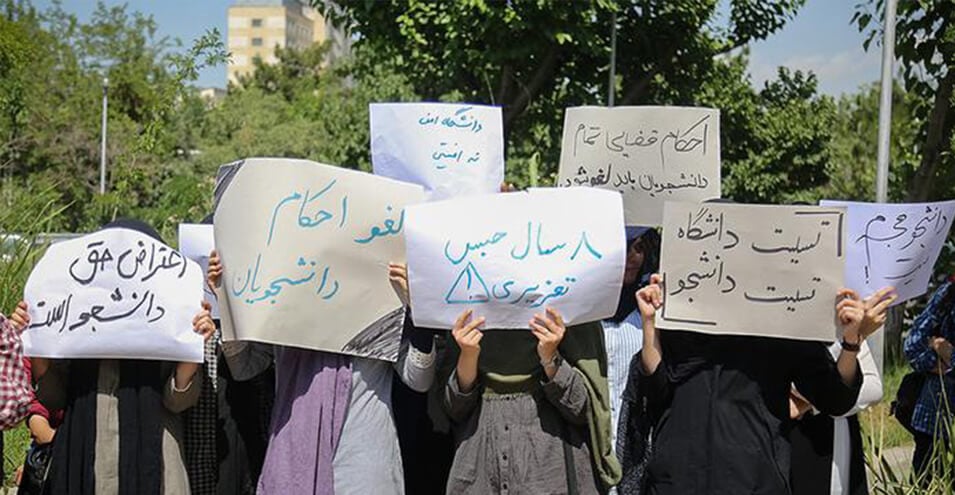
A number of student organizations across Iran have criticized policies based on “authoritarian interpretations” of freedom and religion. They say the result of these policies is the spread of poverty and corruption, repression in universities and interference in citizens’ private affairs.
35 student organizations from Tehran universities and some other centers in the provinces issued a joint statement marking the beginning of a new academic year, strongly criticizing the educational, cultural, social and economic policies of the Islamic Republic’s rulers.
At the beginning of this statement, published on October 7 on the news website “Emtedad”, it states: “We are beginning a new academic year at a time when, concurrent with the intensification of the monetization of university professional and welfare services and the commodification of education, and the approval of an anti-student disciplinary regulation, coercive approaches have cast a shadow over the university environment to increase the cost of any form of critical activism.”
The new executive regulation of the Student Disciplinary Committee, which was signed by the ministers of science and health following changes to the 2009 decision, was circulated to all Iranian universities on September 3 of this year.
Some activists and student organizations have evaluated the new regulation as being vague on certain concepts such as “conduct unbecoming” of students, laying the groundwork for increased pressure on university students and making the higher education environment more repressive.
Mohammad-Ali Kamfiruzi, a lawyer and student activist, told “Etemaad Online”: “This regulation has made the process of addressing student accusations in disciplinary committees far more stringent and severe and of course more arbitrary, and has further created conditions for violations of student rights in disciplinary committees.”
Security atmosphere to intimidate students
The 35 student organizations, in their statement criticizing the security atmosphere prevailing in universities, say that those who have created such an atmosphere mistakenly believe that by issuing “heavy sentences against activists, student organizations and critical student publications,” they can intimidate student movements.
While condemning heavy sentences against civil and student activists, they declared: “As long as these improper and illegal practices continue and the dysfunctional structures leading to these approaches, policies and practices are not reformed, no claims of justice-seeking and anti-corruption by any of the officials responsible for the current situation can be trusted or heeded by the people.”
These organizations, criticizing “structural discriminations” in the student admission process, including “increasing quotas for specific groups,” have assessed the result of the continuation of this situation as an increase in educational injustice.
In a section of the statement, these organizations describe policies called “economic adjustment,” including “the unrestrained transfer of production centers to unproductive and rent-seeking private and quasi-governmental sectors” that has been carried out under the title of privatization, as “anti-people.”
Authoritarian interpretations of the constitution and religion
The signatories of the statement wrote: “Authoritarian and reversed interpretations of freedom, the constitution and religion, in connection with each other, are attempting to impose a particular style of individual and social living on different segments of society, even in the most personal areas such as dress code or participation in sports gatherings.”
The eleventh session elections of the Islamic Consultative Assembly, the first round of which is scheduled to be held on February 20, is another issue that student organizations have addressed, directly addressing the reformist faction of the Islamic Republic government, which has been engaged in discussions about participation, non-participation and conditional participation in these elections for some time.
The statement emphasizes: “Recent years of experience have shown that relying solely on the ballot box without connecting with the realities and capabilities of the public sphere and civil society can be harmful and crisis-creating, and those who tie their freedom of action to the limitations of power institutions can only reproduce these same performances.”
Criticism of power-oriented reformists
The statement’s authors, based on these experiences, have concluded that “the presence of power-oriented reformists and bureaucrats in various positions does not lead to reviving hope at the level of society and liberation from the current situation.”
The statement ends with these words: “In conditions of structural dysfunction that will lead to the destruction of Iran and the loss of social forces, we students, as a social movement, seek our reform and salvation in returning to the university campus and preserving it as one of the bastions of social resistance.”
Thirty-five student organizations across Iran, a decade ago, while referring to what had been called “understanding the processes of internal and external encroachment,” spoke of the necessity of ensuring the security of each citizen so they could “live free from fear and free from want” under the protection of the law.
In a statement issued on the occasion of the beginning of the 1998-1999 academic year, these organizations emphasize that achieving this goal “will not be possible except through maximum resistance against accepting the current situation.”
Source: DW