Where Can Iran Strike at America and Its Allies?
A German newspaper has identified regions that are vulnerable to attacks by Iranian forces or militias supporting the Islamic Republic. In this context, references have been made to Iran’s capabilities in Europe and the United States.
On Sunday, December 15 (January 5), the newspaper “Die Welt” published a comprehensive article about the threats posed by the Islamic Republic against the United States and where Iranian forces or groups supported by the Islamic Republic could strike at America and its allies.
The article was written by four journalists (Böhmer, Lüthus, Wergin, and Hackenegg) and began with statements from Iran’s president.
Hassan Rouhani had said on Friday that the killing of Qasem Soleimani has made Iran more determined in its struggle against “American imperialism.”
The article further emphasizes that the Islamic Republic will not act alone but will increasingly deploy its supporting forces for retaliation through armed operations against the United States.
The authors of the article believe that so far, no military power has been able to transform its weakness into strength like the Islamic Republic.
In this regard, reference is made to “the weakening of the Iranian army due to sanctions” and the fact that Iran possesses weapons that were mostly manufactured between the 1960s and 1980s: “Even Iran’s air force does not have access to aircraft spare parts.”
Four German journalists emphasize that the forces of the Islamic Revolutionary Guard Corps are battle-hardened, but their equipment is not state-of-the-art.
For this reason, Iran has invested in two things: missiles and militia groups in other countries: “Missiles are a relatively inexpensive means of causing damage and deterrence over a large area.”
They also emphasize that the Islamic Republic has been able to gain extensive influence through its proxy forces in various countries, including Lebanon, Syria, and Iraq.
“Iran can create instability in countries of the region while simultaneously preventing crises from reaching within its own borders. In this way, Iran is able to strike its enemies and prevent retaliatory attacks,” because the attacks are carried out by those countries’ militia forces, not Iran itself.
Iraq
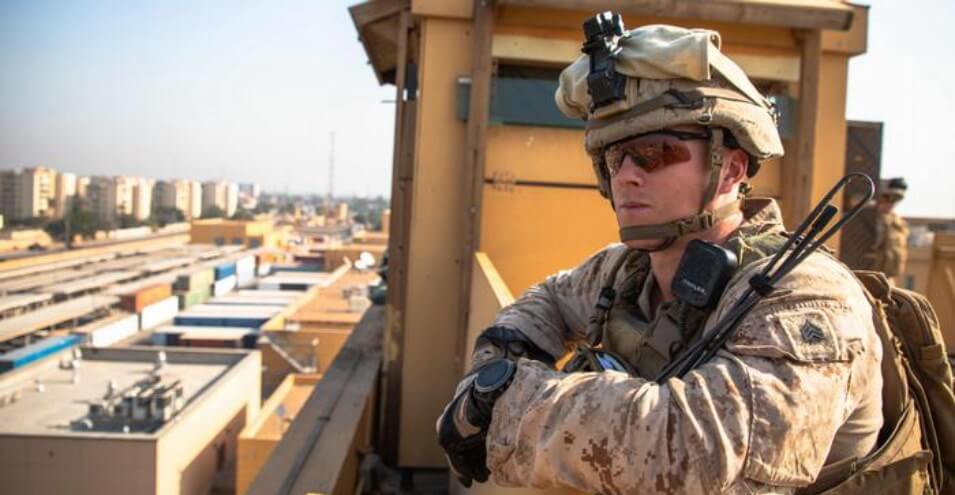
In the “Die Welt” article, reference is made to attacks by Iran-backed supporters on the “Green Zone,” the American Embassy in Baghdad, and the launching of missiles at the Al-Balad base on Saturday.
According to Iraqi sources, two missiles were fired at the “Al-Balad” air base, 80 kilometers north of Baghdad. At Al-Balad, American experts are stationed to train Iraqi military personnel.
According to the article’s authors, these are just two examples of the capabilities of groups under Iran’s cover, and America, in addition to its two offices in Iraq, has 5,200 soldiers and military experts in the country and is stationed at numerous military bases. Each of these could be a target for militia groups; groups that are “merely waiting for a signal from Iran” and “have no qualms about turning Iraq into a battlefield.”
Lebanon and Israel
The “Die Welt” article points to targets in Israel and Lebanon, and that the largest Iran-backed force is Hezbollah, which has deployed approximately 130,000 missiles in Lebanon and is targeting Israel.
From the authors’ perspective, an attack on Israel is Iran’s most important card in the power game in the Middle East: “Israel has the Iron Dome air defense system, but with a large-scale (missile) attack, likely half of the attacking missiles would be neutralized.”
But why doesn’t Iran use this winning card?
“Because it cannot use it multiple times. Israel’s response could be a counter-attack and military intervention in Lebanon. In that case, the missile arsenal that Iran has accumulated for Hezbollah over more than a decade would be destroyed and Tehran’s most important weapon in the region would be lost.”
United States and Europe
The German newspaper article also refers to the Islamic Republic’s capabilities to attack in America and Europe. In this regard, “sleeper cells” are mentioned that are affiliated with Lebanese Hezbollah, and some of them have been identified and prosecuted in the United States.
Western security agencies consider it likely that such “cells” also exist in Europe and are waiting for orders to attack and sabotage.
According to the “Die Welt” authors, Lebanese Hezbollah emphasizes that members of these “cells” should be citizens of Western countries. In this regard, a suicide attack is mentioned that was carried out in 2012 against an Israeli tourist group in Bulgaria. The attacker was a French citizen.
Later in the article, the possibility of terrorist attacks on targets in Germany is also raised. Based on the assessment of the security agency “Protection of the Constitution” (BfV) in summer 2019, the intelligence activities of Iran’s Quds Force in Germany “are aimed at investigating potential attack targets.”
In this regard, espionage regarding Reinhold Robbe, former head of the German-Israeli Association, is mentioned. In 2017, a Pakistani student in Germany was tried for espionage for the Islamic Revolutionary Guard Corps. According to prosecutors, he monitored Robbe’s daily life and that of a French-Israeli professor at the School of Economics in Paris and controlled their routes of movement.
Furthermore, German security forces have arrested ten Iranian suspects who are said to have monitored Israeli or Jewish facilities and projects.
According to the “Protection of the Constitution” office, Iranian opposition activists in Germany are increasingly in danger.
The Federal Criminal Police (BKA) has been updating its assessments since Friday regarding the danger posed by Iranian and non-Iranian groups supporting the Islamic Republic.
Global Trade
The four authors of the “Die Welt” article then address the danger that could be posed to global trade by Iran’s authorities. They point to Iranian forces’ attacks on oil tankers last year and the missile and drone attacks by Yemen’s Houthi rebels on Saudi Arabian facilities, and emphasize that the Strait of Hormuz is the most important waterway for the region’s oil trade, and if endangered, oil prices would rise significantly and disrupt global trade.
Another waterway used to transport oil and other goods to Europe is the Bab el-Mandeb Strait. This strait connects the Gulf of Aden and the Red Sea to each other.
The “Die Welt” article concludes with the point that Iran-backed Houthis could disrupt this strait, which is part of the shortest maritime route from the Gulf of Aden to Europe.
Source: DW