A List of One Hundred Names and a World of Controversy Over Dual-National Officials
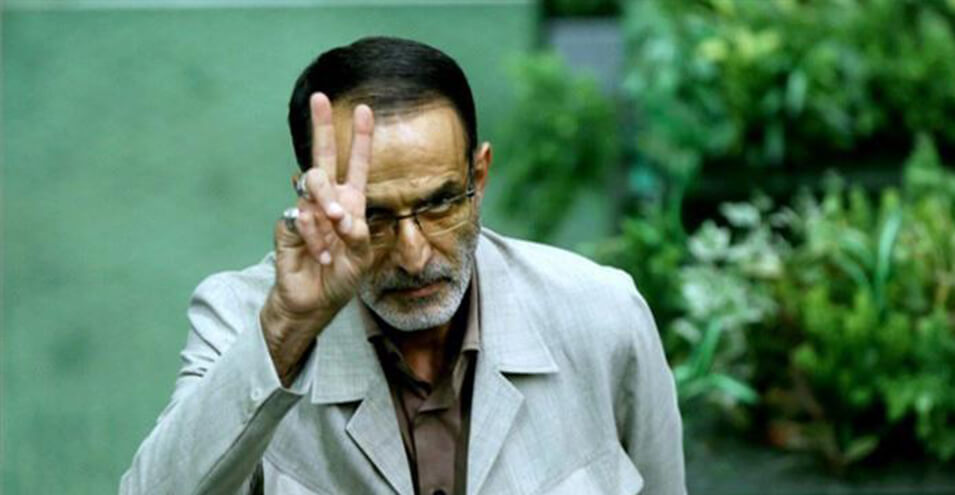
Javad Karimi Qadoosi says he was originally opposed to publishing the list of dual-national officials, but now that the list has been released, accusations have been directed at this principalist member of parliament. One accusation against him is that he holds Afghan nationality.
A list of one hundred names in two sections, marked in blue and green, which Javad Karimi Qadoosi, a principalist representative in the Islamic Consultative Assembly, says is the result of a year’s work by parliament’s oversight committee on dual nationality, has become the source of numerous disputes and controversies.
A summary of the report by the Islamic Consultative Assembly’s oversight committee on dual-national government officials was presented for the first time on Tuesday, the first of Mordad (July 23) by Javad Karimi Qadoosi, a member of parliament’s National Security Commission.
Although the main focus of Karimi Qadoosi’s remarks was not on the report itself but on whether a list contained in the committee’s report should be published or not—a list that includes names of government officials suspected of holding dual nationality.
The list consists of two sections: the first section pertains to individuals for whom “there is evidence and indication of the possibility of holding dual nationality.” The second section pertains to the names of officials for whom “there is strong suspicion based on available documents of holding dual nationality.”
In the first list, the name of Hassan Rouhani, Iran’s former president, also appears, and the controversies began from there.
Karimi Qadoosi: This list should not have been published
Javad Karimi Qadoosi, in an eight-and-a-half-minute speech in parliament’s open session, clarifies that the preparation of this list was the result of a year’s work by the oversight committee and to prepare it they approached various institutions from the security police to the passport police, the Revolutionary Guards’ intelligence, the judiciary, and the Ministry of Intelligence. Finally, they read the report of this year-long work in parliament’s National Security Commission.
Karimi Qadoosi says that during the reading of this report, he insisted that this list not be published, and his reason was that “society does not have the capacity to accept hearing these names.” He mentions Mostafa Kavakbian, a reformist representative, and claims that in the National Security Council meeting, “our brother Mr. Kavakbian insisted that the names be read,” and apparently with insistence, this list was read in that meeting.
Karimi Qadoosi says that after the list was read in the National Security Commission meeting of parliament, he insisted that now that the list has been read, at least don’t publish it, “but then Mr. Rahimi [Jalil Rahimi Jahanbadi, a reformist representative] gave an interview and said that Mr. Rouhani’s name was on this list.”
These two lists were published on the Moj website, and in the first section, besides Hassan Rouhani’s name, there are names of other individuals such as Masoumeh Ebtekar, Vice President for Women’s Affairs, and Saeed Namaki, the current Health Minister.
In the second list, which pertains to individuals for whom there is “strong suspicion” about their dual nationality, there are names such as Mohammad Nahavandian, the President’s Chief of Staff, and Abdolrasoul Deri Esfahani, the Head of the Monetary and Banking Committee of the nuclear negotiating delegation.
On the first of Mordad, the Moj website published an image of a court order based on which Deri Esfahani was sentenced to five years imprisonment on charges of espionage.
Karimi Qadoosi: Seven generations back, we were not even in Afghanistan
Karimi Qadoosi, the representative of Mashhad, mentions in his speech that after the publication of this list—which apparently he had no role in and was even opposed to its publication—he is being “accused” by some of originally being from Afghanistan.
This Mashhad representative says: “If Mr. Rahimi has a document proving that one of our ancestors, even seven generations back, was in Afghanistan and came here, he should broadcast this document on radio and television… Otherwise, I ask the Afghan government to investigate whether we have any connection or roots throughout history with Afghan peoples, and if so, we will go back to Afghanistan.”
Karimi Qadoosi’s reference is to the remarks of Jalil Rahimi Jahanbadi, the reformist representative from Turbat-e Jam, who severely criticized Karimi Qadoosi and said: “Who gave you an Iranian ID card, who allowed you to challenge the pillars of the system, how many days of resistance front experience do you have, how many operations have you participated in that you reached the rank of general? Since when did you become Iranian when we were not Iranian.”
Rahimi Jahanbadi said in another part of his remarks: “Mr. Karimi Qadoosi, at the time when your ancestors, your relatives were attacking Iran from Afghanistan, we were Iranian and we were defending Iran.”
Of course, references to Karimi Qadoosi’s origins were not limited to inside parliament. Mahmoud Vaezi, the President’s Chief of Staff, also said about the publication of the dual-national list: “We don’t know what the roots of these people are and where they come from, they bring up these claims so that no one asks them where they came from.”
The President’s Chief of Staff also welcomed the publication of this list and said: “We were pleased that this list was published and it states next to each of them that it was compiled based on evidence and indication.”
Vaezi continued: “That is, based on evidence about anyone anywhere in the world, you can raise anything, and it becomes clear that none of these gentlemen’s claims have any basis or foundation.”
Presidential Parliamentary Deputy: I refute it
According to the Islamic Republic News Agency, IRNA, Hossein Ali Amiri, the President’s Parliamentary Deputy, said on the sidelines of Wednesday’s government session: “The list of dual nationals has been repeatedly denied by the Intelligence Minister. What has been published in the media since yesterday is based on suspicion and doubt, ambiguity and ‘it is said,’ and it is not correct.”
Amiri emphasized: “I refute this list of dual nationals.”
Bill to ban employment of dual-national individuals
Since Mehr of last year, a bill has been under consideration in the Islamic Consultative Assembly whereby the selection or appointment of dual-national individuals in “all institutions that in any way use the country’s general budget” is prohibited. Also, the employment of holders of “permanent or long-term residence permits exceeding one year from foreign countries” and “ownership of land or properties in foreign countries” is also prohibited.
This bill, however, has not yet been passed and is highly controversial. Among them, Hashmatallaah Fallahatinejad, the former head of parliament’s National Security and Foreign Policy Commission, said about this bill: “In the matter of nationality, the rights and concerns of Iranians should be taken into account. Dual residence and nationality is not a crime.”
Last year, parliament’s National Security and Foreign Policy Commission also began an investigation on “dual-national individuals and those holding green cards among officials and senior managers” and presented its final report on the 27th of Mordad.
In the introduction of this report, with reference to Article 989 of the Civil Code and Articles 41 and 42 of the Islamic Republic’s Constitution, it was emphasized that Iran’s laws do not recognize dual nationality, and a person’s foreign nationality is not valid except in cases such as “acquisition of dual nationality through birthplace or marriage of an Iranian woman to a foreign national.”
This report states that Iran’s laws have many shortcomings and ambiguities in identifying dual-national individuals and employing them in executive agencies that need to be resolved.
Source: DW