Paper Shortage, a New Monster Facing Iran’s Press
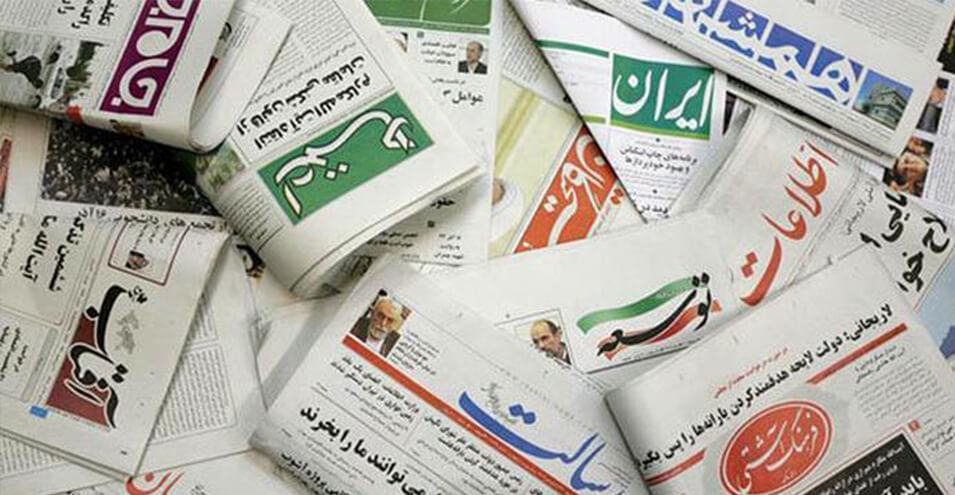
Iran’s print media outlets are facing an unprecedented shortage and price increase of paper. Some publications have been forced to reduce their pages and circulation. Experts warn that the current situation threatens publications with closure and journalists with unemployment.
With the expansion of economic disorder and rising prices of goods in Iran, largely due to foreign sanctions, paper has become a “luxury” commodity and has posed serious challenges to the continuation of print media operations.
Although the government has considered paper as an essential commodity and formed a special task force to regulate its imports, the problem persists: in recent weeks, many print publications and news agencies have reduced their pages and “adjusted their workforce” to prevent closure.
Recently, Javad Deliri, editor-in-chief of the state newspaper Iran, announced an eight-page reduction of the newspaper. According to the Labor News Agency (ILNA), Deliri said in a Twitter message: “Due to the serious paper crisis, from Sunday (April 12) and until further notice, we are reducing eight pages from Iran newspaper’s pages, and this newspaper will be on newsstands with 16 pages instead of 24.”
Javad Deliri explained this decision: “We are forced to reduce paper consumption to make it last longer… The paper crisis is so serious that the circulation of many newspapers has decreased to one-third in the past two months, and based on information I have, some newspapers will have no more paper in the next one or two nights.”
Nilofar Qadiri, a member of the editorial board of Hamshahri newspaper, also announced an eight-page reduction of the newspaper. ILNA quoted Qadiri as saying: “The paper crisis has set fire to the press.”
MohammadReza Saedi, editor-in-chief of “Jahan Sanat” newspaper, and Hossein Abdollahi, editor-in-chief of Arman newspaper, told Hamshahri newspaper that if the paper shortage is not resolved as soon as possible, they do not see a bright prospect for continuing publication.
“200 Years of Journalism in Peril of Destruction”
Mahmoud Mokhtarian, professor at Allameh Tabataba’i University and journalist, told the ILNA news agency: “Since about 95 percent of our paper is imported, with the increase in newspaper paper prices, the production costs of written media have also increased significantly. But apart from economic conditions and rising paper prices, the main problem is the state-owned nature of media, which lacks criticism and the daily life of the people.”
Mahmoud Mokhtarian warns: “It is a pity that 200 years of journalism in the country will be destroyed.”
Mahmoud Sadri, director of “Donyaye Eqtesad” publications and journalist, also shares this pessimism about the future of publications: “This year we witnessed paper costs rising, people’s purchasing power decreasing, and the first effect is the elimination of cultural expenses and reduced newspaper purchases and greater workforce adjustment. Therefore, I believe there is no bright prospect for the future of the press in Iran.”
In this regard, emphasis is placed on the heavy and irreversible consequences of the decline of mass media on the cultural life of society.
The Causes of the Crisis
The most important reason experts cite for the crisis of mass media goes beyond the paper shortage problem and points to the general publishing crisis in Iran.
In Iran, the virtual space has expanded and today social networks and messaging applications such as Telegram, Twitter, and Instagram play the main role in information dissemination.
The widespread phenomenon of the expansion of virtual space and its consequences is seen around the world, but this process has taken a more acute form in Iran. Mahmoud Mokhtarian says about this: “The vulnerability of other countries’ media to this issue was ultimately 5 percent, not that suddenly like Iran, media suffered 80 percent damage.”
Therefore, one must also address the reasons for people’s turning away from major media and their extreme enthusiasm for virtual media. The reality is that “authorized” publications and “official” news agencies are no longer a reliable and credible reference for people. In this regard, not only mass media, but book publishing is also facing a “crisis of trust.”
This veteran journalist, in tracing the root of the problem, points to direct and indirect pressures on the press: “Over the past 20 years, we have constantly humiliated our journalists and closed publications under various pretexts.”
Mokhtarian, criticizing that “media has strayed from its primary functions,” says: “The primary function of media is criticism, highlighting, creating platforms, building trust, creating culture, creating civilization, and creating waves. We should be able to create a wave in our media in service of the national interests of the country. But to what extent is our media in service of this criticism? Almost nothing.”
Mahmoud Sadri also clarifies: “If governments had allowed publications to operate freely in virtual space, if there were no pressures like filtering and if there was more open and free opportunity for speech, instead of unknown and informal media taking hold in this space, our country’s official press could be active in virtual space and have their say.”
Ways Out of the Crisis
With the intensification of paper shortage, a few months ago the Ministry of Culture and Islamic Guidance formed a paper task force to address the crisis, but despite promises and the allocation of government currency for paper and the entry of several shipments, there has been no sign of the crisis abating to this day.
Recognizing the real reasons for the paper shortage not only reveals the root causes of the problem but also shows the horrific dimensions of apparent and hidden corruption (profiteering).
According to the Ministry of Culture and Islamic Guidance, 262,000 tons of paper were imported into the country in the current year with government currency, but only 23,000 tons were distributed with the approval of the cultural and press deputies of the Ministry of Culture and Islamic Guidance. This means that more than 93 percent of imported paper with government currency has been wasted.
Some glimpses of this corruption have been revealed:
Mohammad Soltani Far, former deputy of the Ministry of Culture and Islamic Guidance, said: “Two people received currency for paper imports who had no foreign existence at all.”
He clarified that those two fictitious people received about 24 million euros of government currency for paper imports.
In December 2018, Hassan Rahimi, chief of the Tehran Police, announced the arrest of the “paper sultan” along with a group of 16 people; the value of this case at that time was announced to be more than 1,700 billion tomans.
The Tehran Police Chief said: “These individuals imported about 30,000 tons of paper with government currency, but none of this paper entered the market or was sold freely; with a number of government currencies, no paper was imported at all and it was sold freely in the market.”
In March 2019, Abbas Jafari Dowlatabad, then prosecutor of Tehran, announced the escape of two main accused in paper imports to outside Iran; he said these individuals had received 190 million dollars in currency for paper imports.
The Tehran prosecutor clarified: “In the paper case, eight companies are under investigation, and except for two main accused who have fled, 17 accused are in custody.” According to him: “The total of these eight companies received 190 million dollars in currency, which either brought paper but sold it in the free market by preparing fake invoices or did not import paper at all and sold the currency.”
Profiteering and especially endless illegal spending in paper distribution is an important problem that has particularly made the work of independent media difficult. This is an old and well-known problem where the government uses unfair paper rationing to pressure critical publications.
To this day, no one has heard of government-aligned media complaining about paper shortage.
Source: DW