Flood Damage in Iran: 76 Deaths and 20 Trillion Tomans in Losses
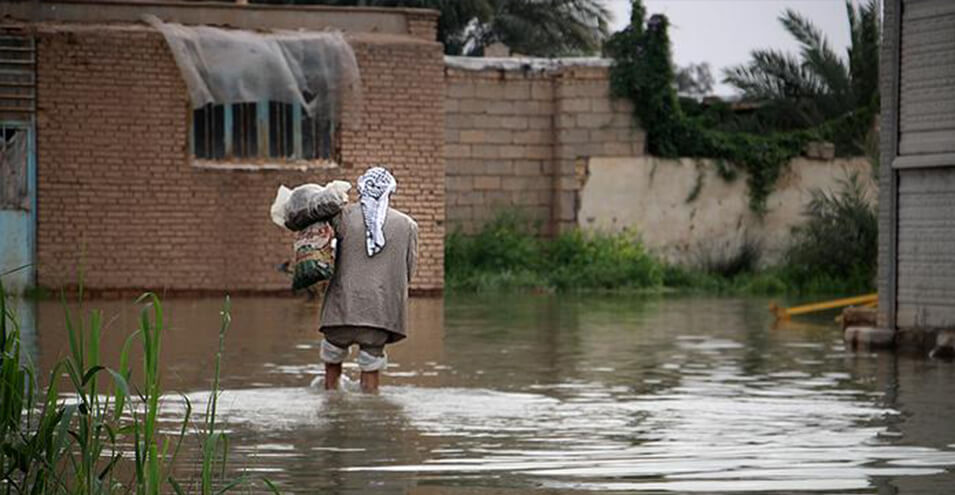
So far, 76 people have lost their lives in the floods. According to available statistics, the floods have caused approximately 20 trillion tomans in damage. Several provinces in southern Iran remain at risk of flooding. Floods are currently occurring in Kerman Province.
According to the latest statement from Iran’s Legal Medicine Organization on the 25th of Farvardin, five people lost their lives in flooding incidents in Khuzestan Province and one person in Ilam Province; these individuals were victims of floods in the cities of Masjed Soleyman, Shushtar, Elhayeh, Poldokhtar, and Ahvaz. As a result, the death toll from the recent floods in Iran has reached 76 people.
The majority of flood victims were from Fars, Khuzestan, and Lorestan provinces.
According to the latest warnings from Iran’s Meteorological Organization, with the arrival of a new weather system, there is still a possibility of flooding in southern provinces of Iran during Sunday and Monday.
A Devastating Flood
Based on statistics presented by responsible officials in the Iranian Parliament and reflected in news agencies, it appears that the floods in Iran have so far caused approximately 20 trillion tomans in damage.
In an open session of the Iranian Parliament on Sunday (25th of Farvardin) dedicated to reviewing the recent floods and rainfall, ministers from four ministries—Interior, Energy, Roads, and Agriculture—along with several other responsible officials presented reports on their operations and activities related to the floods.
Mohammad Eslami, Minister of Roads and Urban Development, said that during the recent flooding, approximately 11,000 technical structures (including bridges and culverts) were damaged, and 725 bridges were completely destroyed.
He assessed the financial loss from the floods at 3,250 billion tomans in damage to roads, railway routes, technical structures, and road and urban development facilities.
He stated that approximately 12,000 employees of the Roads Ministry from 26 Esfand to 17 Farvardin dealt with the flooding phenomenon in 24 provinces of the country.
The Minister of Roads and Urban Development said: In the recent floods, approximately 150,000 residential units in cities and villages were damaged, with 50,000 units requiring reconstruction and 100,000 units needing repair and rehabilitation.
A Disaster for Agriculture
Mahmoud Hejazi, Minister of Agriculture-Jihad, estimated the total damage to producers in various sub-sectors of Iran’s agriculture sector at 13 trillion tomans.
According to the Minister of Agriculture-Jihad, Khuzestan Province suffered the most damage. The sub-sectors of agriculture, horticulture, livestock, beekeeping, and poultry farms sustained significant damage.
Reza Ardakanian, Minister of Energy, announced on Sunday morning in Parliament that the recent floods have caused 2,100 billion tomans in damage to water and power facilities so far.
The Energy Minister reported the cutting off of drinking water to 380 villages during the initial days of flooding and added: “The total damage to water and power can be stated as 2,100 billion tomans.”
Earlier, Bijan Zanganeh, Iran’s Oil Minister, reported that 1,000 billion tomans in damage had been inflicted on oil facilities in Khuzestan during the floods.
The Catastrophe of Climate Change
According to experts and some Iranian officials who “lack scientific authority,” the recent floods have been called a “blessing and mercy,” and they have expressed joy that these floods have ended the severe drought that has gripped this land.
However, responsible organizations and scientific figures fundamentally reject this optimism.
At Sunday’s session of the Iranian Parliament, Sahar Tajbakhsh, Director of the Meteorological Organization, stated that the recent floods resulted from the consequences of climate change and global warming. She emphasized that Iran is still affected by drought and has not entered a wet period. She added: approximately 60 to 65 percent of the country is still suffering from drought.
In this regard, Abbas Ranjbar, Director of the Meteorological Research Institute, says: “In the future, we will experience both very destructive and severe floods and widespread droughts, as well as heat waves and cold waves. Therefore, the occurrence of recent rainfall is not evidence that we will not experience severe drought next year.” This expert, in an interview with ISNA news agency about the measures taken by the Meteorological Research Institute to create flood prediction and warning systems in watersheds, said: “In 2017, we presented a proposal to implement a flood prediction and warning system plan in Shiraz to the relevant authorities in the province, but the necessary support was not provided.”
Source: DW