Moment by Moment with the Flood; “Six Provinces Are in Emergency Conditions”
According to the spokesperson for the country’s crisis management, six out of 23 provinces dealing with severe rainfall are in emergency conditions. The representative from Khorramabad also says that communication disruptions have made aid delivery difficult.
Behnam Saidi, spokesperson for the country’s crisis management, in an interview with the second channel of Islamic Republic of Iran Broadcasting described six out of 23 provinces dealing with severe rainfall as being in emergency conditions. He mentioned these six provinces as Ilam, Kermanshah, Lorestan, Khuzestan, Chaharmahal and Bakhtiari, and Kohgiluyeh and Boyer-Ahmad, and added: “Altogether, 400 cities and villages have been and are affected by the recent weather conditions.”
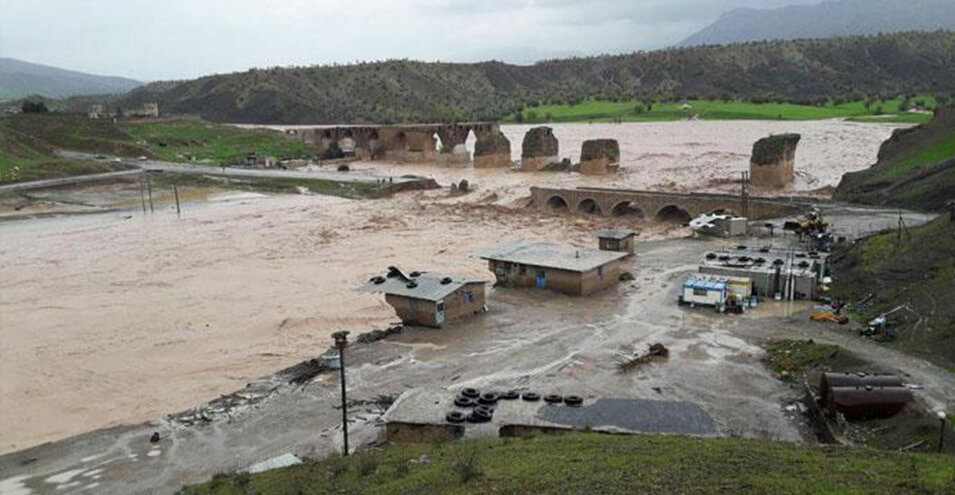
Saidi further reported the overflow of 141 rivers across the country in recent days, which has resulted in the closure of 78 inter-city roads, 2,199 rural roads, and the destruction of 84 bridges.
The crisis management spokesperson then pointed to approximately 400 landslides caused by the flooding and said that most of them are related to Chaharmahal and Bakhtiari. He described the Pol-Dokhtar area in Lorestan Province as having more critical conditions due to the collapse of the city’s main bridge.
“Communication Disruptions Have Made Aid Delivery Difficult”
The general manager of the Red Crescent Society of Lorestan, stating that relief operations have now begun in Pol-Dokhtar city, added: the distribution of essential items among Pol-Dokhtar citizens has also started. A temporary shelter has been provided for Pol-Dokhtar residents, and their settlement operations in Red Crescent tents continue.
Mohammad Biranvand, representative of Khorramabad in parliament, in an interview with ISNA, referring to the latest situation in Khorramabad after the recent flooding, said: “Today the weather in Khorramabad is favorable, but communication with most villages has been cut off. In the city of ‘Dore Chegini’ we urgently need emergency aid. In the villages of Doab, Delbar, and parts of Sepid Dasht and Biran city, communication is completely cut off… it can be said that communication is cut off in most villages and towns of the province and people are in severe distress.”
Biranvand further, emphasizing that there is insufficient equipment to deal with the flooding, said that “whatever equipment does exist, we cannot deliver to the people because of the communication cutoff. Before anything else, communication must be restored. Roads and telephone lines must be restored so that we can manage the situation.”
Red Crescent Rapid Response Teams Entered Pol-Dokhtar
The head of the rescue and relief organization of the Red Crescent Society announced the arrival of rapid response rescue teams to the flood-affected area of Pol-Dokhtar in Lorestan Province.
Morteza Salimi on Tuesday, 13 Farvardin, in an interview with IRNA said that the rescue and relief teams of this organization “with their arrival in the mentioned area are working with full capacity to provide relief to flood victims and those affected by the flooding.”
He also reported the deployment of six helicopters to help flood victims in Pol-Dokhtar. Sarem Rezaei, general manager of the Red Crescent Society of Lorestan, also told FARS News Agency that six helicopters from the provinces of Gilan, Kermanshah, Kurdistan, Central, Kohgiluyeh and Boyer-Ahmad, and Tehran, along with one helicopter from this province, have been deployed to provide relief to various cities in the province, including Pol-Dokhtar.
The head of the rescue and relief organization of the Red Crescent Society, continuing his interview with IRNA, asked the public to refrain from unnecessary travel in flood-affected areas of Lorestan Province so that relief to flood victims can be carried out more quickly.
The head of the rescue and relief organization of the Red Crescent Society also reported the rescue and transfer of a number of villagers to other villages and safe areas, and said: as ground transportation routes to Pol-Dokhtar open, new rescue and relief teams will be deployed to flood-affected areas.
IRNA in its further report stated the damage from the first wave of this year’s rainfall at 800 billion tomans and added: “While efforts to revive the province had begun, a new wave of rainfall from the beginning of this week has engulfed the entire province.”
Currently, three rivers—Kharam Rod and the rivers of Delfan, Kohdasht, Selseleh, Pol-Dokhtar, Momollan, Broujerd, and Chegni cities—have overflowed, the Marak Dam in Dorud has overflowed, and some dams such as Haleh and Kazenar are on the verge of overflowing, and hundreds of thousands of residents have been warned to leave their homes.
Jahangiri: The Main Lock for Water Drainage from Golestan Province Has Not Yet Been Opened
According to Ishaq Jahangiri, First Vice President of Iran, “the recent rainfall has been dozens of times more beneficial to the country than the damage it has caused to areas of the country, and we should be grateful to God in this regard and hope that this blessing continues.”
He, speaking on the evening of 12 Farvardin in a meeting of the crisis management coordination council of Khuzestan Province in Ahvaz, meanwhile acknowledged that the flooding has become a major crisis for the country: “Before the recent flood, crises in the country were such that one region would be affected and other provinces would mobilize and solve the problem, but now the situation is such that the flooding issue has become a main problem in 24 provinces of the country.”
Jahangiri further referred to the dire situation in Golestan Province, which has been dealing with flooding since 28 Esfand, and said that “the main lock for water drainage from some cities and villages of Golestan Province has not yet been opened and the situation in this province is unfavorable.”
Source: DW