Venezuelan Opposition Leader Declares Himself Interim President; US Recognizes Him
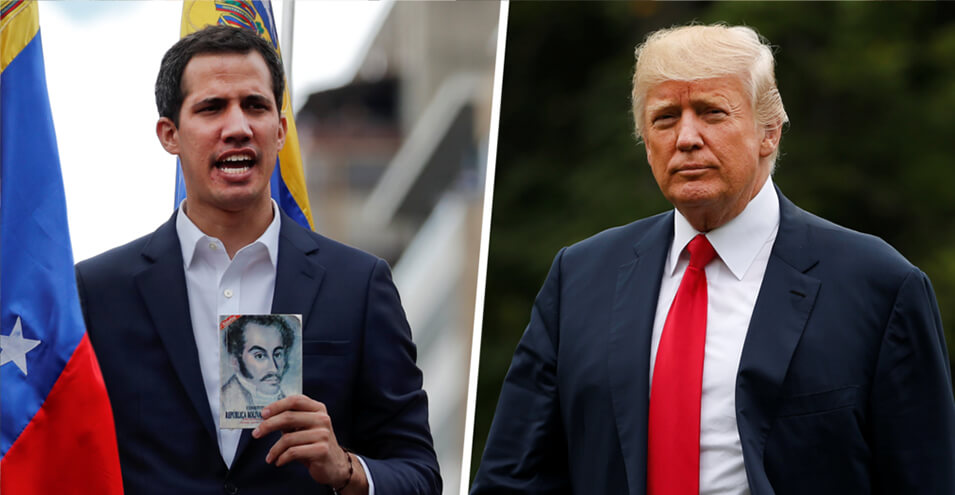
Juan Guaidó, speaker of Venezuela’s parliament, declared himself interim president of Venezuela on Wednesday, January 23rd, as thousands of protesters took to the streets demanding the resignation of Nicolás Maduro. The United States became the first country to formally recognize his presidency.
According to the Associated Press, immediately following the opposition leader’s announcement, US President Donald Trump formally recognized him as Venezuela’s interim president. The US announced it would use its maximum diplomatic and economic power to restore democracy to Venezuela.
President Trump said in a statement: “The citizens of Venezuela have suffered for a long time under the illegitimate Maduro regime. Today I formally recognize Juan Guaidó, the speaker of parliament, as the interim president of Venezuela.”
The US president also called on other Western nations to join him and recognize Guaidó. President Trump said: “The people of Venezuela have courageously stood against Maduro and his regime and are demanding the rule of law and freedom.”
The US Secretary of State also said shortly thereafter: “The United States recognizes Juan Guaidó’s courageous decision to assume the interim presidency of Venezuela based on Article 233 of the country’s constitution.”
Mike Pompeo said in a tweet: “We support Venezuela’s parliament and its efforts to form a transitional government and prepare Venezuela for freedom and fair elections.”
Juan Guaidó, during a symbolic ceremony amid Wednesday’s protests and surrounded by tens of thousands of demonstrators, knelt before God and declared himself interim president. The 35-year-old Mr. Guaidó told his eager supporters: “We all know that everything we do has consequences. Therefore, we must understand that returning to constitutional rule requires the cooperation of all Venezuelan citizens.”
Mr. Guaidó’s announcement came as Caracas, Venezuela’s capital, witnessed thousands of protesters Wednesday holding placards with the slogan “Maduro out” in the streets. Opponents said choosing this day was historically significant, as it marks the anniversary of the 1958 coup that led to the overthrow of dictator Marcos Pérez Jiménez.
Nicolás Maduro began his second presidential term on January 10th, even as Venezuela’s parliament said his presidency was “illegitimate.” Lima Group countries—a group of 12 Latin American nations plus Canada—also announced they would not recognize Maduro’s second presidential term.
Nicolás Maduro, who was Hugo Chavez’s vice president for several years, assumed the presidency following Chavez’s death and promised to continue his policies. Opponents of the Venezuelan government blame the economic policies of left-wing groups over the past nearly two decades for the economic crisis, while the government blames the United States and “domestic factors” for the country’s problems.
Venezuela faces serious economic and financial crises. Inflation has spiraled out of control and despite the country’s substantial oil resources, poverty and hunger have become widespread.
Source: Voice of America