Suspicious Death of Young Woman After Accusing Parliament Member of Sexual Assault
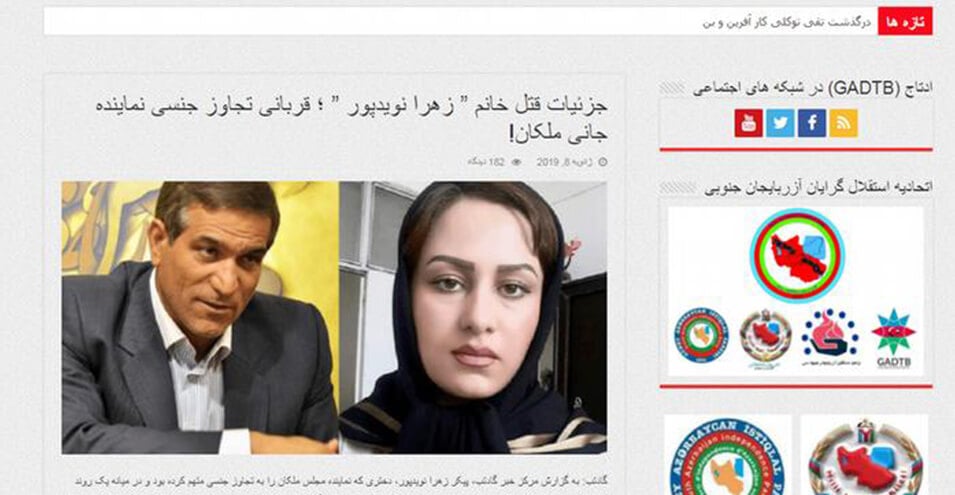
The body of a young woman who had accused a parliament member of sexual assault was found in her home. A lawyer who had been providing legal advice to this woman expressed doubt in an interview with Deutsche Welle about whether the woman’s death was natural or suicide.
The lifeless body of Zahra Nividpour, a young woman who had filed a legal complaint against one of parliament members for sexual assault, was found on Sunday, December 16, 1397 (January 6) at her mother’s home in Malekan city in East Azerbaijan Province.
Akbar Alami, one of the former parliament representatives in the sixth and seventh terms, announced the news of this young woman’s death on his Telegram channel on December 17.
According to reports, Ms. Nividpour’s body was transferred to Farabi Hospital in Malekan on Sunday, and after the confirmation of her death, it was transferred to the city’s coroner’s office for investigation into the cause of death.
Reports suggest that this 28-year-old woman ended her life by “suicide.”
Alami wrote on his Telegram channel: “Given Ms. Nividpour’s determination to obtain her rights, her suicide is a matter for contemplation by relevant authorities and raises suspicious questions.”
Zahra Nividpour, by releasing several audio files and an interview with a television channel belonging to the Republic of Azerbaijan, had claimed that in 1393 (2014), following a job application request from Salman Khadadadi, the representative of Malekan people in the Islamic Consultative Assembly, she was sexually assaulted.
In the television interview, Ms. Nividpour stated that in June 1397, she filed a complaint against Khadadadi with the parliamentary oversight commission, the Guardian Council, and then with the Malekan court.
Salman Khadadadi is currently a member of the parliament’s social commission and also the head of the Tehran province rowing federation.
Akbar Alami wrote on Telegram that despite Nividpour’s legal proceedings and also Alami’s legal pursuits through several parliament members, the complaint case remained unresolved.
Nividpour also announced on social media that she had been repeatedly threatened by unknown individuals and “associates of the mentioned representative” with “acid attacks” and “death,” and she had also informed the court about this matter.
In a handwritten letter that “Hrana” news agency published and claims was written by Zahra Nividpour to the judge of her case, the writer claimed that threats against her had been intensified around the clock by suspicious elements, and she requested “personal security protection.”
The letter was dated on the 26th of Mehr of the current year.
Akbar Alami expressed regret on his Telegram about the silence of the Iranian press and officials and parliament members in response to Ms. Nividpour’s complaint, writing: “It reached the point of stonewalling, but there was no response from the press, responsible individuals, and parliament members to at least announce to the public in defense of the accused and or their colleague that the sexual victim’s claim is pure falsehood and has no basis in reality.”
Nividpour had claimed in a television report that Salman Khadadadi admitted to his charges in the second session of the Tehran court, and the judge issued a 200 million toman bail for him.
According to Hrana’s report, citing Nividpour, the judge promised an imminent ruling.
Hrana subsequently reported that on December 5, Ms. Nividpour announced the transfer of the case from Tabriz to Tehran and expressed dissatisfaction with the “delay” in reviewing her complaint.
Moral Allegations Against Salman Khadadadi
After the success of the Islamic Revolution, Salman Khadadadi was recruited into the intelligence and security apparatus of the Islamic Republic. He was among the intelligence elements of East Azerbaijan during the executions of the 1360s. After a decade of activity in the intelligence office of East Azerbaijan, with the support of the militant clergy, Khadadadi ran as a candidate for the fourth parliament elections from the Banab and Malekan constituency, but failed to gain the necessary votes. However, he was a parliament representative from this constituency in the fifth, sixth, seventh, eighth, and tenth terms.
In the seventh parliament, Khadadadi was arrested and sent to Evin Prison on charges of sexually assaulting his secretary and one of the daughters who visited the office of representatives, an issue that caused his credentials to be rejected by parliament members.
After half an hour of negotiations in a closed-door session while several people from Malekan gathered in front of parliament demanding Salman Khadadadi’s expulsion from parliament, the representatives were persuaded to vote in favor of Khadadadi’s credentials.
Sexual Assault or Consensual Sexual Relations?
Masoud Akhtarani Tehrani, a lawyer residing in Austria, who says he became acquainted with Zahra Nividpour three months ago through media friends in Tehran and had been providing her with legal advice over the phone, told Deutsche Welle Farsi in an interview that Ms. Nividpour sent him audio files of telephone conversations with the accused and his associates, as well as text messages exchanged between the accused and the complainant and other parliament members.
Akhtarani, regarding the rape allegation, says: “Ms. Nividpour sent me three or four audio files of her conversations with Khadadadi in which they speak in Turkic dialect and in which Mr. Khadadadi confesses to the act of rape.”
In an audio file attributed to Salman Khadadadi that was published by the Hrana news agency and spoken in Turkic dialect, Deutsche Welle Farsi concluded that all Turkic conversations were not translated into Farsi and the male speaker did not admit to rape and says: “You had sexual relations with me of your own will, you wanted to not do it!”
Deutsche Welle Farsi cannot verify the authenticity of this audio file.
Masoud Akhtarani Tehrani, a lawyer, continuing the conversation, says: “If the matter was not rape, then why did the accused, despite all those threats, persist in his complaint? According to the audio conversations that have been provided to me, Ms. Nividpour could have accepted the proposal to receive 500 million tomans and two apartments.”
Possibility of Suicide
The lack of social security and necessary support for women in pursuing legal rights in Iran is not a new issue, but this time the person accused of threatening the complainant to death is a representative of the law and a member of the parliament’s social commission.
Akhtarani Tehrani says that Ms. Nividpour last contacted him two weeks ago and informed him that due to countless threats, she had changed her phone line.
He says: “I would talk with this lady for hours; she had absolutely no suicidal tendencies and never for a second thought of suicide. Ms. Nividpour reported her complete physical health in a conversation with my colleague who is a woman.”
Source: DW