Water in Iran Has Crossed the Crisis Line
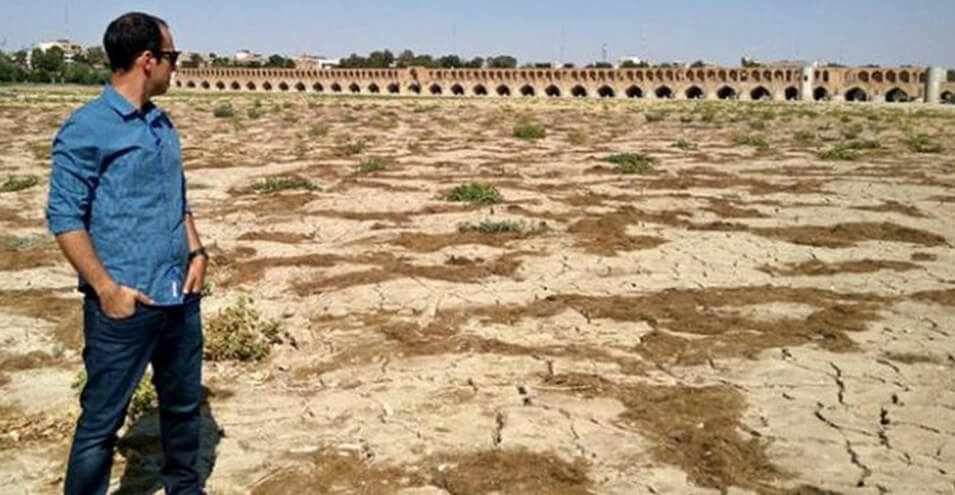
The resignations of representatives due to the water situation in their provinces demonstrate the critical nature of Iran’s water crisis. A crisis that has emerged as a result of mismanagement in the water sector over the past two decades and has confronted the water situation across the country with a crisis.
In recent days, following the escalation of Isfahan’s water crisis, representatives from the province resigned in order to obtain concessions from the government. This resignation prompted Ali Larijani, the Speaker of Parliament, to make promises to secure budget allocations for Isfahan’s water to the representatives so they would return to parliament.
Before the symbolic resignation of Isfahan’s representatives in the final months of the year, at the beginning of the year on April 15, Hossein Ali Mir-Ahmadi, Secretary of the Farmers Association in Isfahan, stated that Isfahan’s water situation had crossed the crisis threshold.
However, the resignation of Isfahan’s representatives and Ali Larijani’s efforts were not the end of the water crisis story. With Isfahan’s representatives returning to the parliament floor, representatives from Khuzestan and Chaharmahal and Bakhtiari provinces gathered at the parliament’s presidium and demanded attention to their protests regarding the water situation in their provinces. They threatened that if the government granted concessions to Isfahan province, they would also resign.
The resignations of representatives due to the water situation in their provinces demonstrate the critical nature of Iran’s water crisis. A crisis that has emerged as a result of mismanagement in the water sector over the past two decades and has confronted the water situation across the country with a crisis.
The Washington Post newspaper reported in June of this year on Iran’s water crisis, attributing the cause to water management over a decade. The report stated that “Iran is heading toward a water crisis on a massive scale, and there are few solutions to this problem that has lasted a decade. Iranians consume 66 gallons of water daily, which is less than American citizens who consume 105 gallons daily, but Iran and other Middle Eastern countries do not have the abundance of fresh water available in Europe and America.”
Unscientific Dam Construction in Iran
The most important problem with dams in Iran is the phenomenon of erosion and sediment accumulation in dam reservoirs, which reduces the lifespan of dams and destroys national capital. Many dams and short dikes in Iran have been built with non-engineering architecture. In some dams, due to dam spillway issues, sediment accumulation, use of inappropriate materials, and incorrect design of auxiliary components, these dikes and dams have been destroyed and rendered unusable.
In some cases, inconsistencies with nature are observed in defining dam objectives, such as the Karaj Dam, which is designated to supply water to Tehran but transfers water from the Karaj watershed to elsewhere. Therefore, its adverse effects manifest in the form of groundwater level decline, groundwater quality degradation, and saltwater intrusion into the lower Karaj plains, posing the danger of aquifer destruction and transforming the green region of Shahr-e Ray and Karaj into desert.
In northern Iran, conditions similar to Sri Lanka exist, where dam construction faces various challenges. These challenges include forest destruction, damage to agricultural lands, submersion of villages and forced displacement of people, slope failures, sediment accumulation behind dams, and water pollution.
In southern dams of the country, due to the low altitude of the area above sea level and relatively high evaporation from the reservoir surface, as well as the entry of organic materials, village wastewater, chemical fertilizers, and surface flows with high electrical conductivity (EC) and high salinity into the reservoir, there is a possibility of stratification in the dam reservoir, which would reduce the water quality of the reservoir. Minab Dam is a striking example of water degradation.
Dam Construction Movement After the Revolution
Dam construction has always been considered one of the most important engineering activities, so that residents of different regions, based on geographic conditions and created necessities, have undertaken the construction of dams or various reservoirs with different materials and specifications.
In this regard, needs such as providing irrigation and water supply have been important, and in some areas, due to the low water level of rivers or the need to redirect a river, dam construction has been carried out to raise the water level and use it for agricultural and development needs.
Dam construction in Iran increased unprecedentedly during the years following the Islamic Revolution. Seven dams with a total reservoir capacity of 2,275 million cubic meters were built from the revolution until 1988.
However, despite dam construction, Iran has faced a water shortage crisis in recent years.
Dam construction for water storage and supply was placed in the country’s development plan. Six dams with a total reservoir volume of 1,046 million cubic meters and 16 dams with a total reservoir volume of 2,090 million cubic meters were constructed. However, in the third and fourth five-year development plans, Iran’s dam construction movement reached its peak.
In the third five-year development plan, 35 dams with a total reservoir volume of 12,550 million cubic meters were built, and in the fourth five-year plan, 33 dams with a total reservoir volume of 7,529 million cubic meters were constructed. Between 1988 and 2008, a total of 97 dams were constructed and filled.
464 dams were under construction from 1979 to 1997, with 388 dams becoming operational. 378 dams were under construction between 1998 and 2005, with 168 dams becoming operational. However, 337 dams were under construction between 2006 and 2013, with only 16 dams becoming operational.
Dam construction continued during the eleventh government, and between 2013 and 2017, 40 dams were reviewed and their objectives were changed, but overall 30 dams became operational during the eleventh government.
The total reservoir volume of the country’s dams from 1947 to 2013 equals 123,442 million cubic meters, with 48,454 million cubic meters being utilized. Between 2006 and 2013, the total reservoir volume was 33,275 million cubic meters, with 454 million cubic meters becoming operational.
The volume of water reservoirs in 2017 exceeded 23 billion cubic meters, with water utilization from dams being 8 billion 590 million cubic meters. The volume of water reservoirs faced a 14 percent decrease and dam output faced a 7 percent decrease compared to previous years.
These statistics show the extent of government commitments regarding water storage and supply policy over the past 40 years. They show how much governments have fulfilled their commitments in dam construction. In the ninth and tenth governments, with over 300 dams under construction, only 16 dams became operational.
Decrease in Dam Water Levels
Of the 100 dams that supply the main source of water in Iran, currently 52 dams in the country hold less than 40 percent of their total reservoir capacity. 28 dams hold 50 to 70 percent of their total reservoir capacity, and 20 dams hold 40 to 50 percent of their reservoir volume. The volume of 25 dams is between 90 to 100 percent of total capacity, and 28 dams also hold 70 to 90 percent water filling. Overall, 35 percent of dams have less than 40 percent water filling. According to the latest statistics until 2017, nearly 50 percent of the country’s dam reservoirs were full, but in current conditions only 41 percent of the country’s dams are full and 59 percent of the country’s dams are empty.
Results obtained from the volume of annual evaporation from the lake surface of the country’s operating dams show that the total annual evaporation volume is equivalent to 2.02 billion cubic meters, which considering the total volume of operating reservoirs of 5.32 billion cubic meters, approximately 6.2 percent of dam water evaporates. Although comparison of evaporation rate and useful reservoir volume shows 8.4 percent evaporation. In recent years, dam water has faced a dramatic decrease, and this has caused the water situation in Iran to become critical.
Neglect of Qanats and Artificial Recharge
Qanat is one of the most complex and ancient tools of Iranian civilization to combat water scarcity in ancient Iran. Currently, approximately 8 billion cubic meters of groundwater across the country is extracted through qanats. According to some researchers, Iran has approximately 30,000 active qanats across the country that are responsible for supplying water to low-water areas of the country.
Qanats are among the groundwater resources in arid and semi-arid regions of Iran. Two main factors are effective in reducing qanat water yields: one is the decline of groundwater level and the other is the global climate change phenomenon, the effects of which in Iran have manifested as severe droughts and have been effective in intensifying groundwater level decline and groundwater storage deficit.
In recent years, due to excessive use of groundwater, insufficient precipitation on an annual scale, and lack of management and maintenance of qanats, many of them have experienced reduced water yields. The groundwater level of aquifers is constantly fluctuating. One of the most important factors causing groundwater level fluctuation, particularly continuous decline, is continuous overextraction from the aquifer.
Decreased Rainfall in Iran
While aridity is a climatic indicator and characteristic of arid regions, drought is a phenomenon that originates from unexpected decreases in precipitation over a specific period in a region that is not necessarily arid.
The degree of this decrease is such that it disrupts the normal growth process in the region and has immediate and damaging effects on agriculture and long-term effects on water resources. By examining precipitation levels between 2008 and 2014, it can be observed that precipitation conditions experienced significant decline each year. The total amount of precipitation from September 21 to February 20 of the 2016-2017 water year was approximately 68 millimeters. This precipitation amount shows a 36 percent decrease compared to the long-term average of similar periods and a 50 percent decrease compared to the similar period of the previous water year.
The water crisis index in Iran, due to its location in the world’s arid and semi-arid region, is considerably more unfavorable than the world average. On the other hand, the occurrence of intermittent and prolonged droughts and high climate fluctuations are among the main causes of water scarcity, particularly surface water resources, which exert double pressure on groundwater resources and cause desertification.
Government policies over the past two decades in the water and dam construction sector have caused Iran to face a water crisis, and in the process, the Islamic Republic not only continues to make no effort to resolve this crisis, but has instead adopted a security approach in this field rather than utilizing specialized personnel.
Source: DW