Rouhani Government Supports Zarif’s Statements on Money Laundering in Iran
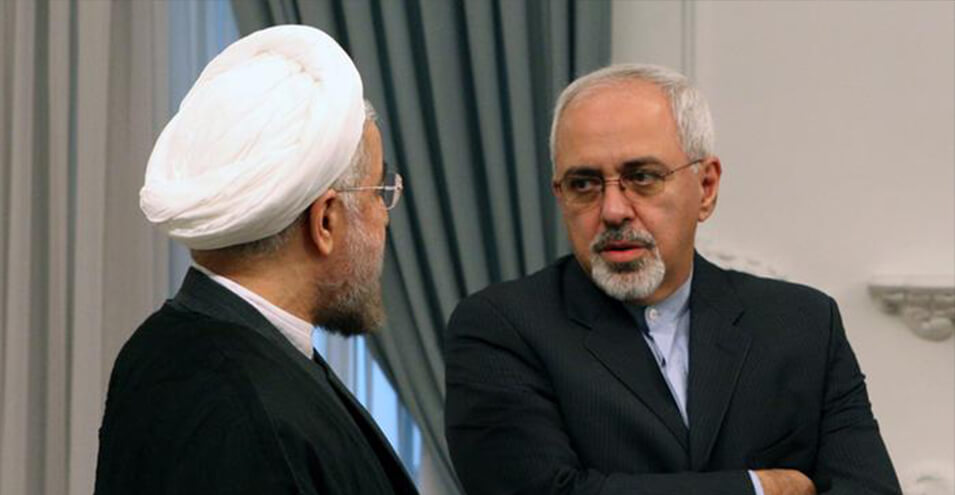
Hassan Rouhani, without naming Zarif, supported the Iranian Foreign Minister’s statements about widespread money laundering in the country. Rouhani’s chief of staff, referring to Zarif’s remarks as “the government’s position,” said that all government members support him.
Hassan Rouhani, President of Iran, on Wednesday, November 21 (November 30 in the Persian calendar), after a long silence in the face of attacks by government opponents against Mohammad Javad Zarif, without naming him, supported the Foreign Minister’s statements about widespread money laundering in Iran. Mahmoud Vaezi, Chief of Staff of the President of Iran, also described Zarif’s position as the government’s position and emphasized that all government members support Zarif’s statements.
Hassan Rouhani, speaking at a cabinet meeting in a non-confrontational tone and referring to “why should there be disagreement between us and why should we speak to each other loudly and in a derogatory tone,” said among other things: “Why do we fight over obvious issues? Yes, the entire world suffers from money laundering. Show me one country in the world where money laundering is not taking place, and show me one country in the world where there is no corruption, drugs, and counterfeit goods. Everyone must try to reduce corruption and close the path of money laundering. Why do we argue so much?”
This is the first time Rouhani has taken a position and expressed support for Zarif’s statements following the launch of a widespread wave of attacks by government opponents against him over the past 10 days.
Mohammad Javad Zarif, in a video interview with “Khabar Online,” referring to “propaganda campaigns” against bills related to the Financial Action Task Force (FATF), described money laundering in Iran as “a reality” from which, according to him, “many people benefit.”
Iran’s Foreign Minister added: “People whose financial transaction volume is 30,000 billion tomans have enough financial capability to spend an amount equal to the entire budget of the Foreign Ministry on a single propaganda campaign. The total budget of the Foreign Ministry is 1,100 billion tomans, which is less than the budget of some cultural institutions that have connections with some powerful organizations in the country, and we cannot counter that propaganda.”
These statements faced a wave of severe attacks by hardliners. Some called it “a grave accusation against the system” and “playing on the enemy’s field,” and others claimed that Zarif, unable to counter the “logical arguments” of opponents of FATF-related bills, made what they called “biased” statements. Sadegh Amoli Larijani, the Judiciary Chief, also compared Zarif’s remarks yesterday to “a dagger in the heart of the system.”
The Relationship Between Dirty Money and Money Laundering
Rouhani, in another part of his today’s remarks, referring to the fact that “Iran is the greatest claimant to fighting terrorism,” added: “Today, in order to prevent terrorists from using different financial systems to transfer money, we must also be and are the greatest claimant to this.”
The President of Iran continued: “Is someone who sells drugs in this region, brings them in and takes them out, not dealing in dirty money? And does this dirty money not exist in our country and region? Does this mean drugs don’t come into our country?”
Hassan Rouhani also emphasized: “Unfortunately, drugs exist in the country and we must fight against them; when there are drugs, there is also dirty money; where does this dirty money go? That is, some money laundering happens somewhere, and money laundering may take place in Afghanistan, Turkey, or Europe.”
Rouhani, finally emphasizing that “we must fight, conduct professional work, and speak professionally,” implicitly attributed recent attacks on Iran’s Foreign Minister to factional disputes and said: “We immediately create a correct alignment between this faction and that faction, then we bring all of human history as evidence, and everyone goes and finds a similarity and says this is like that and that is like this.”
Zarif’s Remarks; “The Government’s Position”
The Chief of Staff of the President of Iran also said at the end of today’s cabinet meeting among journalists, referring to Zarif’s statements about widespread money laundering in Iran, that these remarks “have no flaw and his position is completely correct.” According to Mahmoud Vaezi: “This position is not exclusive to the Foreign Minister, but is the government’s position.”
Rouhani’s chief of staff said: “We have always opposed the entry of drugs into the country. These materials are brought into the country for money; this is why we oppose smuggling and many other illegal economic activities. When we put all these matters together, we arrive at money laundering. Money laundering is the same as smuggling and the entry of counterfeit alcohol and drugs and so on. We in the government oppose these acts. The Foreign Minister has also correctly stated that we must oppose this.”
Vaezi added: “Zarif has not accused any institution or sector; he has opposed money laundering in Iran and believes that the law against money laundering must find its place. I am sorry that despite Zarif’s correct position, some people with prior hostility toward him are attacking him.”
Mahmoud Vaezi also said regarding the government’s position against recent attacks on Zarif: “Government members certainly support Dr. Zarif. We in the government are all together, and the policies adopted are government policies.”
“Rainfall”; Reason for 10-Day Silence
Vaezi also attributed the Rouhani government’s 10-day silence regarding these attacks to “rainfall” and said: “The problem is that there was rainfall last week and government members could not speak with journalists. If you had asked me these questions last week, I would have said what you heard today.”
The Chief of Staff of the President of Iran also, referring to the fact that “criticism is in its place, but saying everything to one official is not acceptable,” emphasized that Hassan Rouhani also supported Zarif in the cabinet meeting.
Yesterday, pressure on Iran’s Foreign Minister because of his recent statements reached its peak and it was announced that some representatives close to the Principlist Front in parliament have drafted a motion to impeach Zarif. Hossein Ali Haji Deligani, a hardliner representative in parliament, announced the drafting of this motion and the collection of signatures for it “in the coming days,” and said that since Zarif has not presented his “evidence” regarding widespread money laundering in Iran to representatives, “representatives will also draft a motion to impeach him and, after collecting signatures, submit it to the parliament’s presiding board.”
However, Hashmatolah Fallahpisheh, Chairman of the National Security and Foreign Policy Committee of Parliament, while emphasizing that “I do not consider the money laundering issue to be at the level of impeachment,” said today that “the general atmosphere in parliament is not inclined to impeach the Foreign Minister.” According to this moderate principlist, “impeachment is the right of representatives, but our diplomacy should currently be strengthened given the circumstances.”
The approval of four bills related to FATF, which Zarif addressed in connection with the issue of money laundering in Iran, is necessary for Iran’s complete removal from the “blacklist” of the Financial Action Task Force and to facilitate international banking transactions of the Islamic Republic. Creating “international standards” to combat money laundering and terrorist financing worldwide is one of the main duties of the Financial Action Task Force.
The FATF-related bills, known in Iran as the four bills, are as follows: the bill on Iran’s accession to the Convention Against Transnational Organized Crime called the “Palermo Convention”; the bill on Iran’s accession to the Convention Against the Financing of Terrorism (CFT), the bill amending the anti-money laundering law, and the bill amending the law against financing terrorism.
Currently, the bill on Iran’s accession to the Convention Against the Financing of Terrorism is a point of contention between parliament, the Guardian Council, and the Expediency Discernment Council. However, Mahmoud Sadeghi, Tehran’s representative in parliament, described the “objections” as removable and said among other things: “There is evidence that the system is determined to finally approve this bill, and it does not seem that there are many obstacles in this regard.”
Commanders of the Islamic Revolutionary Guard Corps, Friday prayer leaders, some government officials including officials related to the office of the Supreme Leader of the Islamic Republic and some officials of the Expediency Discernment Council of the System, as well as media close to the so-called hardline principlist trend, are among the opponents of approving FATF-related bills in Iran. They consider the approval of these bills a threat to the Islamic Republic’s continued support for organizations such as Hamas and Hezbollah of Lebanon. Supporters, on the other hand, evaluate the approval of the four bills as part of “economic transparency” and “anti-corruption.”
Source: DW