Parliament Convinced by Only One of Rouhani’s Answers; Four Questions Referred to Judiciary
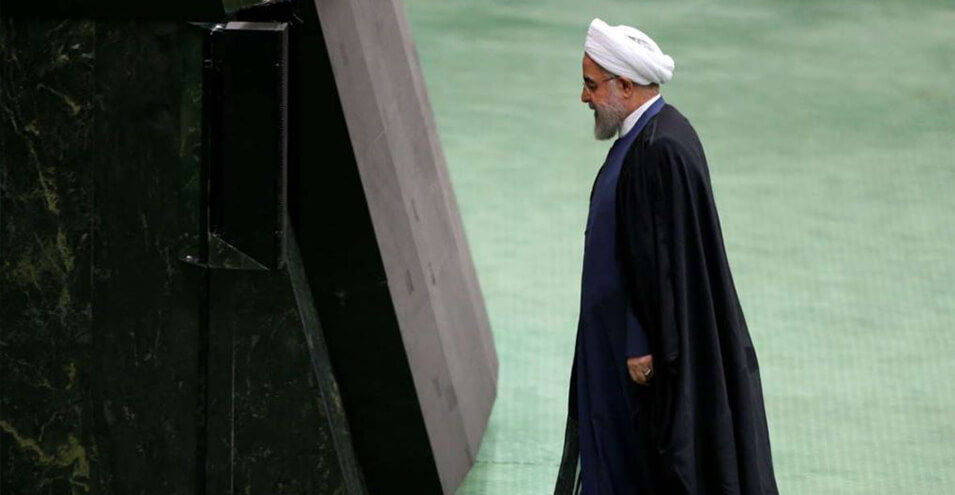
The President of the Islamic Republic presented explanations to the Islamic Consultative Assembly to answer questions about the economic situation and the severe decline in the value of the rial. Representatives were not convinced by four responses to five questions, and these questions are being referred to the judiciary.
Hassan Rouhani visited the Islamic Consultative Assembly for the first time in the past five years with the aim of answering representatives’ questions.
In the first part of his speech, Rouhani told parliament that the five questions from representatives are “questions of the Iranian people” as well; “Why unemployment? Why is the banking situation like this? Why do prosperity and recession pass through conditions not expected by the people? Why the rise in currency prices?”
At the same time, he asked: “But the main question is why our movement, which was forward-moving in four and a half years, and statistics prove this, suddenly new conditions began seven or eight months ago?”
The President of the Islamic Republic added: Why has people’s hope changed, and even beyond that, why have some people become doubtful about the Islamic Republic system.
The President of the Islamic Republic then defended his government’s activities in combating smuggling.
Regarding the continuation of banking sanctions after the nuclear agreement, he said: Sanctions against Iran are not just nuclear sanctions.
Mr. Rouhani asked parliament representatives to approve the bills related to banking affairs as soon as possible “which has significant impact on our banking relations.”
In recent months, four bills combating money laundering and preventing terrorist financing have become a subject of controversy between the government and its supporters and opposing streams.
The peak of these disputes was over joining the implementation of the Financial Action Task Force regulations or FATF. One of the bills that the Rouhani government sent to parliament in late Ordibehesht, coinciding with the end of the suspension period of Iran’s presence on the blacklist of the “Financial Action Task Force Against Money Laundering,” along with bills on Iran’s accession to the Convention on the Prevention of Terrorist Financing, amendments to the Money Laundering Law and amendments to the Terrorist Financing Prevention Law.
The head of parliament’s foreign relations committee and Rob Portman, head of a permanent subcommittee of the U.S. Senate, in a letter in late June requested efforts by the Trump administration to restore the “Financial Action Task Force” sanctions against Iran.
Hassan Rouhani defended his government’s record on unemployment.
Regarding the unprecedented increase in currency prices, Rouhani said “social, psychological, and foreign policy issues” had greater effects on price increases than economic issues.
“Self-Admiration” versus “Blackening”
Mojbati Zolnoor, the designer of the question to Rouhani, during Tuesday’s speech in parliament accused the government of self-admiration and failure to plan for economic problems, saying it had no plan to deal with the consequences of the Trump administration’s withdrawal from the JCPOA.
Mohammad Dehghan, a conservative parliament representative, called the government’s decision to allocate official currency “illegal.” Hamid Reza Foladgar, a representative from Isfahan, criticized “instability in government decisions,” “lack of attention to domestic production,” and “non-implementation of the resistance economy law.” Mohammad Hossein Farhangi, a representative from Tabriz, also said that in the Rouhani government, recession “dominated” the country’s economy and “no sign of the government’s plan to solve it is seen.” He predicted that inflation this year would “reach 60 percent.”
However, Hassan Rouhani in the second part of his remarks said the history of recent events and developments goes back to “December 2017.” Referring to the protests of December 7, 2017, he said some people took to the streets and gave “norm-breaking slogans” and “people were bewildered.”
On December 7, hundreds of participants in a gathering in front of Mashhad city hall and several other cities, while protesting high prices, chanted slogans against Hassan Rouhani, “dictator,” Iran’s assistance to other countries, and in support of Reza Shah.
These protests quickly spread to other cities. The spark of these widespread protests was first ignited by economic reasons, but it was not long before protesters in different cities chanted slogans against senior officials of the Islamic Republic, against Iran’s presence in regional countries, or in defense of Iran’s previous government.
The President of the Islamic Republic said this incident “tempted” the U.S. government and Donald Trump announced in late December that if the JCPOA was not reformed, he would withdraw from it.
This is while Trump had been a staunch opponent of the JCPOA even before the U.S. presidential election and had promised to abandon it if he won. The Trump administration says the nuclear agreement with Iran has led to Tehran’s “interventions” in the region, ballistic missile development in Iran has continued despite this country’s commitments, Iran “remains the world’s most important state sponsor of terrorism” and conducts “destabilizing activities.”
The U.S. government has asked Iran to move toward more comprehensive negotiations, but Iran has not yet agreed to such a thing.
Hassan Rouhani in another part of his speech asked internal critics “from behind podiums” not to say the country is in crisis: “The country is not in crisis, we are in a phase of harm and in some cases on the brink of threat, but the country is not in crisis.” Rouhani says “know that destruction brings ruin. Blackening leads the people’s lives toward darkness.”
Different cities in Iran have continued to be scenes of protests in recent months. Economic situation, environmental issues, currency and gold crisis and other problems have been raised in these protests, and slogans continue to be heard in corners of the country against senior officials, Iran’s presence in regional countries and Tehran’s spending there, political and economic corruption. These protests are not limited to the streets and various evidence and examples of them can be seen in cyberspace.
Hassan Rouhani says: Apart from staying or leaving the JCPOA, there is also a third way and if Europe does not fulfill its commitments, we will announce a new method. He did not provide an explanation about the “third way” and said we will announce it if necessary.
Yesterday, coinciding with the Iranian president’s request from countries committed to the JCPOA to take practical action to save this agreement, his French counterpart called for more talks on the Islamic Republic’s missile program and Tehran’s role in the Middle East.
The European Union supports the JCPOA and has differences with the United States on this. However, leaders of several European countries, including Emmanuel Macron and Angela Merkel, leaders of France and Germany, have repeatedly expressed concerns about Iran’s missile program and its activities in the Middle East.
In the second part of his speech, Rouhani called several times for “unity,” “brotherhood” and “standing together” of the three branches of the Islamic Republic and said “there is no other way.” At the end of his remarks, he said the government is increasing foreign exchange reserves “for the coming months and years” and for this reason is not currently using these reserves.
Parliament representatives were only convinced about the reason for the continuation of banking sanctions and were not convinced about the government’s measures to reduce unemployment, economic recession, sharp increase in foreign currency prices, sharp decline in the value of the national currency and control of smuggling.
“Secrets Behind the Scenes”?
Hassan Rouhani previously, in a letter to the head of the Islamic Consultative Assembly, described the representatives’ questions as “unconstitutional,” but said he would use this opportunity to express “some truths” to the people.
Shahindokht Molaverdi, his special assistant for citizen rights, on the afternoon of the fifth day of September during a conference in Mashhad said Mr. Rouhani “by appearing in the Islamic Consultative Assembly will expose the secrets behind the scenes and people who through scenario-making and forming think tanks made every effort to bring the country to this situation.”
But Mojtaba Zolnoor, a conservative representative from Qom, who was previously the deputy of Ayatollah Khamenei’s representative in the IRGC, said “if the president speaks off-topic” and no one stops him “in that case it is possible that the parliament atmosphere could leave the state of calm which is not befitting parliament and government.”
Economic Situation and Five Questions
Five main axes of questions were listed as “government’s failure to control commodity and currency smuggling,” “continuation of banking sanctions,” “government’s failure to take appropriate action to reduce unemployment rate,” “severe years-long economic recession,” “rapidly increasing foreign currency rates and sharp decline in the value of national money.”
Since America withdrew from the nuclear agreement with Tehran and began the process of re-imposing sanctions, Iran’s economy has experienced severe tensions; the national currency has lost its value significantly, the price of coins and other goods has increased, many large Western companies have left Iran, and a wave of protests has formed in different cities.
U.S. officials say these tensions are consequences of the return of sanctions. John Bolton, Donald Trump’s national security advisor, recently said the return of sanctions has had a significant impact on Iran’s economy and public opinion. Mike Pompeo, U.S. Secretary of State, also said “We don’t ask much from Iran’s leadership. We just want them to behave like normal leaders. Don’t plunder your people; don’t waste your people’s money because of adventures in Syria, Yemen, Lebanon, Iraq, and so on.”
On the other hand, however, the leader of the Islamic Republic says the main problem is internal and related to “performance.” Iran’s foreign minister has also said “internal disputes have completed the psychological atmosphere.”
Source: Radio Farda