Injured ‘Shinabad Girls’ Protest Failure to Send Them Abroad for Continued Treatment
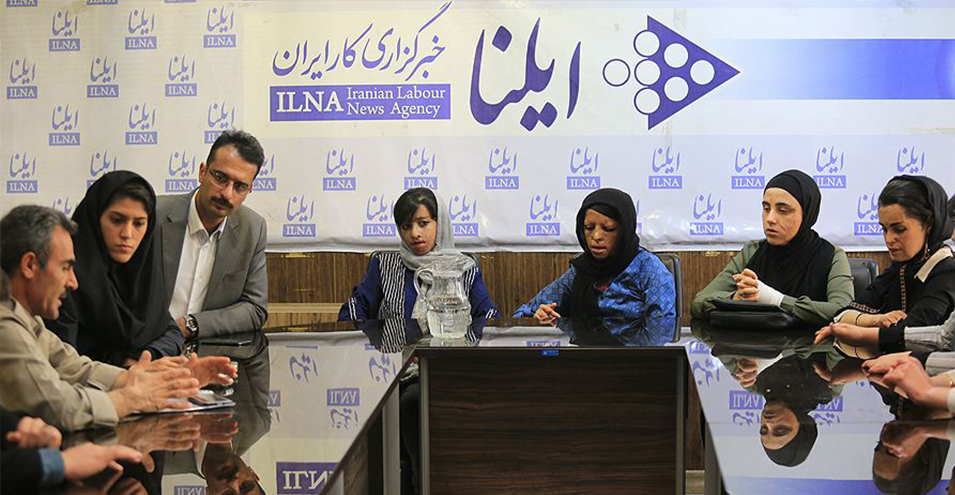
The ‘Shinabad girls’ have complained about their treatment process and criticized the ‘unfulfilled promises’ of relevant officials, including the Minister of Health, in this regard, demanding to be sent abroad to continue their treatment.
Twelve schoolgirls who suffered severe burns five years ago when an oil heater caught fire at an elementary school in Shinabad village in Piranshahr, West Azerbaijan Province, stated these points at the ILNA news agency. The incident left two dead and 27 wounded.
Sima, one of these girls, said in this regard that “our doctor says if we stay here, we might recover more slowly, but abroad, due to better facilities, we would recover faster.”
According to her, “Eight months ago, Mr. Hashemi (the Minister of Health) promised us and signed a letter that equipment would be brought to our hospital, but this did not happen.”
ILNA news agency meanwhile published an image of a letter dated July 12, 2017, which based on meeting minutes, was “addressed to Mr. Rezaei, head of the budget office of the medical affairs deputy at the Ministry of Health and director of Fatema Zahra Hospital, stating that equipment was to be delivered to this hospital within two weeks, which has not happened to this day.”
Her father also said that over the past five years, “treatment and medical facilities in the country have not been adequate for our children; if they were adequate, the joints and fingers of our children would not have withered.”
He demanded a meeting with Hassan Rouhani, the President, adding that perhaps with this meeting, “we can send the children abroad.”
As Sima’s father said, two years ago, “at a burns congress, the Minister of Health had lunch with Sima and said that if necessary, each of the children would be sent abroad. But unfortunately, it was only promises.”
He added that “each of the children has undergone more than 150 surgeries” and after the allocated budget of “one billion and 360 million tomans” for treating these girls was exhausted, “the children’s treatment is progressing with difficulty.”
Another one of these girls, whose name was not mentioned, also said that due to budget shortages, the equipment used in their surgery at “Fatema Zahra Hospital, which is a government-teaching hospital,” lacks proper quality and as a result the treatment process repeatedly encounters problems.
She also noted the “withering of joints” in her hands and other girls’ hands, adding that “we cannot do anything with our hands. We study, but it doesn’t go well; we are constantly traveling to Tehran and the teacher no longer repeats the lessons. That’s why our GPA drops.”
Esrin, another one of the Shinabad girls, also criticized the Minister of Health’s unfulfilled promises, raising the question of whether “if she were his daughter, would he have her operated on in Iran with this equipment?”
The father of Nadia, one of these girls, also said that “because the hospital expenses are high, surgeons do not personally perform the operation and delegate it to assistants.”
The father of another girl, also referring to “Fatema Zahra” hospital being “teaching,” said that “surgical assistants perform the operations. Our children are not laboratory rats.”
Other criticisms from the parents of these girls include the failure to pay the full blood money (compensation) for two of the dead girls by Iran Insurance and the payment of only half of it due to them being female.
In December of this year, the lawyer of the ‘Shinabad girls’ in an open letter to Hassan Rouhani criticized discrimination in the payment of blood money to students of this school due to them being female, demanding full respect for their civil rights.
Hossein Ahmadi Niyaz in a letter on the fifth anniversary of this incident addressed to Rouhani wrote that “despite the promises made, so far only half of the blood money” for Saria Rasoulzadeh and Siran Yeganeh, two deceased students, has been paid.
He added that in Iran “gender is still the basis for blood money” and “this inequality has caused the deprivation of rights of these girls and thousands of other girls across Iran.”
According to this lawyer, while the treatment process of the Shinabad girls will continue for another 15 years and they and their parents must endure the hardship of traveling to Tehran and undergoing multiple surgeries, their rights have not been paid.
He added: “In my opinion, civil rights are realized when the rights of these wronged girls are fully deposited and paid.”
Shortly after this incident, Rasoul Khazri, the representative of Piranshahr in parliament, had said that according to the protocol of the government resolution, all costs related to plastic surgery, life insurance, and blood money of Shinabad school students are the responsibility of the government.
The Armane newspaper also reported in that year about “the amputation of fingers of three victims of the fire at Shinabad elementary school” and wrote that “the affected students were still in the hospital,” but “sending some of the victims abroad to continue treatment was deemed unnecessary.”
Source: Radio Farda