Retirement in Iran: Bitterness Instead of Leisure
The absolute majority of retired workers, receiving only ten days’ worth of monthly salary, live a hand-to-mouth existence. Their right is the continuous equalization of pensions, not running around in old age to make up for household expenses.
On February 11, 2018, during the opening of a hospital in Qaemshahr, Mazandaran, a retired worker interrupted the labor minister’s speech. When given the microphone, he spoke of his own problems; of a salary of one million and 500 thousand tomans for a family of four, of the rising cost of medicine, the shortage of hospital beds, and the broken promises of the labor ministry and social security organization. The minister kissed him, the crowd sent blessings, and the worker’s complaints remained incomplete.
When the Yort mine exploded in May 2017 and 22 people were buried 1,800 meters underground, 100 retired miners dared to say that the employer owed each of them more than 10 million tomans and had counted their wage claims against retirement costs.
When about 400 retired workers from Kian Tire gathered in front of the Ministry of Industry and Mines on December 18, 2017, to say they had been retired for six years but had not received their end-of-service years, special guard forces had a heavy presence in the compound. Each one of them was owed between 80 to 100 million tomans from the factory.
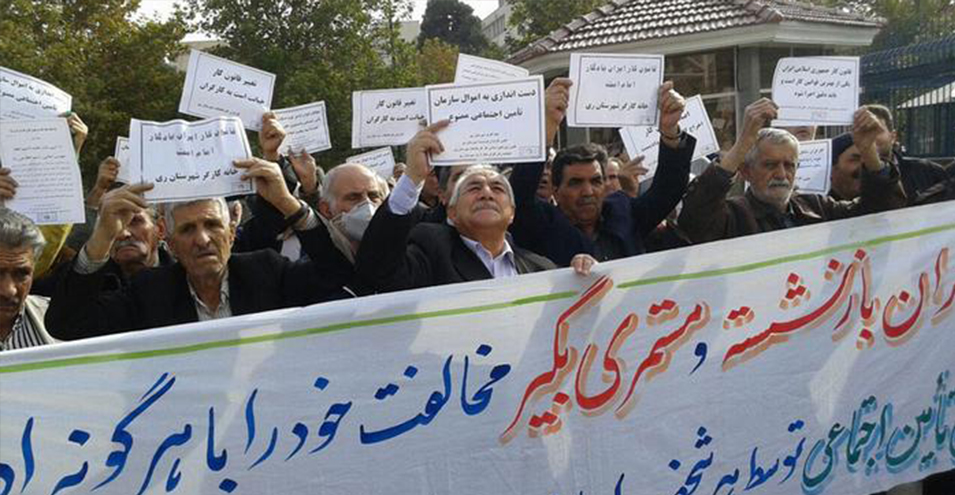
When on December 10, a group of retired steelworkers, for the umpteenth time, came from different cities and provinces to Tehran and gathered in front of parliament, representatives were debating the proposed 2018 budget. The retirees were demanding the autonomy of the steel fund, obligating the government to fulfill commitments, and the payment of salaries and medical expenses for this class.
These examples are a mirror of the wage, welfare, and medical conditions of workers who, in old age, need peace of mind but whose main concern becomes household budget deficits and accumulating debts.
Alirezah Mahjoub, secretary general of the Workers’ House and parliament representative, says: “When the social security law was written, life expectancy was 49 years and today it has reached 73 years. The rapid growth of the elderly population in the country and their greater demands on the social security organization require a rational and scientific approach from government institutions and the social security organization.”
“The Government Should Not Do Wrong”
Is pension equalization not the right of a retired worker whose maximum income is between one million and 200 to one million and 500 thousand tomans? Akbar Ghorbani, secretary of the “Workers’ House” in west Tehran, raising this question, says: “80 percent of retired workers are minimum earners, therefore pension equalization is their right and the government should not do any more wrong to workers.”
Akbar Ghorbani, in explaining the “minimum earning” status of a vast multitude of retired workers, points out that two million and 500 thousand out of a total of 3 million people are struggling with living expenses: “It is their right to be able to spend more comfortably in their old age and senility, but under these conditions they must plan for every toman they receive so that by the end of the month they don’t have to borrow.” Many of these retired workers have borrowed from banks or acquaintances to pay living expenses and are left with interest to pay.
According to articles 96 and 111 of the social security law, the minimum pension of insured retired and unemployed members of the social security organization should not be less than the approved minimum wage of the Supreme Labor Council, and on the other hand, the pension of retired workers should increase each year by the inflation value of living expenses.
Labor activists point to the government’s responsibility for the livelihood of low-income and underprivileged groups. No employer hires a retired worker, and most of them are forced to work as taxi drivers to meet their living expenses; work that is a second job for employed and retired people whose income is insufficient.
Masoud Nili, special assistant to Rouhani, has said that pension funds are one of the “super challenges” of the country’s economy.
Double Deprivation
The minimum living basket for workers is two million and 500 thousand tomans. Based on this, if any worker or retiree has an income less than this amount, they live below the poverty line and within the range of the misery index.
The secretary of the Workers’ House in west Tehran says that when the government is passive toward deprived social groups, labor and retirement organizations must pressure so they are not accused of inaction like the government.
The government and parliament have promised to increase retirees’ pensions gradually by allocating 3,400 billion tomans in the budget, but this promise, even if implemented, would mostly benefit retirees of national and military funds rather than social security retirees.
But the 2018 increase in pensions for retired workers depends more on the outcome of wage negotiations in Supreme Labor Council sessions and the payment of overdue government debts than on government and parliament coordination for budget allocation.
In December, 160 representatives wrote a letter to the parliament speaker asking him to pursue the issue of adjusting the salaries of retired workers from the social security fund. The letter stated: “The condition of retired and pension recipients’ salaries (generally receiving less than one million tomans), given the cultural conditions of society and the role and social position of veterans and the elderly and the specific physical conditions and diseases of this period, not only have no correspondence between retired and pension recipients’ salaries with inflation, but also do not match the minimum conventional living expenses.”
Meanwhile, the tenth parliament has recently approved the payment of 50 thousand billion tomans from the social security organization’s claims. Ali-Asghar Beyat, head of the “Supreme Council of Retired Workers,” says it is expected that the government will be fair and pay the outstanding social security claims according to the sixth development plan law.
Below the Misery Line
How should those retirees who receive the minimum pension make a living; especially considering that during retirement age, children’s wedding expenses are added to the list of expenses and the family becomes larger with the arrival of bride, groom, and grandchildren.
Gholamreza Alizadeh, a social security researcher and retired university professor, points out that families of this kind are forced to make do with nutrition and health and medical expenses. According to him, one of the reasons that part of the labor force, especially in the civil service sector, is driven to corruption and embezzlement is observing the living conditions of retirees who have lived and worked with honor all their lives.
Hossein Izdan, inspector of the Tehran Retired Workers’ Union, estimates that a retired person, on average, has three times the health and medical expenses of an ordinary worker. This is while private and semi-government companies offering supplementary insurance do not insure retirees because it is not worthwhile for them to bear the costs of someone with a high disease risk.
In most countries of the world, retirement is considered a golden period of life with various benefits, but it may be said that retirement in Iran, especially for workers, is the beginning of a dark period. The beginning of a descent into poverty, financial pressure, and economy. Instead of being an opportunity for inner peace, these days have become an economic threat.
Source: DW