Millions of Uncounted Votes and Growing Criticism of Interior Ministry
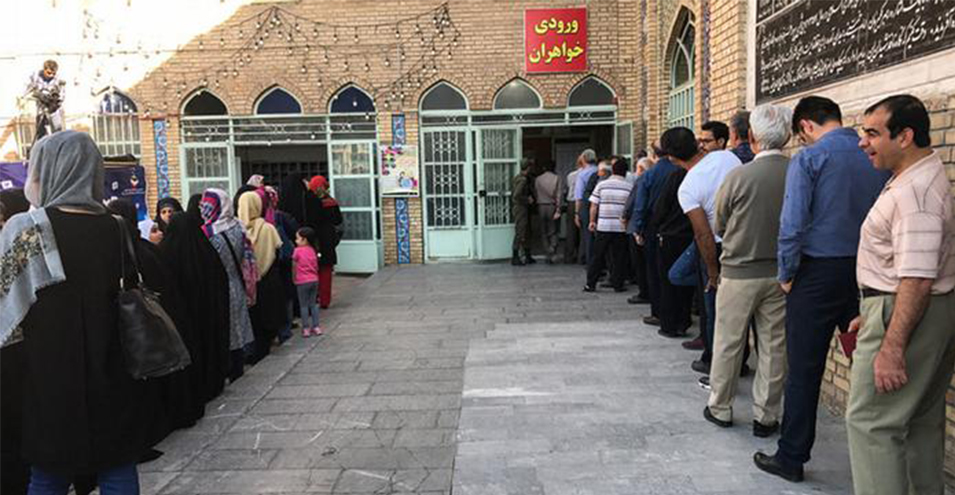
Apparently, around 4 million people failed to cast their votes in the June 19 elections due to poor planning by the Interior Ministry. This issue, which the president also referenced, has drawn severe criticism against the ministry.
Interior Minister Abdolreza Rahmani Fazli announced one day after the simultaneous elections for the twelfth presidential term and fifth municipal and village council elections that slightly over 41 million and 220 thousand votes were cast in these elections.
The crowding of voters in many polling stations was such that when the legal deadline ended at midnight, many people who intended to vote were unable to do so.
Throughout the day, field reports indicated that a significant number of eligible voters, exhausted from waiting for several hours without reaching the polling booths, returned home.
Hassan Rouhani, in his first press conference after winning the June 19 elections, said regarding voter turnout: “If they could have counted the votes of all those who were in line, the numbers would have reached 45 million.”
The president mentioned this issue twice in that press conference and at least three times over the past few days. This repetition can be interpreted as an implicit criticism of the Interior Ministry’s inefficiency and shortcomings in forecasting and preparing for the proper conduct of elections.
Although Hassan Rouhani has not made direct and explicit criticism of the institutions and bodies responsible for conducting elections, media outlets supporting the government have targeted the Interior Ministry with sharper and more open attacks.
The Jomhouri Eslami newspaper wrote in a note published on May 23: “The twelfth presidential election has ended and Mr. Rouhani remains president, but this does not justify ignoring the violated rights of nearly four million Iranians who could not participate in the elections due to polling station overcrowding, exhaustion of ballot papers, and the end of voting time.”
The newspaper expressed regret that “five days after the elections, the relevant officials, particularly the Interior Ministry which is responsible for conducting elections, have not provided a convincing answer to the public.”
The Votes That Could Have Increased Rouhani’s Power
Jomhouri Eslami newspaper points out that if all eligible voters had succeeded in casting their votes, Rouhani’s votes would have also been higher, and accordingly, the Interior Ministry’s shortcomings in election planning deprived the head of the twelfth government from achieving a more powerful position.
Hassan Rouhani received over 23 million and 549 thousand votes in this competition, which is nearly 5 million votes and approximately six percent more than the 1392 election.
When he won the presidency of the eleventh government with slightly less than 51 percent of votes in 1392, he emphasized in one of this year’s campaign speeches that fulfilling some of his promises with this level of votes is no simple task.
On this basis, one can imagine what impact the uncounted votes—at least 60 percent of which would have gone to Rouhani—could have had on the authority of the twelfth government head to implement his promises.
The “Asr-e Iran” website, considering polls that declared participation in the elections at above 70 percent, accused the Interior Ministry of negligence and inefficiency, and did not rule out the possibility that the Interior Minister was responsible in this regard.
“The Interior Minister Either Refused or Was Unable”
Asr-e Iran wrote: “The Interior Ministry, for whatever reason, administered by a minister misaligned with the president, either refused or was unable to properly perform its most important duty, and thus the rights of millions of Iranians were violated and Rouhani’s votes were diminished more than anyone else’s.”
The Interior Minister is close to Ali Larijani, Speaker of the Islamic Consultative Assembly, and it is said that his appointment to this position was due to his campaign support for Rouhani in 1392.
In the meantime, apparently the Guardian Council was also not blameless in millions of people’s failure to vote. Unlike previous elections where votes of those present at polling stations were counted even after midnight, on June 19, the Guardian Council announced that voting would end one minute after midnight on the “voting day.”
The Role of the Guardian Council
Mohammad Baqer Nobakht, during a press gathering at the edge of the third-day government meeting, pointed out that according to the Guardian Council’s order and contrary to previous years, Interior Ministry officials refrained from recording the votes of people present at polling stations after midnight.
The Entekhab news outlet, another government-supporting media, also on May 23, referring to the fact that if votes had been counted from all those prepared to participate in the elections, the difference between Rouhani’s votes and his principlist rival Ibrahim Raisi could have reached 9 million, called the Interior Ministry “the main culprit of this failure” and described this occurrence as “a blow that the Interior Ministry dealt to Rouhani on election night.”
Meanwhile, Abdolreza Rahmani Fazli, to reduce pressure on his ministry, considered the figures presented by the president and some other officials as exaggerated, and in a special press interview said: “The claim that 4 million people remained in line is an estimate, and our estimate as the ministry responsible for elections is one million people.”
Source: DW