France’s Elections, a Defeat for Traditional Parties
With nearly all votes counted in the French presidential election, Emmanuel Macron, a liberal and independent politician, and Marine Le Pen, a right-wing populist politician, advanced to the second round. The election results were a “historic defeat” for the French left.
Among 11 candidates in the French presidential election, two candidates reached the final competition to enter the Élysée Palace. With nearly all votes counted, Emmanuel Macron, a liberal and independent politician, secured 23.9% of the vote, and Marine Le Pen, leader of the nationalist and right-wing “National Front” party, obtained 21.4% of the votes, becoming the winners of the first round of the French presidential election.
Marine Le Pen described the election results as historic. More than 7 million and 600 thousand French voters voted for Marine Le Pen. In her campaign, she advocated for closing borders, withdrawing from the European Union, and ending free trade.
The populist leader of the “National Front” received around 6 million and 800 thousand votes in the 2015 local elections and around 6 million and 400 thousand votes (17.9% of total votes) in the 2012 presidential election.
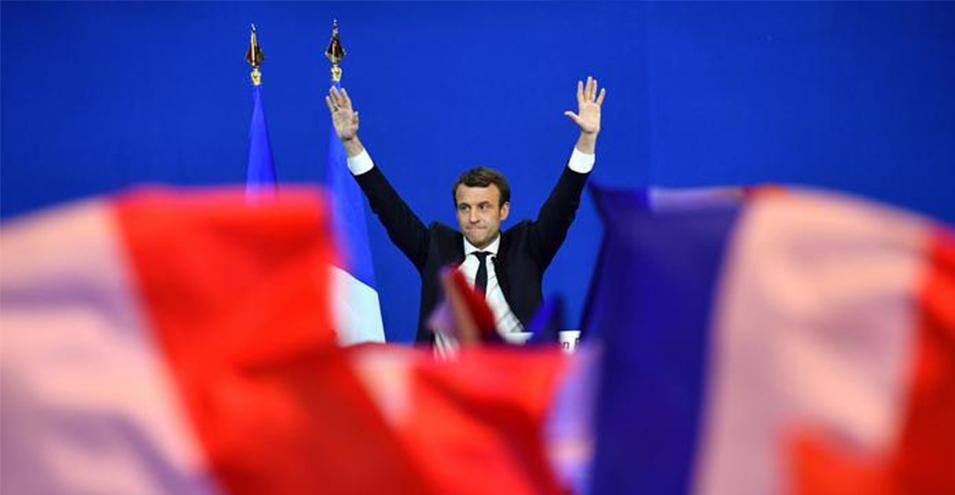
However, the real winner of Sunday’s French elections was Emmanuel Macron, a French independent and liberal politician. He called his success a “turning point in French politics” and said the French voted for “reform and reconstruction.”
Macron is 39 years old and leads a movement called “Forward.” During his election campaign, he promised that if elected, he would reform the labor market and the retirement system. Macron, who was previously a banker and served as economy minister in Hollande’s cabinet, is a left-leaning liberal and a supporter of Europe.
François Fillon, the Republican conservative candidate, captured 20% of French votes. When he was nominated, he was the luckiest politician to enter the Élysée Palace, but within a few months he transformed from being a politician with a “clean record” to a controversial one facing accusations of financial misconduct.
François Fillon, on Sunday evening, accepting his defeat, asked his supporters to vote for Emmanuel Macron in the second round.
Jean-Luc Mélenchon, the French left candidate, received 19.2% of the votes and, after Macron, Le Pen, and Fillon, came in fourth place.
The Socialists’ Harsh Defeat
The French Socialist Party suffered a harsh defeat in Sunday’s election. Benoît Hamon, the Socialist Party’s candidate and the current ruling party, received 6.3% of French votes. This was the worst result in the party’s history.
Benoît Hamon called his defeat a “flagrant historic defeat” for the French left. François Hollande, the current president, is from the Socialist Party and did not run as a candidate due to his low popularity.
It is now clear to almost all observers that two weeks from now, on May 7, French voters will entrust the key to the Élysée Palace to Emmanuel Macron, a young liberal politician.
Macron appeared before his supporters last night after the announcement of preliminary results and his confirmation as the frontrunner. He said that in Sunday’s election, “France won.”
Emmanuel Macron’s entry into French politics and his likely victory in the second round of elections mark the end of the two-party system in the post-World War II era in France.
A Shift in French Political Discourse
Polls from recent weeks also showed that Emmanuel Macron, an independent, and Marine Le Pen, leader of France’s National Front, would advance to the second round. These polls placed Macron in first place and Le Pen in second.
Nevertheless, many French people were concerned about the possibility of polls being wrong, an occurrence that happened in the past two years first in the British referendum and then in the US presidential election.
Moreover, despite the confirmation of predictions, the results of Sunday’s French election still remain surprising and constitute a turning point in the history of this country. For the first time in the history of the Fifth Republic (the period that began with De Gaulle’s presidency), none of the candidates from traditional center-left or center-right parties were able to advance to the second round.
Analysts view the defeat of traditional parties as meaning that from now on, in the discourse of French politics, the traditional confrontation between left and right blocs will give way to a clash between supporters of globalization and its opponents.
Source: DW