Collapse of Elites and Rise of Nepotism in Iran
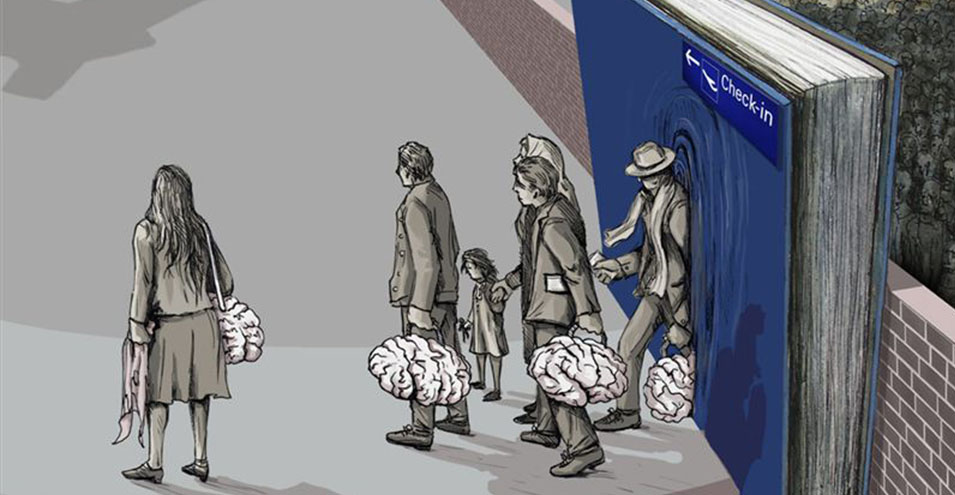
Sara.K., FCN News Agency: The exodus of elites and educated individuals from Iran is experiencing an unprecedented upward trend. Groups from this class are leaving for countries with greater opportunities than their homeland. However, a considerable number completely sever their ties with Iran upon fleeing, depriving their homeland and compatriots entirely of their capabilities and assets.
Some Iranian students and young people residing abroad discuss their concerns in interviews with FCN News Agency. They fear that future generations of Iran will become victims of brain drain and the exodus of elites in the not-too-distant future. The percentage of intelligent individuals in the country could reach a minimum, and proportionally, society’s intelligence quotient could enter an uncontrollable downward spiral.
Each of these young people attributes one factor to the flight or migration of elites from their homeland.
Elimination of Merit in Iran
Sima Lotfi, a student studying in America, claims in an interview with FCN News Agency that disregard for meritocracy is the main reason for the departure and even flight of many elites from Iran.
Criticizing views that attribute this choice of intelligent youths to economic problems or their desire for recklessness, she emphasizes that money is part of the motivation for migration among Iranian elites, not all of it.
She believes that those who desire recklessness have enough opportunities in Iran without needing to leave their homes.
According to Sima, disregarding the principle of meritocracy in Iran is a kind of waste of elite forces and an insult to these national assets. However, this Iranian student goes further, claiming that our country’s officials, without considering the consequences of their actions, welcome brain drain. This enables the shortage of educated workforce in the country to create opportunities for nepotism.
I Worry About Iran’s Future
Omid Sazgar, another Iranian who has lived with his family in Germany for over three decades, views the phenomenon of brain drain from a different perspective.
Omid cannot bear the disregard for the problems and needs of his compatriots and hopes that once conditions become secure, he can serve his fellow countrymen.
According to this young Iranian, fleeing from a country that needs the presence of elites and intellectuals does not solve any of Iranians’ problems.
He is among those who worry about Iran’s future.
Omid further emphasizes in his interview with FCN News Agency that fleeing one’s homeland cannot be justified for any reason, except when one’s life is in danger.
This happened to him and his family due to their political activities in the early days of the revolution in Iran. Nevertheless, Omid claims that whenever his health and security are ensured, he will return to Iran and serve his compatriots.
Our Country is Declining
Sadegh Javaanmardi migrated to Canada years ago to continue his education.
Sadegh is pleased that he left his country at age nineteen and claims that had he stayed, he would have faced the same fate as other young members of his family.
In his view, economic problems, stagnant industry and production, state monopoly, and various forms of corruption common in our country block the path of progress for young people.
To the extent that they must either accept conditions and, despite their abilities, engage in a profession unrelated to their specialty and education and stagnate, or fall into the trap of addiction and corruption and ruin their lives with negligence. Of course, in his view, there is a third way, which is migration or fleeing the country.
According to Sadegh, there are those with unremarkable intelligence who are included in various quotas in educational and professional centers and appear to progress.
He continues: “In general, in a country where stagnation prevails, no one develops. Nepotists and their associates only become wealthy. Until a poisoned seedling like Babak Zanjani grows. These conditions push the country further backward day by day.”
Silent Warnings from Officials
Meanwhile, we have witnessed that occasionally some of our country’s officials sound an alarm and warn about the waste of Iran’s elite potential. Of course, without addressing the roots or forcing anyone to account in the matter.
Seyyed Zia Hashemi, Deputy Minister of Science, Research and Technology, has confirmed that our country is weak in employing elite and educated manpower. According to this official, while we hold the 15th position in research projects, we rank 75th globally in employing educated manpower.
Of course, Hashemi, like other officials, is unwilling to identify blind spots and merely repeats a few slogans to resolve this problem.
Mehdi Seidi, Head of the Elites Working Group of Iran’s Supreme Council of Cultural Revolution, has also reported an increase in elite migration in recent years and stated that this trend has accelerated again.
He announced in an interview with Tasnim, referring to the latest statistics, that the exodus of elites from Iran in the last academic year (2014-15) had a sixteen percent growth compared to the same period before.
Under these circumstances, we see no reaction from officials and those responsible in our country. In other words, it seems no effort is being made to retain elites and young people with high intelligence quotients in the country. Sometimes the officials’ planning even accelerates the loss of the country’s scientific potential and exploits every opportunity.
This time it is the students’ turn—those who feel duty-bound in organizing Islamic religious ceremonies.
Apparently, university administrators in the country have reached into their pockets to encourage this group of students and their travel to war-torn and crisis-ridden Iraq.
Zolqadr Yazanmehr, Head of the Student Welfare Fund of the Ministry of Science, announced the promise of providing 7-million-rial loans to students seeking to participate in the Arbaeen march in Iraq.
The repayment period for this interest-free loan is after students complete their studies.
According to this official, the mentioned trip is a cultural and spiritual initiative, and the university has a duty to support sending students to Iraq on this journey.