Reza Pahlavi’s Message on Rex Cinema Anniversary: From the Abadan Fire to 47 Years of Suppression and Persecution by the Islamic Republic
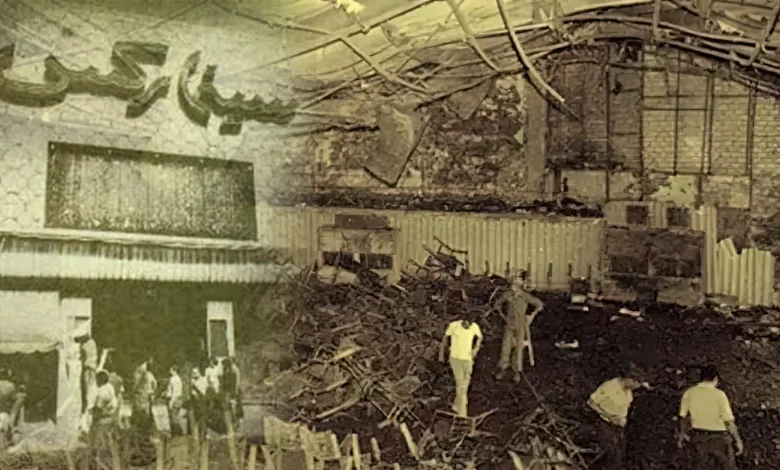
On the anniversary of the deadly Rex Cinema fire in Abadan, Reza Pahlavi, recalling the hundreds of victims of this tragedy, characterized it as an example of violence by Islamic fundamentalists against Iran; a tragedy that, following the 1979 revolution, was distorted in the official narrative of the Islamic Republic and transformed into a symbol of a chain of suppression, executions, and discrimination against opponents and religious and ethnic minorities in the decades that followed.
The Rex Cinema fire in Abadan on the evening of 28 Mordad 1357 (August 19, 1978) was one of the most shocking events in the final months of Pahlavi rule. Hundreds of people who had gathered to watch the film “The Deer” in the cinema were trapped in an intentional fire. There is disagreement about the exact number of victims, with various historical sources recording figures ranging from 377 to over 400 people; however, the essence of the tragedy—the mass death of innocent people in an intentional fire—is beyond doubt.
The significance of the Rex Cinema extends beyond the number of victims. The incident occurred during one of the most sensitive periods of the Iranian revolution and greatly intensified public anger against the government of the time. The initial narrative attributing responsibility for the fire to SAVAK and the Shah’s government spread rapidly in the charged atmosphere of those days and became one of the important catalysts for revolutionary protests. However, subsequent historical research has presented a more complex picture.
Based on research published after the revolution, four men named “Hossein Takbalizadeh,” “Faraj Bazdarikar,” “Fallah Mohammadi,” and “Yedallah Mohammadpour” played roles in setting the cinema fire. Takbalizadeh was the only surviving member of this group and, in a post-revolution court, spoke about his connections to religious circles and Quranic study sessions, and acknowledged his participation in setting the cinema fire. The “Abdorrahman Boroumand” Center, citing documents and testimonies related to the case file, has also documented his connections to religious circles in Abadan.
Contemporary Iranian historians have also concluded in subsequent years that the narrative attributing the fire to SAVAK is incompatible with at least a significant portion of the available evidence. Abbas Amanat, a historian and Yale University professor, emphasized in examining the history of the revolution that the burning of cinemas and cultural centers by Islamist activists had precedent before the Rex Cinema incident, and this event can be examined as a continuation of that same process. An academic study published in recent years also presents the Rex Cinema as an example of an attack by extreme Islamists on symbols of modern culture.
One of the most controversial chapters of this case relates to the period after the revolution. The families of the victims pursued the matter for months to clarify the truth and hold a fair trial, even staging sit-ins. The case finally reached a court in Abadan in 1980; however, the proceedings and their outcome remain subjects of serious criticism by researchers and victims’ families.
The court was headed by “Hossein Mousavi Tabrizi,” a revolutionary cleric who, after the revolution, became one of the Islamic Republic’s important judicial officials. Reports related to the case show that Takbalizadeh spoke in court about his connections to religious circles, but many of the individuals whose names had been mentioned in connection with the religious network around him did not appear in court as defendants or key witnesses. Ultimately, Takbalizadeh and several other defendants were executed, and the narrative of SAVAK’s responsibility maintained its position in the Islamic Republic’s official structure.
This chapter of history is one of the most important reasons why the Rex Cinema remains an unresolved historical case. The issue is not merely who lit the match; the larger question is what network lay behind this act, who benefited politically from it, and why, after the revolution, the truth of the case was never clarified for the families of the victims.
In this regard, the Abdorrahman Boroumand Center has also documented that the families of the victims accused the new authorities after the revolution of delaying the investigation process and preventing a full examination of the case.
Reza Pahlavi, in his recent message marking the anniversary of this tragedy, has emphasized this same historical connection. He believes that to understand the Islamic Republic, one should not begin the history of political violence by Islamists from the day of the revolution’s victory in Bahman 1357 (February 1979).
He states in his message: “Today, on the anniversary of the horrific crime of the Rex Cinema in Abadan, we honor the memory of the hundreds of innocent victims of this tragedy.
A historical fact that many in the Western world are still unaware of is that the crimes of Islamic fundamentalists and their enmity toward Iran, Iranian culture, and modern life began before the Islamic Republic came to power, and the Rex Cinema crime is one of its most blatant examples.
It is no accident that the perpetrators of this crime reached positions and power within the structure of the Islamic Republic after the tragedy of 1979. This history must be told and taught. To understand the Islamic Republic and its enmity toward Iran and Iranians, one must know that this enmity did not begin in February 1979, but rather the Islamic Republic transformed it into political and governmental power.”
The importance of this perspective becomes even greater when we trace the history of the Islamic Republic from the first years after the revolution until now. The Islamic Republic was not merely a political change in the structure of power; rather, it was a system based on a specific ideological interpretation of Islam in which the rights and freedoms of certain sections of society have been restricted due to religion, sect, ethnicity, gender, or belief.
Over the past four decades, numerous instances of political executions, suppression of opponents, serial killings, violent responses to protests, detention of civil activists, and widespread restrictions against religious and ethnic minorities have been documented.
In this context, the situation of religious minorities is of particular importance to a Christian news organization. The United States Commission on International Religious Freedom, in its 2025 report, has stated that the Islamic Republic systematically targets religious minorities including Bahá’ís, Jews, Christians, and Sunnis, and restrictions on religious freedom in Iran remain severe.
The same organization’s annual report has also reported that at least 21 Christians were imprisoned in Iran at some point in 2024 and has referenced harsh sentences against some Christians, including a 10-year prison sentence for an Armenian Christian accused of charges related to evangelical Christian proselytization.
This situation is not limited to Christians alone. Human Rights Watch, in a report on Bahá’ís, has stated that the systematic suppression of this community in Iran, ranging from arrest and imprisonment to confiscation of property, educational and employment deprivation, and even prevention of proper burial, has continued throughout the four decades since the revolution. The organization has assessed this process as amounting to “crimes against humanity of persecution and torture.”
In fact, international human rights reports demonstrate that pressure on religious minorities has not been an intermittent aspect of Islamic Republic policy, but rather has persisted over decades. In 2025, a new wave of arrests, summons, trials, and confiscation of property of Bahá’ís was reported, while simultaneously Christians and Jews faced government persecution in the heightened security environment following the Iran-Israel war.
From this perspective, the Rex Cinema can be understood as one of the starting points of a chain that later continued in various forms: “violence against political opponents, restriction of social freedoms, control of culture and art, widespread executions, suppression of protests, and systematic pressure on minorities who do not conform to the government’s official interpretation of the ‘desirable citizen.'”
Of course, direct comparison of all these events with the Rex Cinema requires historical caution. The Rex Cinema occurred before the establishment of the Islamic Republic, and the ultimate responsibility of those who ordered it remains a subject of historical debate. However, what is less subject to doubt is that this tragedy in the months leading up to the revolution became a very effective political tool, and its case was pursued in a controversial manner even after the revolution.
This very point doubles the importance of Reza Pahlavi’s message: “The issue is not merely the remembrance of a historical fire; rather, it is a question about the relationship between ideological violence, political power, and the suppression of people who, due to their beliefs, identity, or lifestyle, are considered ‘other’ by the government.”
48 years after the Rex Cinema fire, the families of the victims and Iranian society still face a fundamental question: “Who was behind this crime and why has the complete truth about it never been presented in an agreed-upon and transparent manner before the public?”
For a society that has faced executions, imprisonment, torture, religious discrimination, and political suppression for nearly half a century, answering this question is not merely a historical curiosity. The truth about the Rex Cinema is part of the collective memory of Iranians; just as documenting and examining the crimes of subsequent decades is part of the effort to prevent the oblivion of victims.
From this perspective, honoring the victims of the Rex Cinema should not be confined to a calendar date. Their memory reminds us of a reality: in any political system, when human lives are placed in service of ideology and power, victims will be the first whose voices are silenced.
Perhaps the most important duty today is the very thing Reza Pahlavi emphasized in his message: “This history must be told and taught. Not to perpetuate hatred, but to understand the truth, to hear the voice of the victims, and to prevent the repetition of crime.”