“Hossein Aziz-Nasri” Faces Security Charges and 5 Billion Toman Bond
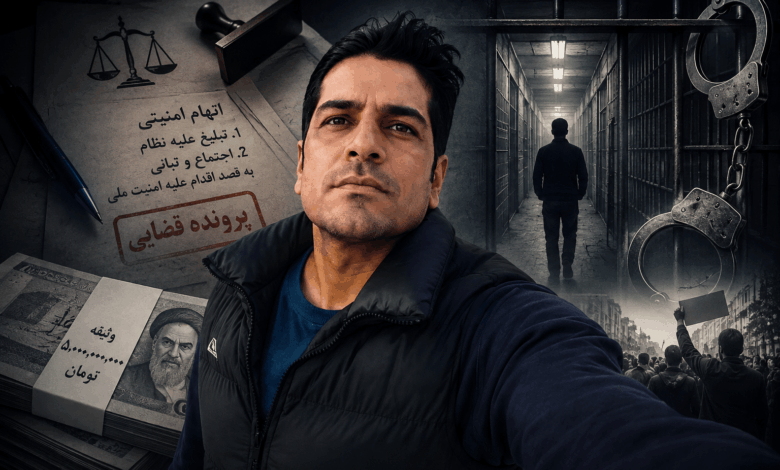
“Hossein Aziz-Nasri,” a 33-year-old resident of Mashhad and a long-standing critic of the Islamic Republic, faced two new security charges following his interrogation session, with a 5 billion toman bond set for his temporary release. This case, occurring amid a fresh wave of security crackdowns on protesters and critics in Iran, has heightened concerns about the government’s use of the judicial system to pressure and silence dissenting voices.
Hossein Aziz-Nasri, a Mashhad resident, has faced an expansion of judicial charges against him at a time when his case has been under investigation by Iran’s security and judicial authorities for several months.
According to reports on his case, Aziz-Nasri’s interrogation session was held on Saturday, August 31, 1405 (August 22, 2026), at Branch 271 of the Public and Revolutionary Prosecutor’s Office in Mashhad’s District Two. During this session, Aziz-Nasri defended himself against the charge of “disrupting public order and safety,” but simultaneously two new charges were brought against him: “assembly and conspiracy to commit crimes against national security” and “membership in illegal groups and contact with hostile individuals outside the country.”
According to released information, the prosecutor stated after presenting the new charges that a payslip and previous bail were insufficient for temporary release, and Aziz-Nasri must provide a document worth 5 billion tomans within four days. The citizen subsequently submitted the requested document to the judicial authority.
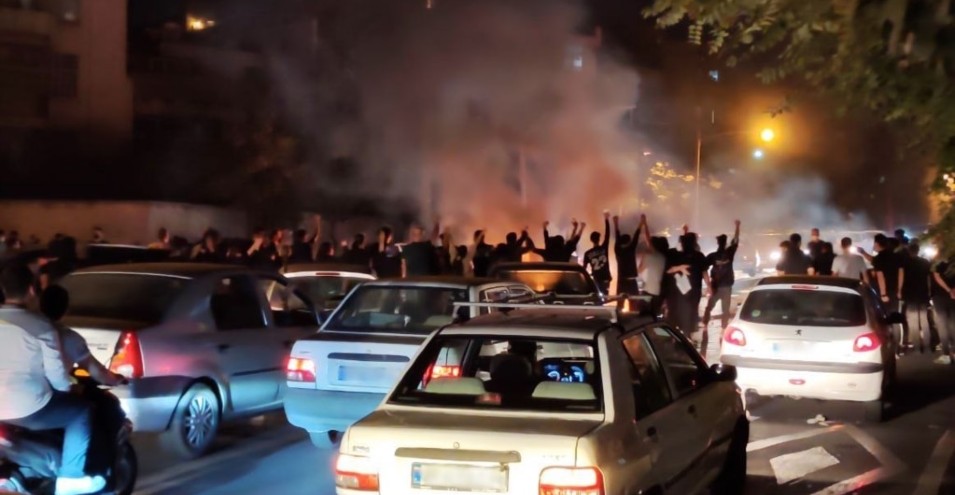
The substantial bond amount in this case cannot be separated from the broader pattern of judicial action by the Islamic Republic against opponents and protesters. In 2026, human rights organizations have repeatedly warned about the use of broad and vague security charges to prosecute citizens who have engaged in civil, protest, or critical activities.
Human Rights Watch reported in its 2026 report on Iran that arbitrary detention and unfair trials continue, noting that Islamic Republic officials use security charges to deal with both actual and alleged opponents. The organization also warned about the limited access of security detainees to independent lawyers and serious problems during investigation and interrogation phases.
Amnesty International has also recently reported an intensification of repression in Iran, stating that Islamic Republic officials have increasingly used broad national security charges against protesters following January 2026 demonstrations. The organization has also spoken of widespread arrests, expedited judicial proceedings, and concerns about torture and mistreatment of detainees.
The Center for Human Rights in Iran reported that dozens of trade union and civil activists have faced arrest, trial, imprisonment, and security charges, a process that the center describes as part of the government’s organized effort to eliminate independent civil organizations and silence opponents.
Aziz-Nasri’s case is significant from this perspective. He had previously been detained during nationwide protests. Documents from HRANA show that his name is recorded among those arrested during the 2022 protests in Mashhad. Additionally, reports released this year indicate that in April 2026, he was arrested by Intelligence Ministry officials at his home and released after one day on bail; during that arrest, his mobile phone and several electronic devices were confiscated.
In August, a summons was issued for him to appear at Branch 271 of the Prosecutor’s Office, and he was requested to prepare his defense within five days.
Now, with the addition of new charges, his case has entered a more critical phase. It is noteworthy that charges such as “assembly and conspiracy against national security” have been repeatedly used against protesters, civil activists, journalists, and government critics in recent years. Human rights organizations have repeatedly warned about the vagueness of these charges and the danger of their political misuse.
For a citizen, temporary release should not become an unattainable privilege accessible only through a bond of several billion tomans. Such a process, especially when new charges are added to a case during interrogation, raises serious questions about the proportionality of judicial measures, the right to defense, and the principle of presumption of innocence.
From a human rights perspective, the core issue is not merely Hossein Aziz-Nasri’s case alone; it is the mechanism in which protest, civil activity, or contact with others can be construed as a security threat, and the judicial system, instead of guaranteeing citizens’ rights, becomes a tool for pressuring critics.
For a Christian media outlet, this case is a reminder of a fundamental truth about human dignity: freedom of conscience, the right to speak, and access to justice are not privileges that governments can grant or revoke at will. These rights belong to humans, and no political power can strip a person of their inherent human worth through security labels.
What Hossein Aziz-Nasri is experiencing today, alongside numerous other cases, presents a picture of Iran’s tense and security-dominated environment; a space where the judicial system, rather than serving as a citizen’s refuge against power, has become, according to human rights critics, one of the tools for exerting pressure on civil society.
Aziz-Nasri remains accused, and the charges brought against him are not considered proven until a final verdict is issued, but the Islamic Republic’s responsibility to respect the right to defense, fair trial, and the presumption of innocence remains, independent of the final outcome of the case. Existing international reports show that these concerns are not about a single case, but are part of a broader pattern of repression against people in Iran.