Empress Farah Pahlavi’s Birthday: A Woman Who Saw Iranian Culture as the Beacon of the Future
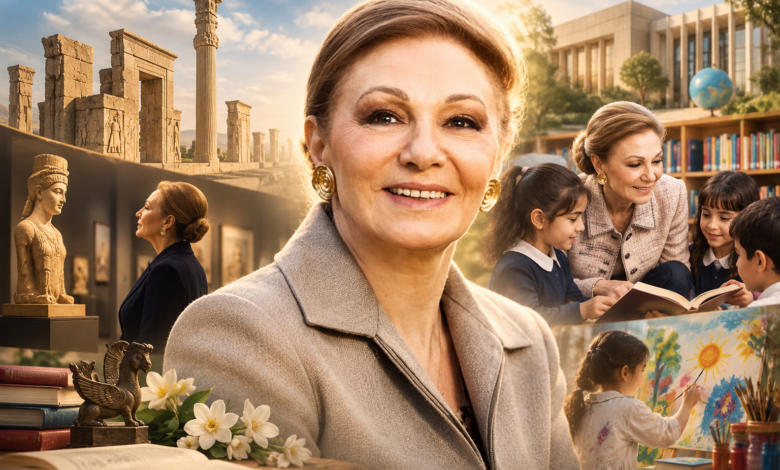
October 14 is the birthday of Empress Farah Pahlavi; a woman whose name is linked with support for culture and art, the expansion of educational institutions, the preservation of Iran’s historical heritage, and social activities. From museums and cultural centers to children’s libraries and support programs, part of her legacy relates to efforts to build a society in which education, culture, and the welfare of children held an important place. Today, on the anniversary of her birth, reflecting on this legacy is an opportunity to recall the importance of cultural freedom, social responsibility, and hope for Iran’s future.
Farah Diba was born on October 14, 1938, in Tehran. After her marriage to Mohammad Reza Shah Pahlavi in 1959, she participated in cultural and social activities as Queen and later as Empress of Iran. During a period when Iran faced broad social and economic changes, support for art, education, social services, and the preservation of historical works were among the areas at the center of activities associated with her.
To understand the Empress’s record, one must look beyond formal titles and examine the institutions and programs that took shape or developed during that period; institutions, some of which became enduring in Iran’s cultural history and influenced the lives of artists, writers, children, and art enthusiasts.
One of the most recognized aspects of Empress Farah Pahlavi’s record was support for Iranian culture and art. During her time, attention increased to establishing and developing museums, introducing Iranian art, and creating opportunities for exchange between Iranian artists and artistic movements worldwide.
The Tehran Museum of Contemporary Art, the Iran Carpet Museum, and the Reza Abbasi Museum are among important cultural centers that took shape or developed in the cultural atmosphere of that era. These centers, through collecting, preserving, and exhibiting artworks, provided the foundation for introducing different generations to Iran’s and the world’s artistic heritage.
The Shiraz Festival of Arts and cultural and artistic festivals of that period also sought to expose music, theater, performing arts, and other expressions of culture to Iranian and international audiences. These events, despite criticisms regarding certain programs and how they were organized, formed part of Iran’s contemporary cultural history.
Support for culture was not limited to museums and festivals. The Kanoon (Institute for the Intellectual Development of Children and Adolescents), founded in 1965, played an important role in expanding children’s literature, reading, film, and creative activities for the young generation. This institute became a venue for nurturing talents that later became recognized in Iran’s literature, cinema, and art.
This experience carries a clear message: culture is not an additional expense for a society; it is an investment that can nurture critical thinking, creativity, identity, and self-confidence in a generation.
Among social activities of that era, special attention was given to the situation of children and adolescents. The expansion of educational facilities, support for underprivileged children, development of childcare and educational centers, and providing greater access to books and cultural activities were among areas in which social and charitable organizations operated.
In accounts from that period, support programs for the nutrition of children and students are also mentioned, including the provision of milk and food for groups of children. However, to attribute a specific free food distribution program in schools to Empress Pahlavi, the historical documents of that program must be examined; since the activities of charitable organizations, government programs, and personal initiatives or those under court patronage are not necessarily identical.
But the underlying principle is of clear importance: a child who comes to school hungry faces greater difficulties in learning. Access to adequate food, quality education, medical care, and a safe environment is not a privilege but part of every child’s fundamental rights.
Attention to these areas reminds us of the responsibility every government has toward the next generation. No country can speak of progress while its children are denied proper education, adequate nutrition, or equal opportunity to develop their talents.
Social activities associated with Empress Farah Pahlavi were not limited to culture and education. Support for medical centers, charitable institutions, and vulnerable groups also formed part of social activities of that era. Some of these initiatives were carried out through formal institutions, charitable organizations, and programs administered through the participation of various individuals and organizations.
In reviewing this record, it is important to distinguish between the Empress’s personal activities, her support for an institution, and the overall performance of the government of the time. Such differentiation does not diminish the value of social initiatives nor does it allow history to become a one-sided narrative.
Pre-revolution Iran, despite development plans and some social and cultural achievements, still faced poverty, inequality, and economic problems in parts of society. Therefore, commemorating the cultural and social services of a period should not mean ignoring its shortcomings and limitations. History is instructive only when we examine achievements and failures simultaneously.
Protection of historical monuments, museum development, and introduction of Iranian art were other important aspects of cultural activities of that era. A country’s historical heritage is not merely a collection of old buildings and artifacts; this heritage is the living memory of a nation and the link between its past, present, and future.
Preserving ancient works, maintaining traditional arts, and introducing the achievements of Iranian artists to the world help strengthen public knowledge of Iranian civilization. Such actions have the greatest value when they remove cultural heritage from the monopoly of political institutions and place it within reach of the general public and future generations.
Iranian culture is the product of centuries of experience, thought, poetry, music, architecture, and art. No government and no political movement can be the exclusive owner of this heritage; preserving it is a national responsibility belonging to all Iranians.
The 1979 Revolution changed the course of Empress Farah Pahlavi’s life. She left Iran with the royal family and began life in exile. Despite being far from her homeland, her name remains linked with memories of a period in Iran’s history, particularly the cultural and artistic activities of that era.
Iranians’ view of contemporary history is not uniform. For some, Empress Farah Pahlavi is a symbol of support for art, culture, and social activities; for others, her name evokes part of the history of the monarchy and the political disputes before the Revolution. This difference in perspectives cannot be ignored, but political disagreement should not prevent documented and fair examination of individuals’ cultural and social records.
What matters today is attention to values that can transcend political differences and lay the foundation for a better future: education, freedom of thought, support for children, preservation of historical heritage, and providing opportunities for artists and writers.
In a country whose people face economic difficulties, concerns about their children’s future, and cultural limitations, recalling the importance of these values takes on meaning beyond a calendar occasion.
Prince Reza Pahlavi also issued a message on the occasion of his mother Empress Farah Pahlavi’s birthday, speaking of her love for Iran, efforts to preserve culture and art, and her hope for the country’s freedom.
In his message, Prince Reza Pahlavi wrote:
“I wish a happy birthday to my mother, Empress Farah Pahlavi. A woman who has held and holds a maternal place not only for me but for several generations of Iranians.
What has always been praiseworthy in my mother’s being is her endless love for Iran and her enduring effort to preserve and flourish the culture and art of this land.
My mother has never lost faith in the victory of light over darkness. I hope soon to witness the fulfillment of a dream she has nurtured in her heart all her life: Iran’s freedom, the dignity of its people, and the return of light to a land that has never been far from her heart.
Iran eternal, Reza Pahlavi”
Empress Farah Pahlavi’s birthday is an opportunity to review part of Iran’s cultural and social history; a history in which support for art, the expansion of cultural institutions, and attention to children’s education, alongside political and social challenges and shortcomings, hold their place.
A bright future for Iran is not built merely by changing political faces; this future requires a society in which no child is denied proper education and nutrition due to poverty, no artist is pressured for expressing thought, the nation’s cultural heritage is not sacrificed to politics, and human dignity, regardless of belief and political orientation, is respected.
If Iran is to one day reach a place befitting it in the world, it must view culture and education not as tools of propaganda but as national capital; it must give children the opportunity to grow, support the sick and needy, and enable the flourishing of talents in all citizens.
Happy birthday to Empress Farah Pahlavi; with the hope for a day when Iran, the ancient land of culture, art, and civilization, witnesses in freedom and peace the renewed flourishing of its children; a day when light, hope, and human dignity find their rightful place throughout this land.