Parliamentary Member Warns: “Countering Infiltration” Bill Could Turn Iran Into North Korea
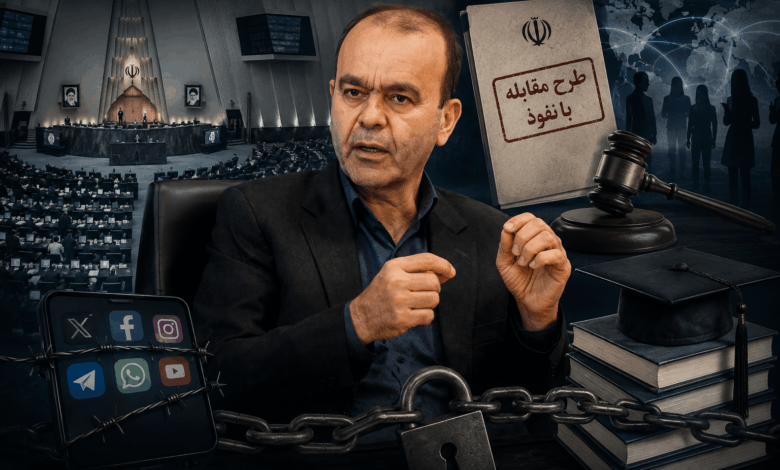
As Iran’s parliament approves the general principles of a bill dubbed “Countering Infiltration,” Majid Nasirpour, a member of the social affairs commission, has warned about its consequences for communication freedom, scientific and cultural activities, and citizens’ interaction with the world, calling for a six-month halt and re-examination of the bill in the judicial commission—a bill that international media have also expressed concerns about regarding the scope of its restrictions.
Iran’s Islamic Consultative Assembly has recently witnessed serious debate over a bill titled “Countering the Infiltration of Intelligence Services and Foreign Governments or Entities in the Country”—a bill presented ostensibly to counter foreign influence, yet the scope of some of its proposed articles has raised concerns about limiting Iranians’ contact with foreign media, universities, cultural institutions, and international organizations.
The general principles of the bill were approved on August 16 with 183 votes in favor, four against, and five abstentions out of 258 MPs present. However, approval of general principles does not mean final approval of all articles, and the details and prescribed penalties remain under parliamentary review.
Majid Nasirpour, a member of the social affairs commission, considers the principle of countering infiltration as a defensible measure, but believes the method of drafting and the speed of review could have adverse consequences. Referring to articles 32 and 33 of the proposed text, he called for greater legal and technical examination and said the bill should be referred to the judicial commission.
According to Nasirpour, the main issue is that the concept of “infiltration” in the bill has been extended to a much broader sphere than sensitive centers and power structures, and could affect ordinary people’s communications with the outside world. He warned that scientific, social, cultural, and economic activities could face restrictions or even criminal consequences if the bill’s provisions are interpreted broadly.
This concern overlaps with what international media have reported about the proposed text. Al Jazeera wrote that the published version of the bill covers contact with foreign media, scientific cooperation, scholarships, cultural activities, communication with embassies, and even some civil activities. According to this report, in some cases imprisonment is prescribed for unauthorized media communications, and cultural and artistic activities related to some foreign institutions could also face restrictions.
Radio Farda, affiliated with Radio Free Europe, has also reported that the bill could criminalize interviews, conversations, or contact with media that the government considers “hostile.” The proposed text also subjects sending photos, videos, audio, or data to foreign media or media activists to criminal penalties.
In a report published on August 26, The Guardian considered the scope of concerns to extend beyond journalists and wrote that the bill could affect researchers’, academics’, and ordinary citizens’ contact with foreign media and platforms. The newspaper also referred to legal warnings about the possibility of increasing Iran’s isolation.
In criticizing the current approach, Nasirpour does not view the issue as limited to media alone. He believes that a security-focused and hardwired approach to “infiltration” does not align with new methods of infiltration and instead could limit society’s communication channels with the world without necessarily eliminating actual threats.
He warned about the potential consequences of such a policy, saying: “If we pass one or two similar laws in this country, we no longer need anyone to sanction us; we have automatically turned into North Korea.”
This comparison comes as international media have in recent days discussed the possibility of intensifying Iran’s isolation if broad restrictions are implemented. The Guardian, citing an Iranian legal expert, warned that the expansion of such restrictions could bring Iran close to a situation similar to North Korea—a matter showing that concerns about increasing Iran’s distance from the global community have been raised not only domestically.
On the other hand, opposition to the current text of the bill is not limited to some parliamentary members. The government of Masoud Pezeshkian has also previously expressed its opposition. Majid Ansari, the legal deputy to the president, said that criminalizing broad general titles could harm citizens’ rights and limit the connection of Iranian universities and researchers with global scientific centers. The government has proposed that the bill be reviewed more carefully with the participation of legal, judicial, and security sectors.
In this regard, Al Jazeera reported that even some media close to Iran’s security establishment have warned about the bill’s consequences. Nournews, a media outlet close to the Supreme National Security Council, warned of the possibility that the bill, instead of reducing foreign infiltration, could weaken social capital by limiting media, parties, and citizens.
One of the controversial points of the bill is the extension of the concept of infiltration to social layers. Nasirpour believes that countering infiltration should mainly target elites, senior managers, and sensitive decision-making centers, not the general public. In his view, subjecting citizens, academics, cultural activists, and private institutions to broad security rules could limit Iran’s space for social and scientific interaction.
This matter has special importance for the Christian community and other religious minorities from the perspective of contact with the outside world, because any expansion of vague definitions of “foreign contact,” particularly in the areas of cultural, educational, and social activities and contact with foreign institutions, could affect the public space for civil and religious activities. However, in the reviewed sources, no direct evidence was found showing that the current text of the bill specifically targets churches or Christians; therefore, such a claim cannot be attributed to this bill.
Ultimately, the main question now is whether parliament will further narrow the scope of the bill and clarify its definitions. Domestic reports show that some MPs emphasize amending the articles, while the government has called for more legal and technical review. International media are also closely following the process of passing this bill, as its outcome could affect media freedom, scientific cooperation, cultural communications, and the level of Iranian society’s contact with the outside world.
In such circumstances, Nasirpour’s warning, more than being merely an intra-parliamentary criticism, reflects a larger dispute over the boundary between “national security” and “society’s normal contact with the world”—a dispute that has now reached international media from inside Iran’s parliament.