Five-Year Prison Sentence for Two Baha’i Citizens; Continued Persecution of Religious Minorities in Iran

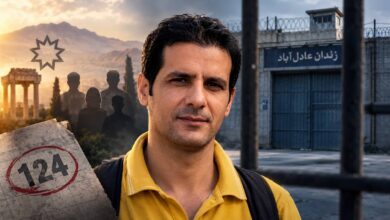
“Iraj Shekoor” and “Pedram Abher,” two Baha’i citizens residing in Tehran, were arrested after being summoned to Tehran’s security prosecutor’s office and transferred to Evin Prison to serve their five-year prison sentences. This case has once again drawn attention to the systematic pressure exercised by the Islamic Republic on Baha’i citizens and the extensive restrictions on freedom of religion and belief in Iran, affecting Baha’is, Christians, and Zoroastrians alike.
According to published reports, “Iraj Shekoor,” a writer and researcher, and “Pedram Abher” were arrested on Monday, September 7, 2026, corresponding to Shahrivar 16, 1405, after reporting to the first branch of the enforcement of sentences at Tehran’s security prosecutor’s office. They were subsequently transferred to Evin Prison to serve their prison terms.
These two citizens had previously been sentenced by Branch 29 of Tehran’s Revolutionary Court, headed by Judge Seyyed Ali Mazloom, to five years of imprisonment on charges of “membership in groups and organizations with intent to undermine national security.” This sentence was later upheld by Branch 36 of Tehran Province’s Appeals Court.
However, case records indicate that the initial charges were broader than the sentence ultimately enforced. In the initial proceedings, Shekoor and Abher faced charges not only of security violations but also of “propaganda against the system.” However, the appeals court rejected this portion of the charges and acquitted both defendants on this count. Nevertheless, their five-year conviction on charges related to membership in the Baha’i community remained in place.
Pedram Abher had previously been arrested by security forces in November 2021. After being transferred to Evin and undergoing interrogation, he was released on bail. Iraj Shekoor also has a history of being summoned, arrested, and interrogated by security forces and remained free on bail until the execution of his sentence.
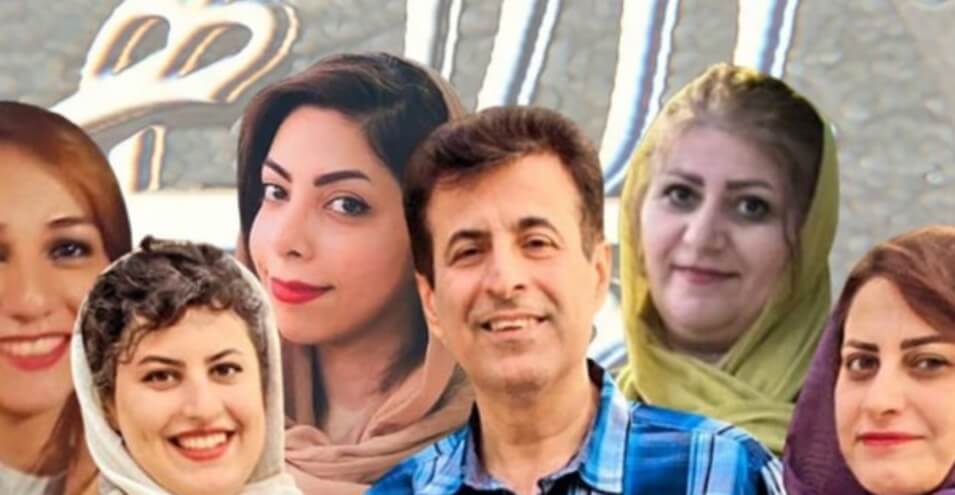
The case of these two citizens is part of a broader pattern that has targeted Iran’s Baha’i community in recent years. In this particular case, Iraj Shekoor and Pedram Abher were tried alongside four other Baha’i citizens, and heavy prison sentences and asset seizures were imposed against members of this group. Human rights reports further indicate that the appeals court hearing was held without a formal session and without the presence of the defendants and their lawyers.
What elevates this case beyond an ordinary legal dispute is the nature of the charges and their direct connection to the defendants’ religious identity and religious activities. In the Islamic Republic, Baha’is are not officially recognized by the government as a religious minority, and their religious, social, and educational activities have repeatedly been subjected to security-related designations. The “HANA” human rights organization reported in August 2026 that pressure on religious and ideological minorities in Iran, particularly following the 12-day conflict and the increased security atmosphere, has intensified. The report states that Baha’is have once again faced charges of connection to Israel, and their activities and even contacts with people outside the country can trigger sensitivity among security institutions.
Christians are not immune to this atmosphere of persecution either. Although the Islamic Republic’s Constitution officially recognizes Christians, Jews, and Zoroastrians as religious minorities, this recognition does not guarantee equal enjoyment of religious freedom. The updated British government report on the status of Christians in Iran clarifies that Christian citizens and those who have converted from Islam to Christianity face arrest and legal prosecution, with charges such as “propaganda against the system” and “promotion of Zionist Christianity” used against them.
The report further states that Christians who openly practice their faith in Iran are likely to face government conduct that, in terms of severity and frequency, constitutes religious harassment and persecution. Churches are also under government surveillance, and restrictions are imposed on some Christian communities, including bans on conducting religious services in the Persian language.
Zoroastrians, while officially recognized as a religious minority in the Islamic Republic’s Constitution, are not exempt from the broader structural discrimination against non-Muslims. Article 13 of the Constitution identifies Zoroastrians, Jews, and Christians as official religious minorities; however, their freedoms are explicitly conditioned by “the limits of the law.” This same legal framework, combined with laws and regulations based on the country’s official religion, has resulted in the civil rights of religious minorities falling far short of the principle of complete equality for all citizens.
The distinction between “official recognition” and “enjoyment of actual freedom” is of great importance in the case of Iran’s religious minorities. The Islamic Republic may officially recognize some minorities in its Constitution, but simultaneously impose restrictions on them in religious, social, occupational, and political spheres. In contrast, Baha’is fundamentally lack a status comparable to official religious minorities within the Islamic Republic’s legal structure and in many cases face security-based treatment.
From the perspective of fundamental human rights, religious belief or change of religion should not be considered a crime, and membership in a religious community should not serve as grounds for deprivation of freedom, education, employment, property ownership, or access to fair legal proceedings. Nevertheless, the case of Iraj Shekoor and Pedram Abher demonstrates that in Iran, activity related to the Baha’i community can still result in the opening of a security case and the imposition of a prison sentence.
The continuation of such treatment is not limited to the Baha’i community. Christians, particularly converts, face arrest and prosecution, and Zoroastrians live within a framework in which the rights of minorities are in many areas subject to the laws and restrictions of the Islamic Republic based on religion. For this reason, the case of the two Baha’i citizens in Evin can be understood as part of a larger picture: a picture of a system in which freedom of religion and belief is not an equal right for all citizens but a limited privilege conditional upon acceptance of the government’s ideological framework.
Under such circumstances, the transfer of Iraj Shekoor and Pedram Abher to Evin Prison is not merely the execution of two court orders; this event once again raises the question of why the religious beliefs and identity of citizens in Iran must be turned into security cases and why citizens who belong to a different religious community must face prison, interrogation, bail, and social deprivations in order to enjoy the most basic of their rights.
For Iran’s Baha’i community, this question remains unanswered, and for Christians and other religious minorities, the experience of recent years demonstrates that the danger of persecution, particularly during periods of heightened security atmosphere, remains serious. International reports in 2026 continue to emphasize concerns about freedom of religion and belief in Iran, and the British government has explicitly deemed the targeting of religious minorities because of their religious beliefs as “unacceptable.”
As long as membership in a religious community or attempts to freely conduct religious ceremonies and activities can serve as the basis for security charges and imprisonment, claims of respect for the rights of religious minorities in Iran will remain at a profound distance from the reality of the lives of many such citizens—a reality that is once again manifested in the fate of Iraj Shekoor and Pedram Abher, two Baha’i citizens who have been sent to Evin to serve their five-year prison sentences.