The Mysterious Death of Erfan Mirzaei in Dastgerd Prison: A 21-Year-Old Rapper Protester Whose Fate Was Buried in Silence
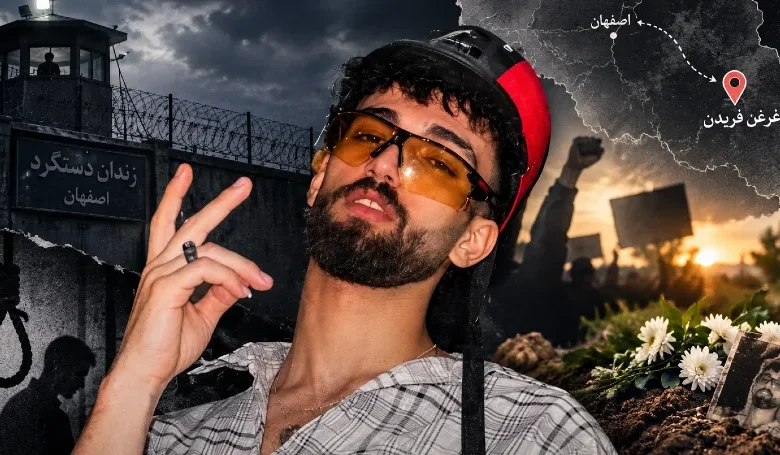
Erfan Mirzaei, a 21-year-old rapper and protester, died in Dastgerd Prison in Isfahan, while conflicting reports regarding his fate have circulated—ranging from secret execution to death from torture—and the Islamic Republic authorities have yet to provide a formal and transparent explanation about the cause of his death. The body of this young man was buried under security measures not in Isfahan, but in the village of Ghorgan in Faridan, rather than his hometown.
Erfan Mirzaei, born in August 2005 and a resident of Faridan in Isfahan Province, was among the youth detained during the December protests. Published reports indicate that after participating in the demonstrations, he was identified and arrested at a checkpoint inspection in Shahinshahr, Isfahan. Security officers, after reviewing his mobile phone, found videos of his presence at the protests, and this became one of the central pillars of his legal case file.
According to a report by Iran Wire, informed sources stated that Mirzaei had been sentenced to death on charges of “moharebeh” (enmity against God), and efforts by his relatives to prevent the execution were unsuccessful. These sources said that his family learned of his fate without prior notice of the execution being carried out, and security officials had previously threatened them not to disclose information about his detention, case file, and death sentence.
However, serious ambiguities exist regarding the manner in which this young man died. Some sources, including Iran Wire, have reported that Erfan Mirzaei’s execution order was carried out on Sunday, September 6, 2024, in Dastgerd Prison. In this account, his death has been described as the implementation of an execution order. Conversely, other sources have stated that he died in prison as a result of severe torture and beatings, and some reports have even raised the possibility of suicide. Iran International, while pointing to this conflicting narrative, has emphasized that the manner of his death remains unclear.
What has compounded the ambiguities is the condition of his body after death. According to reports published by Iran Wire and other sources, when his body was returned, multiple signs of injuries and bruises were observed on his body and face, and his relatives spoke of fractures in his hands, feet, and pelvic area. These claims have yet to be independently explained or investigated by Islamic Republic authorities.
According to published reports, Mirzaei’s body was not directly handed over to his family, and permission for burial in Isfahan was denied. Security officers transferred his body to the village of Ghorgan in Faridan County; informed sources have described this action as an attempt to prevent the formation of public gatherings and the widespread spread of news about this young man’s death. Mirzaei was buried yesterday, Monday, September 7, 2024, in Ghorgan.
Under such circumstances, the main question is not merely how Erfan Mirzaei died; the greater question is why the family of a young prisoner should remain unaware of their child’s fate, and why no mechanism exists for an independent and transparent investigation into the cause of his death?
Mirzaei’s case came at a time when the use of serious charges such as “moharebeh” against protesters has once again raised widespread concerns about the legal process in political and protest-related cases in Iran. The charge of “moharebeh” is among the serious criminal charges that can result in death sentences and has been used in recent years in the cases of some protesters.
In Erfan Mirzaei’s case, what is clear based on published reports is that a 21-year-old was detained after participating in protests, and content on his mobile phone was used as part of the documentary evidence in his case file. Sources close to him have also spoken of pressure and torture to extract forced confessions.
A report by Independent Farsi also stated that Mirzaei’s relatives reported the presence of multiple fractures on his body after his corpse was returned, and considered his death to be a result of months of detention and severe beatings. This outlet also reported that files related to December protesters in Dastgerd Prison and Isfahan’s judicial system have been accompanied by the issuance of severe sentences.
On the other hand, a recent report from the “Tuesday-No-to-Execution” campaign described Mirzaei’s death as “suspicious” and spoke of him being killed in Dastgerd Prison. Nevertheless, at the time of writing this report, no official body of the Islamic Republic has clearly announced the cause of his death.
This official silence is of great significance. If his execution order was carried out, his family and the public have the right to know on what basis the sentence was issued and how it was implemented. If he died in prison as a result of torture or severe beatings, an independent investigation should be conducted into the possible perpetrators and those responsible, and if there is another account of his death, the government is obligated to present its evidence and documentation transparently.
The death of a prisoner in detention, particularly a young prisoner who faced a serious charge such as moharebeh before his death, cannot be concluded merely with an ambiguous statement or news silence. The responsibility for preserving the life of a prisoner throughout detention rests with the competent authorities, and the family has the right to know the truth about the fate of their loved one.
Erfan Mirzaei now rests in the soil of Faridan; however, the questions raised about his case and death remain unanswered. Available reports speak of secret execution, torture, signs of injuries on his body, and prevention of his burial in Isfahan, while another account has been raised about the cause of his death. These very contradictions make the need for an independent and impartial investigation all the more urgent.
What is certain is that a 21-year-old who participated in the protests died in prison, and his family, instead of receiving a clear answer, has been faced with an injured body and a series of unanswered questions.
In Iran, where execution orders are sometimes carried out without prior notification to the family and where little information about the condition of some prisoners is available to the public, the fate of Erfan Mirzaei once again underscores the necessity of transparency, fair trials, and accountability regarding the death of prisoners.
He was 21 years old; a young rapper who had life, art, and a future ahead of him. Now, instead of the sound of his music, questions about his fate remain; questions that, without an independent investigation and clear answers from the government, will remain shrouded in ambiguity.