Abolfazl Mohammadi Dies in Qarchak Prison Due to Lack of Medical Care
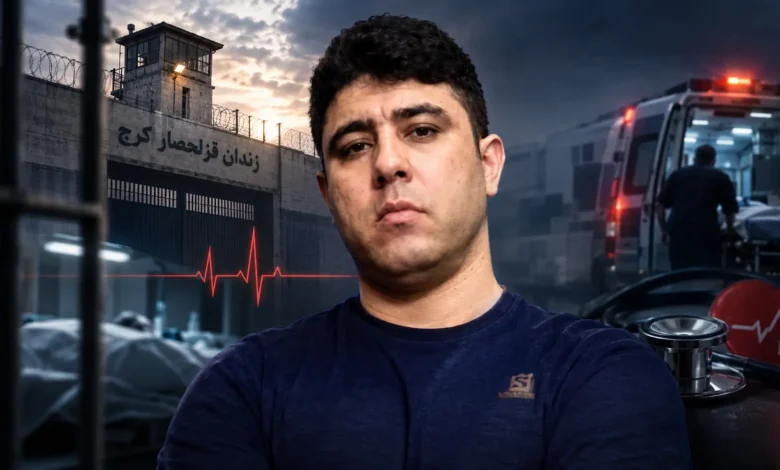
Abolfazl Mohammadi, a prisoner from Varamin, died in Qarchak Prison in Karaj after suffering a heart condition and following delays in receiving medical care and transfer to a medical facility outside the prison. His death once again highlights concerns about the deprivation of prisoners in Iran from their most basic human right: access to immediate and appropriate medical treatment—a right that should not be stripped from a person based on accusation or conviction.
The death of a person in prison, regardless of why they are incarcerated, raises serious questions about the state’s responsibility for their life. The report published about Abolfazl Mohammadi’s death in Qarchak Prison in Karaj is significant from this perspective, because the issue is not merely the fate of one prisoner, but something more fundamental: Can prison punishment mean depriving a person of the right to medical treatment and healthcare?
According to a report also published by Hengaw, Abolfazl Mohammadi, a citizen from Varamin in Tehran Province, died in Qarchak Prison on Monday, September 16 (September 7 Gregorian calendar), after suffering a heart condition. According to this report, lack of medical attention and delays in transferring him to a medical facility outside the prison are cited as factors related to his death.
Mohammadi had previously been detained in connection with charges related to ordinary crimes and had spent time in Khorin Prison in Varamin. He was then transferred to Qarchak Prison in Karaj to continue serving his sentence. The details published about his final hours (if confirmed by independent investigations) raise an issue that human rights organizations have repeatedly warned about in recent years: the deprivation or delay in providing medical services to prisoners in Iran. This issue is not limited to political or ideological prisoners.
Amnesty International, in reviewing cases of prisoner deaths in Iran, has stated that among those who died after being denied appropriate medical care are prisoners charged with or convicted of non-political crimes. This organization has documented cases where the transfer of critically ill prisoners to hospitals was delayed or necessary medical care was not provided to them at all.
From this perspective, the fate of Abolfazl Mohammadi cannot be examined solely within the framework of his legal case. Even if a person has committed a crime and been sentenced to imprisonment, a prison sentence does not mean deprivation of the right to life, health, and treatment. A prisoner loses only the freedom of movement, not their right to be human.
International standards also make no such distinction between political and non-political prisoners. United Nations experts have emphasized that states are obligated to ensure that prisoners and detainees have access to healthcare services, and the Mandela Rules also emphasize the right of prisoners to timely and appropriate medical care.
The history of human rights reports on Iranian prisons shows that concern about this situation is not a new issue. Amnesty International, in a report on 96 cases of prisoner deaths in 30 Iranian prisons, has documented numerous cases where delays in transferring patients to hospitals or deprivation of appropriate treatment led to deterioration of the patient’s condition and ultimately death. This organization has also emphasized that Iranian prisons lack the necessary facilities to manage complex illnesses and emergency situations in many cases, and critically ill prisoners must be transferred without delay to specialized medical facilities outside the prison.
Human Rights Watch also stated in 2025, following the deaths of three women prisoners in Qarchak, that there is a long history of prisoners in Iran being denied medical care, and emphasized that deprivation of treatment can constitute a violation of prisoners’ right to life. The organization also called on the Islamic Republic’s authorities to provide timely and adequate medical care, including specialized treatment outside the prison, for all prisoners.
In this same context, a report by a UN special mechanism in December 2025 also raised cases of prisoner deaths in Iran following medical negligence and cited Qarchak Prison in Karaj among facilities where concerns have been expressed about medical conditions and cases of death in detention.
Therefore, if the report regarding Abolfazl Mohammadi’s death is accurate, the issue is not merely that a prisoner with ordinary criminal charges died in prison; the more important issue is whether he had timely and unobstructed access to necessary medical care at the moment when he suffered a heart condition.
This question must have a clear and verifiable answer. If the transfer of a critically ill prisoner was deliberately delayed, we can no longer regard the matter as merely “administrative negligence” or “lack of facilities.” Delays in treating someone whose life is in danger can have irreversible consequences, and if responsible authorities were aware of the deterioration of his condition and nonetheless delayed his transfer or treatment, the necessity for independent investigation and accountability becomes all the more pressing.
On the other hand, even if the cause of Mohammadi’s death ultimately requires forensic medical examination and independent investigations, one principle should not be subject to dispute: being a prisoner does not deprive a person of the right to treatment.
This principle must be applied equally to all prisoners; whether someone is imprisoned for political activity or for an ordinary crime, whether awaiting trial or serving a sentence. A prisoner may have lost their freedom, but the state is responsible for preserving their life.
The death of Abolfazl Mohammadi in Qarchak, based on the account published by Hengaw, now requires clarification of the facts: When did his heart condition begin? When did prison authorities become aware of his condition? What care was provided to him? Why and after what time interval was action taken to transfer him to a medical facility outside the prison? And was there a possibility of saving his life with faster treatment?
These answers can demonstrate whether in Iran’s prison system, a prisoner’s life is still considered a human right or not.
Ultimately, the punishment for any crime a person has committed must be applied within the framework of law and court judgment; not through deprivation of treatment, not through endangering life, and not by turning the prison into a place where a treatable illness can lead to death. Behind prison bars, one’s right to humanity does not end.