Judah Hakamti, Jewish-American Citizen, Released from Evin Prison but Barred from Leaving Iran
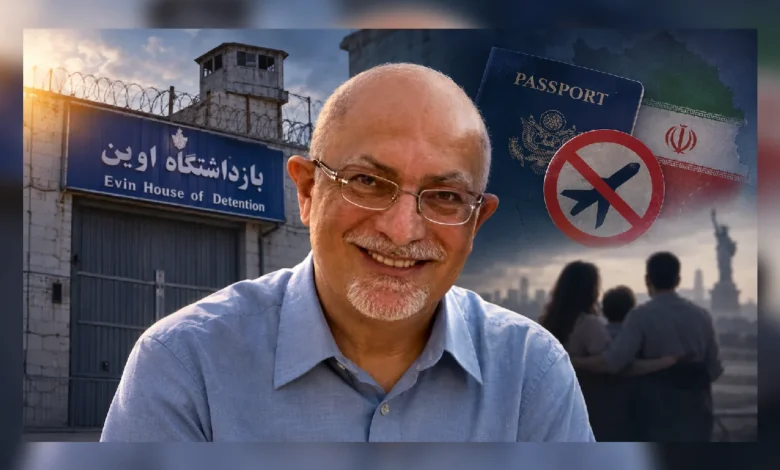
Judah (Kamran) Hakamti, a 71-year-old Jewish dual Iranian-American citizen who was held in Evin Prison while battling cancer, has been released after more than a year in detention. However, his release does not mean he can return to his family in America, as a travel ban preventing him from leaving Iran remains in effect, and Islamic Republic authorities have provided no formal explanation regarding his release or its conditions.
According to recent reports from Radio Farda and The Jerusalem Post, Hakamti was released from Evin Prison on Saturday evening, September 5th, corresponding to the 14th of Shahrivar. Radio Farda reported, citing its sources, that he has been freed but remains under a travel ban preventing him from leaving the country. The Jerusalem Post also confirmed his release, citing Iranian sources, though it emphasized that no official Islamic Republic authorities have yet announced this news or details regarding the conditions of his release.
Meanwhile, the Jewish website Belaaz reported that Hakamti was released on bail and that an informed source claimed his release came at the request of Qatar. According to this report, in the weeks leading up to his release, contacts took place between certain figures from the Jewish community and Qatari officials, and these efforts ultimately aided his release on bail. Since this claim has not yet been confirmed by official authorities or other independent sources, the role of Qatar in Hakamti’s release cannot be considered definitive.
Hakamti’s case came into the spotlight of Jewish, human rights, and American media outlets in the fall of 2025. He, who has lived in New York for years, traveled to Iran in May 2025 to visit relatives; a trip that was initially intended to be brief, but when attempting to return, his passport and certain electronic devices were confiscated, and despite repeated follow-ups, he was not permitted to leave Iran. Approximately two months later, following heightened security sensitivities after the twelve-day war between Iran and Israel, he was arrested and transferred to Evin Prison.
The primary charge against Hakamti related to a trip to Israel he had taken approximately thirteen years before his arrest. Multiple reports indicate that this trip was to attend his son’s bar mitzvah ceremony, and his family has described it as a purely family and non-political trip. The law invoked by the Islamic Republic criminalizes travel by Iranian nationals to Israel; however, human rights and media reports have emphasized that Hakamti’s trip occurred outside the timeframe specified in this law.
Tehran’s Revolutionary Court initially issued a four-year prison sentence for him. Following changes to regulations concerning punishment for travel to Israel, the sentence was reduced to two years, and according to the Hrana news agency and sources related to the case, his punishment was ultimately reduced to one year of imprisonment.
Hakamti’s family also objected to the manner in which his case was handled judicially. According to published reports, the trial session was extremely brief and was held without the presence of a defense attorney or witnesses. This issue was among the factors that led human rights activists and several American institutions to present Hakamti’s case as an example of the unjust detention of dual nationals.
Hakamti’s physical condition also added to the concerns. He is battling bladder cancer, and his family repeatedly warned about his access to adequate medical care in prison. In December 2025, Tom Suozzi and Claudia Tenney, two members of the U.S. Congress, in a letter to U.S. Secretary of State Marco Rubio, called for immediate efforts to secure Hakamti’s release on humanitarian grounds and also referenced his medical condition.
In March 2026, the U.S. State Department also formally designated Hakamti as being among “wrongfully detained” individuals. Tom Suozzi, a member of the U.S. Congress, following this decision, stated: “This is a clear and obvious case of wrongful detention. Mr. Hakamti and several other Americans imprisoned in Iran are not detained for crimes they have committed, but because they are Americans, and in Mr. Hakamti’s case, an American Jew.”
Despite Hakamti’s release from Evin, a significant portion of the concerns remain. He still cannot leave Iran and return to his family in New York, and it is unclear when his travel ban will be lifted. Radio Farda reported that Iranian authorities have not yet formally confirmed his release, and the exact conditions of his release remain unclear.
Thus, Judah Hakamti’s release can be viewed as the end of one period of detention, not the end of his case; as this Jewish-American citizen remains trapped in Iran by restrictions that have prevented his return home to his family. While American institutions previously considered his detention unjust, the key question now is whether Islamic Republic authorities will lift his travel ban or not.