One Woman and Two Men Executed at Vakil-Abad Prison in Mashhad amid Government Media Silence
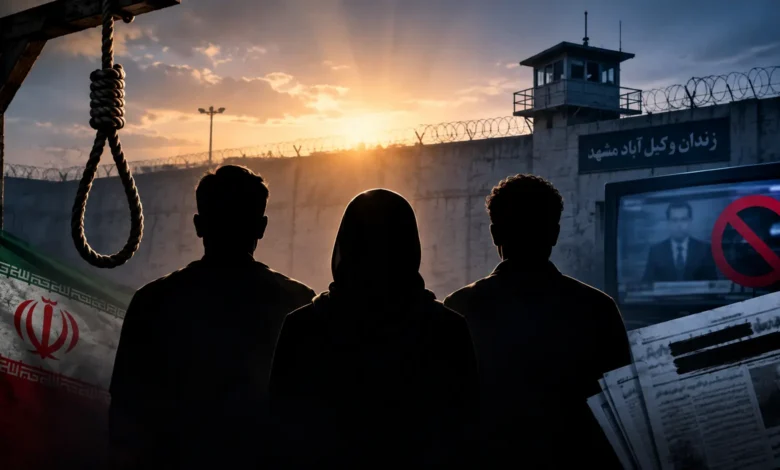
Early Sunday morning, September 6, 2026, three inmates—one woman and two men—were executed at Vakil-Abad Prison in Mashhad. This event, coupled with government media silence regarding two of the three executions, once again illustrates the ongoing implementation of death sentences in the Islamic Republic and the concealment of some executions in Iran.
According to a report by the Iran Human Rights Organization, Fatema Jahangard, approximately 40 years old, Mehrdad Mokhtari, 24, and Mohammad Reza Mohammad Parast, 27, who had been sentenced to qisas (retribution) on charges of intentional murder in separate cases, were hanged at Mashhad’s central prison, known as Vakil-Abad.
According to the released information, Fatema Jahangard had spent approximately five years in prison, and her case involved the killing of her husband. Mehrdad Mokhtari had been arrested around four years ago and was charged with murder in connection with a altercation. Mohammad Reza Mohammad Parast had also been imprisoned for approximately four years and was accused of murder in a separate case involving his mother’s partner.
However, what makes these executions particularly noteworthy is not merely the implementation of three death sentences in one prison; rather, it is the gap between what happens in Iran’s prisons and what the official media is permitted to report. According to the Iran Human Rights Organization’s report, domestic media outlets only covered the execution of Mohammad Reza Mohammad Parast—and even then without publishing his full name—while maintaining silence on the executions of Fatema Jahangard and Mehrdad Mokhtari.
Thus, once again, the issue of unreported executions and the lack of transparency regarding the implementation of death sentences in Iran is raised—a matter that human rights organizations have repeatedly highlighted in recent months. In numerous cases, families have only learned of inmates’ fates after the sentences were carried out, and some executions have taken place without prior notification.
At the same prison, just days before this incident, three other inmates, including two Afghan nationals, had been executed. The Iran Human Rights Organization reported that Omid Rokhshani, Ansar Nami, and Nazif Rasoulkhande were executed on September 2 at Vakil-Abad in Mashhad, and the execution of the two Afghan nationals was carried out without prior notification to their families. Iran’s state media and judicial authorities did not publicly announce those executions.
The repetition of these cases demonstrates that Vakil-Abad Prison in Mashhad has remained one of the sites where execution orders are carried out in Iran in recent months. Previously, multiple reports had been issued regarding the execution of inmates charged with murder or drug-related offenses in this prison.
However, the cases of the three inmates executed in September cannot be examined separately from the broader process of the Islamic Republic’s use of capital punishment. The Iran Human Rights Organization states that in just the first eight months of 2026, at least 528 people have been executed in Iran; 18 of them were women, and 270 were executed under qisas sentences in murder cases. According to the same report, only approximately 14.5 percent of recorded executions have been announced by official sources, with the vast majority of these executions confirmed through independent and human rights organizations.
These statistics fall within a year in which Iran has become one of the world’s primary centers for implementing capital punishment. Amnesty International stated in its annual report that at least 2,159 people were executed in Iran in 2025—a figure that, according to the organization, represents the highest recorded rate in Iran since 1981. Amnesty International also emphasized that the increase in executions in Iran was one of the main factors in the surge of global execution statistics in 2025.
In recent months, human rights organizations have also warned about the use of capital punishment to suppress opponents and protesters. Human Rights Watch reported in its latest report the continuation of a campaign to execute protesters in Iran, with dozens facing immediate execution risk. The organization states that Islamic Republic authorities announced the executions of 29 people in connection with recent protests between March 18 and the end of August 2026.
On the other hand, Amnesty International warned in July that at least 60 people, including three who were children at the time of the alleged crimes, remain at risk of execution, and in cases related to protests, there are serious concerns about torture, forced confessions, and unfair trials.
Under such circumstances, the execution of Fatema Jahangard, Mehrdad Mokhtari, and Mohammad Reza Mohammad Parast cannot be considered merely another judicial news item. Three gallows in Vakil-Abad Prison, alongside hundreds of other death sentences carried out since the beginning of this year, are indicative of the continuation of a system that continues to employ capital punishment as one of its tools of power; a system in which even some of its executions do not receive coverage in official media.
The execution machinery of the Islamic Republic, despite years of domestic protest and international condemnation, has not fallen silent, and silence regarding the names and fates of some of the executed neither reduces the number of victims nor conceals the reality of this process.