Netanyahu: We Will Overthrow the Islamic Republic; Confrontation with Hamas and Hezbollah Continues
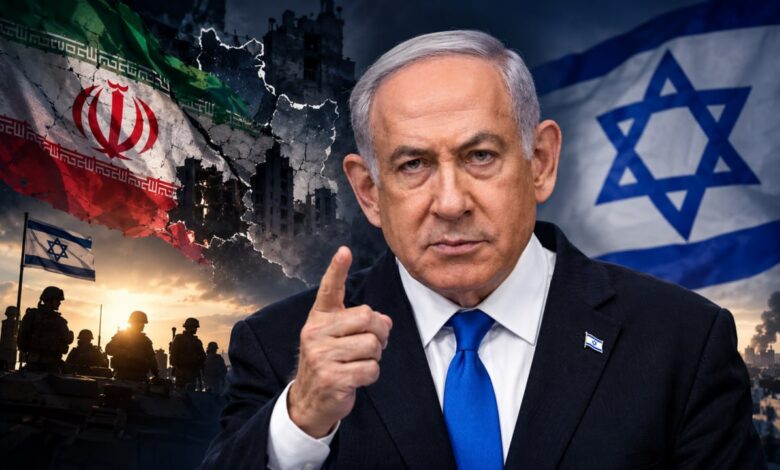
Benjamin Netanyahu, Prime Minister of Israel, once again declared the overthrow of the Islamic Republic as one of Israel’s main objectives, stating that Iran’s government will fall. Speaking at a ceremony honoring distinguished members of the Shin Bet, he emphasized that Israel will continue its operations against the Islamic Republic alongside ongoing measures against Hamas in Gaza and Hezbollah in Lebanon. Netanyahu said that a large portion of the planned actions have been carried out, but work still remains.
Benjamin Netanyahu, Prime Minister of Israel, on Thursday, September 17, at a ceremony honoring distinguished personnel of Israel’s domestic security agency, the Shin Bet, held at the residence of Israel’s President in Jerusalem, once again spoke of Israel’s objective to change the government in Iran.
In this ceremony, he said: “We will destroy Hamas and, above all, we will defeat the Iranian regime. We will overthrow it. It will fall. We will also deal with Hezbollah and it too will fall.”
These remarks were made in the presence of Isaac Herzog, President of Israel, and David Zini, chief of the Shin Bet.
Netanyahu also stated that the Islamic Republic’s desire and its allied forces’ intent to destroy Israel has not diminished, but according to him, their capability to achieve this goal has been significantly reduced.
He added that Israel has carried out the major portion of its planned operations, but there are still “tasks to be completed.”
The Israeli Prime Minister’s new remarks are the latest in a series of his statements in recent weeks about the overthrow of the Islamic Republic.
Netanyahu had also stated on September 6 that “the end of the Iranian regime is near” and that Israel is determined to complete its mission to overthrow it. At that time, he had described the Islamic Republic as a government fighting for its survival.
He had previously referred to the overthrow of Iran’s government as Israel’s “primary mission.” These statements indicate that regime change in Tehran has become one of the main pillars of the Israeli Prime Minister’s public positions in recent weeks.
In contrast, it should be noted that Netanyahu’s statements reflect the position and objective of the Israeli government, and the realization of such a goal depends on numerous political, military, and domestic factors.
Another part of the Israeli Prime Minister’s remarks focused on the Gaza war. Netanyahu, rejecting the notion that Hamas forces in areas controlled by the group are safe from Israeli attacks, stated that Israel will continue pursuing those it holds responsible for the October 7, 2023 attack.
He said Israel is “settling accounts” with the perpetrators of the October 7 attack and stressed that no one will be immune from Israeli pursuit.
These remarks were made as, according to a report by Times of Israel, Israeli attacks on Hamas forces in Gaza have continued even during ceasefire periods, and these attacks have become one of the points of contention between Israel and the US-backed “peace delegation,” an entity working to advance Donald Trump’s plan for Gaza’s future.
In his remarks, Netanyahu viewed confrontation with the Islamic Republic, Hamas, and Hezbollah as parts of a broader confrontation.
From the Israeli government’s perspective, the Islamic Republic and its allied armed groups in the region are considered threats related to Israel’s security. In his recent remarks, Netanyahu has also emphasized that the capability of the Islamic Republic and its allied forces to threaten Israel has diminished, but Israel still pursues objectives to complete its military operations.
This approach is being presented at a time when any escalation in confrontation between Israel, the Islamic Republic, and Tehran’s allied forces could have broader consequences for civilians in Iran, Israel, Lebanon, and Gaza.
While Netanyahu has emphasized the continuation of military operations, the human costs and regional conflicts remain one of the main concerns.
Continued attacks in Gaza, confrontation with Hezbollah in Lebanon, and direct or indirect confrontation with the Islamic Republic increase the risk of escalating the scope of war. In such circumstances, protecting civilian lives and adhering to international humanitarian law are of particular importance.
For the Iranian people as well, the issue is not merely the future of the Islamic Republic’s government; rather, any escalation in military confrontation could directly affect the lives of citizens, civilian infrastructure, and public security.
Netanyahu’s latest remarks show that the Israeli government continues to present regime change in Iran within the framework of its objectives and places this alongside the continuation of operations against Hamas and Hezbollah.
However, there is a considerable gap between stating a political objective and achieving it. The future of the Islamic Republic and Iran’s political structure will ultimately be affected by a set of internal and external factors, and statements by Israeli officials alone do not determine the outcome of this process.
In this context, for the Iranian people, preserving civilian lives, freedom of conscience and religion, human dignity, and the right to self-determination regarding their political future are of fundamental importance—rights that must be respected independent of military developments and interstate competition.