Death Sentence Issued for Mohammad Naderi; Execution Order Overturned for Arghavan Fallahi
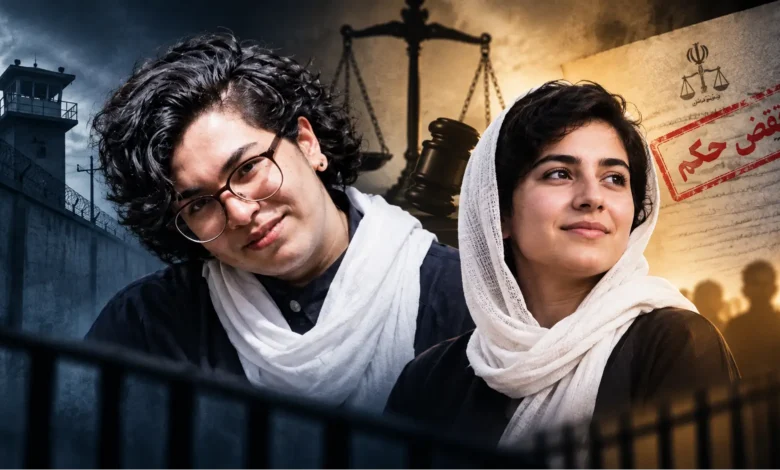
While Mohammad Naderi, a prisoner held in Tehran’s Greater Prison, has been sentenced to death by Branch 23 of Tehran’s Revolutionary Court on charges of “espionage,” in another case, the death sentence of 24-year-old political prisoner Arghavan Fallahi has been overturned following the acceptance of a retrial petition by the Supreme Court, with execution suspended. These two cases have once again drawn the attention of human rights organizations to the judicial proceedings in security and political cases in Iran.
According to reports released by human rights organizations, Mohammad Naderi was arrested coinciding with security developments related to the Iran-US-Israel conflict and transferred to Tehran’s Greater Prison. Branch 23 of Tehran’s Revolutionary Court has sentenced him to death on charges of “espionage.” However, the precise details of the charges, the evidence cited by the court, the proceedings, and the status of his access to a lawyer of his choice have not been disclosed to date.
This sentence was issued at a time when, in recent months, security-related charges of espionage have been brought against numerous detainees, and human rights organizations have expressed concern about the judicial process in such cases. Regarding Naderi as well, independent and public information about the evidence upon which the court based its death sentence is not available.
In another case, 24-year-old political prisoner Arghavan Fallahi, who was previously sentenced to death by Branch 15 of Tehran’s Revolutionary Court, headed by Abolghasem Salavati, on charges of “moharebeh” (enmity against God), now faces suspension of execution. The Supreme Court, in the retrial phase, has accepted the objections and appeals raised regarding the case and overturned the death sentence. The case must now be sent for renewed review to an equivalent branch of the Revolutionary Court, and acceptance of the retrial does not mean the end of the case or dismissal of charges against Fallahi.
This development occurred after Fallahi’s death sentence had been upheld in Mordad by Branch 41 of the Supreme Court, and a previous retrial request had been rejected. Recent reports indicate that the retrial request was reviewed once more, and this time the objections raised regarding the case were accepted.
Arghavan Fallahi was arrested in Bahman 1403 and transferred to Ward 209 of Evin Prison. Human rights sources have reported accounts of her being held in security detention facilities and pressure to extract confessions; claims for which independent reports on the details have not been released by the judicial authorities of the Islamic Republic.
Fallahi’s case is also linked to the killing of Mohammad Moghisseh and Ali Razini, two judges of the Supreme Court. According to released reports, she was arrested following this incident, and the charge of “moharebeh” was brought against her in her case. Her lawyer has also stated that no weapons were found on Fallahi.
As a result, the fate of the two prisoners now lies in two different judicial paths: Mohammad Naderi’s death sentence has been issued by the Revolutionary Court and the details of the evidence remain unavailable to the public; in contrast, Arghavan Fallahi’s death sentence, which had previously been upheld, has been overturned in the retrial phase and its execution remains suspended pending renewed review. Both cases have emerged in an environment where the use of security charges and issuance of severe sentences against prisoners continues to be one of the most important issues of concern for human rights organizations regarding the state of human rights in Iran.