Arrest of Hamid Rahmani-Monshadi, Attorney and Law Professor at Yazd University
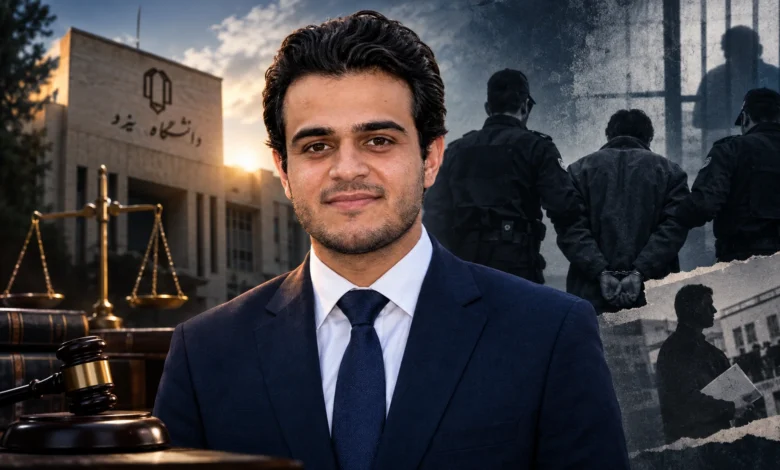
Hamid Rahmani-Monshadi, an attorney and law professor at Yazd University, has been detained by security forces approximately two weeks after being summoned and appearing in court. There is currently no information available regarding his detention location and condition. Human rights reports indicate that he was arrested following his protests and revelations about the conduct of university officials and the Yazd judicial system, and has been deprived of contact with his family and access to legal counsel during this period—a situation that has intensified concerns about violations of defense rights and the independence of the legal profession in Iran.
Hamid Rahmani-Monshadi, 45, is an attorney, researcher, and faculty member in the law department at Yazd University. According to Hengaw’s report, he was summoned to court from mid-September 2026 following his protests and disclosures about the conduct of university and judicial officials in Yazd, and was arrested after appearing before the judicial authority.
This legal scholar was detained by security forces in Yazd approximately two weeks ago, following his court appearance, and to date no information has been released regarding his place of detention. Hrana has also announced that the reason for his arrest and the charges against him remain unclear.
Another report published by the Human Rights Organization in Iran states that Rahmani-Monshadi was arrested after attending a preliminary hearing and charge briefing session, with the initial charge against him described as “propaganda activity against the system.” The source also noted that he was transferred to the General Office of Information of Yazd Province for interrogation.
Published reports on the background of this case link Rahmani-Monshadi’s detention to his protests and critical statements regarding the conduct of some officials at Yazd University and the judicial system of the province.
A source close to the case who spoke with “Voice of Iran’s Detainees” claimed that prior to his arrest, he had criticized and made disclosures about the conduct of some university administrators and Yazd judges on social media and in university circles. Certain aspects of these claims, including details about the individuals criticized, cannot be independently verified.
Conversely, judicial authorities have not yet released official and complete details about the charges, case documents, and the basis for his detention.
One of the most significant concerns regarding the situation of this law professor is the ongoing lack of information about his detention location. Rahmani has been deprived of phone contact, family visits, and access to legal counsel for approximately two weeks following his arrest. His family has also been pressured and threatened to refrain from speaking to the media about his condition.
Hrana has confirmed his deprivation of family visits and access to legal counsel, but has not released further information about the reason for his arrest and his detention location.
The Human Rights Organization in Iran has also stated that he is being held in the Yazd Information Office detention facility; however, these details have not yet been officially confirmed by authorities.
According to Hengaw’s report, following the arrest of this attorney, some of his property was seized and his family has been subjected to security pressure to prevent them from reporting on his condition.
In another report, it has been claimed that Rahmani’s family has been threatened to remain silent about the case. These claims have been attributed to informed sources and no independent official clarification has been issued regarding them.
Pressure on the families of detainees, in addition to affecting the detained individual themselves, can also limit the possibility of reporting on their legal and physical condition.
The case of Hamid Rahmani-Monshadi is significant in another respect as well: he is himself an attorney and law professor—that is, someone whose profession and expertise are directly related to law, litigation, and the right to defense.
The United Nations Basic Principles on the Role of Lawyers emphasize that arrested individuals must have access to legal counsel without delay, and states must create conditions enabling lawyers to perform their professional duties without intimidation, obstruction, or unwarranted interference. These principles also emphasize confidential and effective access of the arrested person to legal counsel.
Therefore, the deprivation of an arrested person from communication with legal counsel and family, particularly at the interrogation stage, raises serious concerns about the possibility of effective defense and adherence to fair judicial proceedings.
As of the publication of this report, human rights sources have provided varying accounts of the case details. Hrana stated that charges remain unspecified, while “Human Rights in Iran” announced the initial charge as “propaganda activity against the system.”
Under such circumstances, definitively attributing a crime to an individual who has not yet been tried is inconsistent with the presumption of innocence. If charges exist against Rahmani-Monshadi, judicial authorities must declare them transparently, provide him access to legal counsel, and allow the case to be examined in a fair judicial process.
The arrest of a law professor and attorney, if connected to his professional and academic criticisms, raises serious questions about the environment for academic and professional activity in Iran.
A university should be a place for discussion, research, and critique, and a court should be a place for law enforcement and ensuring the right to defense—not a place where an individual is arrested without transparent notification after being summoned to explain his views or activities.
Of course, one cannot make a definitive judgment about the precise motivation for Rahmani-Monshadi’s arrest without access to the case file and official documents. What is now clear is the approximately two-week detention, the lack of information about his detention location, deprivation of family visits, and concerns about his access to legal counsel.
A society that respects the law allows lawyers to defend the rights of their clients and law professors to raise questions and criticisms about the conduct of public institutions. Hamid Rahmani-Monshadi is now in the position of an individual whose family is unaware of his detention location and condition, and effective access to legal counsel and family has not been reported for him.
Now his family, students, and colleagues of this law professor are awaiting clear answers to several questions: What exactly is he charged with? Where is he being held? What is his physical condition? And why, after approximately two weeks, has effective communication and access to his family and legal counsel not yet been provided?