Unprecedented Letter from IRGC to American People; From Call to Separate from Israel to Claims of Decisive Victory in War
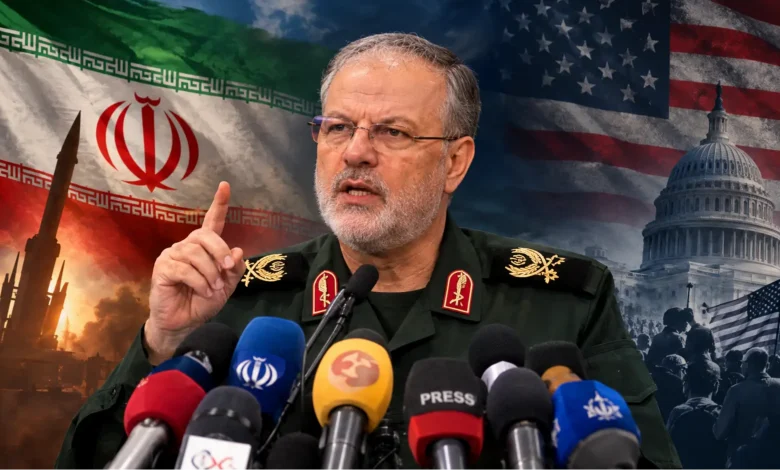
The Islamic Revolutionary Guard Corps (IRGC) has released a detailed and unprecedented letter addressed to the American people, in which it presents its own narrative of a seven-month war with the United States and Israel, calling on Americans to separate their accounts from Israel and U.S. government policies, and claiming that the Islamic Republic has achieved “decisive victory” in this conflict. The letter, whose text was published today, contains a collection of political, military, historical, and economic claims about Iran and America, and concludes by calling on the American people to change their country’s policies through pressure on the government and Congress.
At the beginning of the letter, addressing “the noble people of the United States of America, scholars, students, and media professionals,” the IRGC has claimed that seven months ago, the U.S. military launched a war by attacking Iran, and according to the IRGC’s account, a school in Minab was targeted, killing 168 students, and simultaneously the office of Ayatollah Ali Khamenei came under attack, and he and members of his family, including his 14-month-old grandson, were killed.
The IRGC has also claimed that during the war, more than 3,600 people, mostly civilians and including 400 children, have been killed, and eight universities, three hospitals, and eight schools have also been targeted. These figures and narrative represent the IRGC’s position and are presented in the letter as the basis for arguing Iran’s “victory.”
The IRGC subsequently claimed that America and Israel, despite extensive attacks, have failed to achieve their objectives, writing: “America and Israel have suffered a devastating defeat and the Islamic Revolution has achieved decisive victory.” In explaining this claim, the organization listed objectives that it says were put forward by America after the start of the war, including regime change, the dismemberment of Iran, unconditional surrender, the occupation of Khark Island, a ground invasion, the destruction of industrial and energy infrastructure, control of the Strait of Hormuz, prevention of Iran’s imports and exports, destruction of Iran’s nuclear, missile, and drone capabilities, and the end of Tehran’s support for allied regional groups, and stated that America has not achieved these objectives.
In another section of the letter, the IRGC claimed that more than 200 drones, 12 tanker and transport aircraft, 30 fighter jets, at least one AWACS aircraft, dozens of helicopters, radar and air defense systems, and more than 350 units of facilities and infrastructure of U.S. military bases were destroyed during the war, and the operational capability of 18 American bases in the region has been almost eliminated. The IRGC also claimed that for the first time it has taken operational control of the Strait of Hormuz, pushed the U.S. Navy back into the Indian Ocean, Iran’s missile and drone capabilities have not been destroyed, and the country’s air defense has been strengthened throughout the war. These military claims are presented in the letter and are not independently documented within the text.
The IRGC has also viewed the war as a factor in increasing Iran’s internal cohesion and claimed that the American and Israeli attack has strengthened national identity, increased support for the Islamic Republic, and deepened support for groups referred to as the “Axis of Resistance.” In this section, the letter claims that Iran’s position in global public opinion has increased and has even claimed that “Iran has found a much loftier place in the hearts of the peoples.”
One of the main themes of the letter is an attempt to explain what the IRGC calls Iran’s “victory.” In this narrative, the main reason for the Islamic Republic’s success is not merely missiles and drones, but three factors: “The school and monotheistic worldview of the Quran,” “the faith and unity of the people around this school,” and “divine leadership.” The IRGC subsequently presented the Islamic Republic as a system based on justice, freedom, equality, and the struggle against oppression, and used religious concepts and figures such as the Prophet Muhammad, Imam Ali, Imam Hussein, Abbas, and Zainab to explain its intended culture of resistance.
In another section, the IRGC directly praised Mujtaba Khamenei, the current leader of the Islamic Republic, introducing him as a “worthy and virtuous leader” and the principal factor in Iran’s victory. The letter lists five characteristics for the Islamic Republic’s leader—”scholarship and wisdom, justice, piety, awareness of contemporary issues, and courage”—and claims that these criteria exist in the Islamic Republic’s leadership. The IRGC has also introduced Ayatollah Ali Khamenei as a leader who, according to this organization, after 37 years of leadership has enjoyed widespread support among the people.
In contrast, the letter presents a very harsh narrative of the U.S. government and Donald Trump, viewing the performance of America’s political leadership as the principal factor in that country’s defeat. In parts of the letter, the IRGC has described Trump and the U.S. government in very strong language, claiming that American decisions are influenced by personal interests, wealth, and Israeli interests. Within this framework, the letter claims that the U.S. military, due to a lack of worthy leadership in past wars ranging from Vietnam and Afghanistan to Iraq and Yemen, has been defeated, and now too has been defeated against Iran.
The IRGC then addresses one of the letter’s key themes: the slogan “Death to America.” This organization claims that this slogan is not directed at the American people, but rather targets the oppressive rulers of the White House. The letter states that the people of Iran and America are, in a sense, victims of the policies of American rulers, and the IRGC attempts to make a distinction between the American people and the government of that country.
In this section, the IRGC has made numerous claims about conditions inside America, including that America, with approximately four percent of the world’s population, holds approximately 20 percent of the world’s prisoners, over 1,300 people are killed annually in police shootings, and American society faces deep divisions and disagreements. The letter also speaks of poverty, war expenses, inflation, unemployment, housing costs, and America’s economic problems, claiming that a large portion of American taxpayers’ money is spent on wars and military support for Israel.
Subsequently, the IRGC presented a long list of what it calls “73 years of oppression and crimes by the American government against the Iranian people,” ranging from the 1953 coup and American support for the Pahlavi regime through the 1979 revolution, the hostage crisis at the American embassy, the Iran-Iraq War, American attacks on Iranian oil platforms, the downing of an Iranian civilian airliner, economic sanctions, the assassination of Qasem Soleimani, and recent military attacks.
The IRGC has also held America responsible for supporting groups opposed to the Islamic Republic and for creating media networks and psychological operations against Iran. Many of these points are presented in the letter as a single political narrative from the perspective of the Islamic Republic.
The IRGC subsequently addressed America’s history of interventions in various countries around the world, citing examples such as Japan, Korea, Vietnam, Cambodia, Afghanistan, Iraq, Syria, and Libya. In the section on Palestine, the letter has made American support for Israel one of the principal focuses of its criticism, presenting statistics on deaths in Gaza, destruction of homes, schools and hospitals. This section of the letter holds Israel responsible for crimes against Palestinians and considers America responsible for the consequences of those crimes due to its financial and military support for Israel.
Another detailed section of the letter is devoted to the question of whether the IRGC is “terrorist.” The IRGC has rejected this designation and introduced itself as a popular institution created to protect the Islamic Revolution. The letter states that the reason for the IRGC’s inclusion on America’s list of terrorist groups is, according to this organization, its role in confronting American and Israeli policies in the region. The IRGC has also claimed that it is itself one of the world’s largest forces fighting terrorism.
In the economic section, the letter identifies the cost of American wars as one of the factors weakening that country’s economy, and by referring to U.S. government debt, the costs of the wars in Afghanistan and Iraq, military presence in various parts of the world and foreign bases, claims that enormous resources from the American economy have been devoted to military interventions instead of production and services. The IRGC has also noted the increase in American crude oil production and exports, viewing it as a sign of changes in that country’s economic structure.
The IRGC subsequently criticized America’s domestic and foreign policies and claimed that the U.S. government, instead of focusing on problems such as inflation, housing, and health care, has been preoccupied with secondary issues and foreign wars. In the letter, the wars in Afghanistan and Iraq are cited as examples of costly wars without benefit, and their several-trillion-dollar costs are noted.
Another claim in the letter is that America is losing its global standing and the era of this country’s unmatched superpower status is coming to an end. Within this framework, the IRGC compares China’s development in areas such as artificial intelligence and quantum technology to America’s military costs and problems, concluding that the continuation of current policies will weaken America’s economy and international standing.
In another section, the IRGC has questioned America’s policy on Iran’s nuclear program and, referring to the JCPOA and previous claims by American officials about Iran’s nuclear program, has argued that claims of an Iranian nuclear threat have been used to justify pressure and military attack. The IRGC has also claimed that Iran is not seeking to build nuclear weapons and cited Ayatollah Ali Khamenei’s fatwa on the prohibition of nuclear weapons.
In the final section, the letter’s tone shifts from explaining the IRGC’s positions to directly appealing to the American people. The IRGC calls on Americans to use elections and social pressure to change government and congressional policies and to distance themselves from war and military support for Israel. The organization also calls on Americans to review military bases abroad, war expenditures, and financial support for Israel, and to redirect financial resources to domestic research, production, and services.
In this section, the IRGC, citing passages from the Old Testament and the Gospel as well as the Quran, has emphasized the concept of changing the destiny of nations and tells Americans that responsibility for changing their country’s conditions rests with themselves. The letter also identifies anti-war protests and university protests in America as a sign of awakening public opinion in that country.
Finally, the IRGC clearly calls on the American people to “separate your account from the occupiers of Palestine” and writes: “We can have peaceful coexistence with one another.” Subsequently, using language that is very harsh against the U.S. government, it calls on people in that country to change their leaders and warns that the continuation of current policies could have serious consequences for America.
The letter concludes by emphasizing the Islamic Republic’s opposition to what it calls “oppression, aggression, and tyranny” and by referring to the fact that all of this will end with the awaited appearance of Christ and the Mahdi, it calls on the American people to stand alongside what the IRGC calls the “front of the oppressed and justice-seekers.”
Thus, the IRGC’s letter is not merely a message about the recent war, but rather a collection of the Islamic Republic’s historical narrative about Iran-America relations, a defense of the IRGC’s performance and the Islamic Republic system, an attack on the policies of the U.S. and Israeli governments, and a direct appeal to American society to change Washington’s foreign policy. Reuters has also reported that this 25-page letter was released ahead of American midterm elections and the IRGC called on American voters to reject Donald Trump’s administration’s policies.
In a section of the letter presented as the main message to the American people, the IRGC writes: “Those who can change this ill fate are you, the people of America. Separate your account from the occupiers of Palestine who, willingly or unwillingly, must leave there and return to their countries. We can have peaceful coexistence with one another.” It then adds: “The world has changed, the people of the world have awakened, the era of plundering nations’ wealth by force is over. This century is the century of the triumph of the people’s will.”
This letter has been released at a time when war and direct confrontation between Iran and America remain a principal issue of regional tensions, and the claims made by the IRGC regarding the extent of damage inflicted on American forces, the number of casualties, control of the Strait of Hormuz, and the ultimate outcome of the war are presented in the letter without providing independent documentation. On the other hand, Reuters has reported that the IRGC in this message emphasized that if America changes its policies, Iran seeks peaceful coexistence with the American people.