Amid Iran’s Economic Crisis, Judiciary Chief Reframes Women’s Hijab as a “Security Issue”
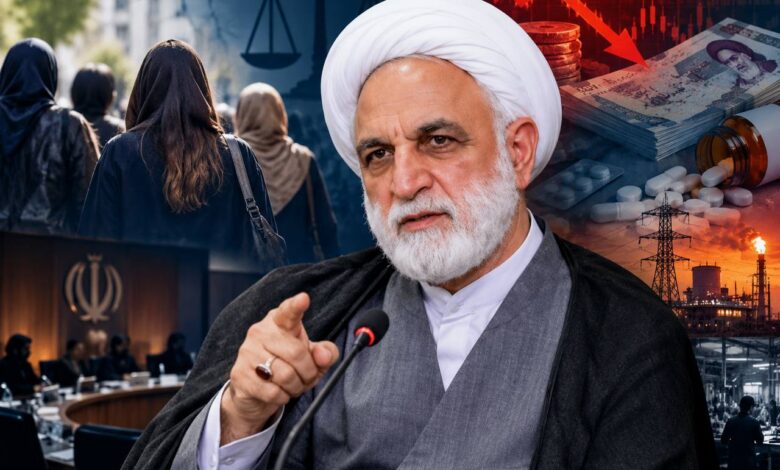
While Iran’s economy struggles with severe inflation, a collapsing rial, drug shortages, an energy crisis, and sharply declining production, the head of the Islamic Republic’s judiciary has once again elevated the issue of women’s dress code to a security matter. Gholamhossein Mohseni Ejei has asked the country’s prosecutor general to place combating women’s voluntary hijab on the agenda of the security council, stating: “What is necessary is to end this chaos.”
On Monday, September 28, 2026 (6 Mehr), Ejei described women’s voluntary dress as “nakedness” in a meeting with judicial officials and claimed that all people are concerned about it—a claim unsupported by any independent survey or data. He also asked the prosecutor general to seek assistance from law enforcement, the Ministry of Interior, and prosecutors across Iran to combat this situation, saying there should be no fear of “mob rule and chaos.”
These remarks come as Iran’s economic and livelihood problems have cast a more pronounced shadow over citizens’ lives than ever before. According to a report by the British House of Commons Library, Iran’s annual inflation rate reached 84 percent in August 2026, and the rial’s value has plummeted to its lowest historical level. The same report documents ongoing electricity cuts, fuel problems, and a decline in the country’s economic activity.
The health sector also faces a concerning situation. In September, Al Jazeera reported that approximately 800 medications in Iran face shortages, with around 90 of them considered essential and life-saving drugs. Some drug prices have multiplied within a year, including a 220 percent increase in gabapentin prices and a 375 percent increase in acetaminophen prices.
According to officially released data, Iran’s economy contracted by 10.1 percent between March 21 and June 20, 2026, compared to the same period last year. The oil and gas sector declined by 26.4 percent during this period, while the industrial and mining sectors saw a 14.7 percent drop.
Despite these conditions, a significant portion of the government apparatus continues to dedicate considerable judicial and security resources to controlling women’s dress. This is not a new phenomenon. Human Rights Watch has documented that the Islamic Republic has in recent years pursued women and girls who reject mandatory hijab, confiscated their vehicles, closed their businesses, and employed surveillance tools and city cameras to identify women without mandatory hijab.
Simultaneously, pressure to enforce mandatory hijab has not been limited to Ejei’s statements. In September, Islamic Republic officials announced the drafting of new mandatory hijab guidelines in universities, and an official close to the Supreme Leader’s office at universities stated: “Existing regulations must be enforced with greater rigor.”
Even during wartime, the hijab issue has not disappeared from the agenda of some Islamic Republic officials. Gholamali Haddad-Adel, a member of the Expediency Discernment Council, previously acknowledged that due to “wartime conditions,” the government currently cannot engage on the “hijab front” as much as it would like—remarks suggesting that women’s dress code remains a matter for government and cultural pursuit in the view of parts of the power structure.
In contrast, human rights organizations regard mandatory hijab as an issue related to women’s fundamental rights. UN experts previously warned about the repressive enforcement of Iran’s hijab laws and stated that punishments and forced measures against women who do not comply with the government’s required hijab constitute violations of women’s and girls’ rights.
Now Ejei’s new statements raise a serious question anew: In a country where families face food inflation, drug shortages, electricity cuts, the collapse of the national currency’s value, and declining purchasing power, why is enforcement against women’s voluntary dress code again being pursued at the level of the security council and judicial apparatus?
For many critics of the Islamic Republic, the issue is not merely hijab; the issue is what the government considers “necessary.” At a time when economic data reveals one of the most difficult periods in contemporary Iranian economics, senior judiciary officials’ insistence on intensifying measures against women’s clothing choices once again highlights the question: Is the power structure’s priority solving people’s everyday problems, or controlling their lifestyle?
Ultimately, what is happening on Iran’s streets is not merely a disagreement over a type of clothing. Many women have openly stood against mandatory hijab in recent years, and the government, rather than accepting this choice as part of individual freedom, continues to use law, police, courts, and security mechanisms to impose it—an approach that has faced severe criticism from international human rights bodies.