Government Plan to Distribute Meat to “Special Groups”
While Iranian officials are telling families not to worry about securing red meat, media outlets continue to report long queues at meat purchase points. Meanwhile, a senior official has announced a new government plan to restrict meat distribution.
Shortage of livestock due to smuggling to neighboring countries, reduced slaughter rates, and activities by so-called “middlemen,” according to officials, are cited as the main reasons for disruption in the red meat distribution system and the formation of long queues for buying frozen meat in Iran.
Meanwhile, Morteza Rezaei, Deputy Minister of Agriculture for Livestock Production, has recently announced a new government plan for “restricting the distribution of lamb meat to a specific segment of society.”
Emphasizing that this issue is currently under government review, he added: “Perhaps the regulated market meat that reaches consumers at specified prices will be limited to a specific segment of society and will be made available to them through food baskets or shopping cards.”
The Deputy Minister of Agriculture did not announce the implementation timeline for this plan but said he hopes decisions will be made before Nowruz 1398 (March 2019).
“Families Rush”
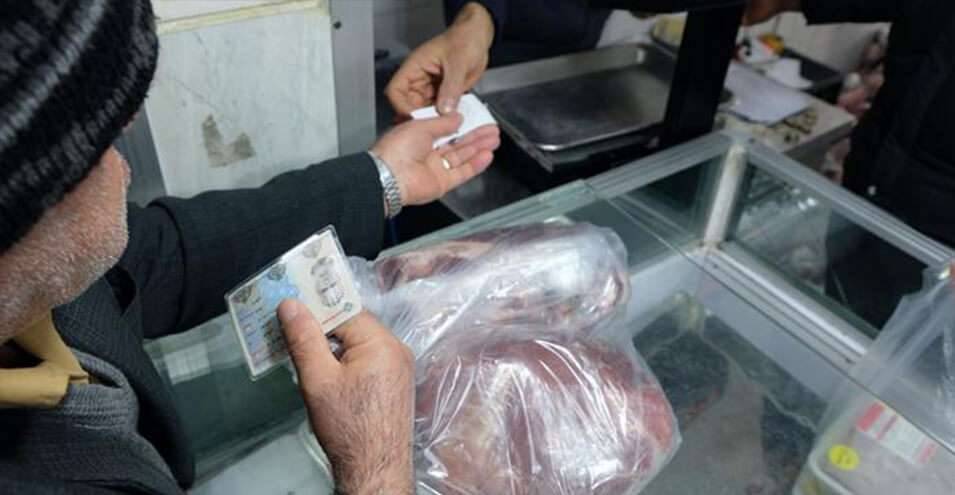
Low-income families in recent weeks, with a sudden increase in meat prices at shops and butcheries, have turned to buying government-subsidized frozen meat at “penalty rates.” Meanwhile, officials have asked families not to “rush” to frozen meat distribution stores.
Executive officials, to clear the round-the-clock queues for government meat purchases that sparked public protests, announced an online sales plan for regulated market meat. This plan went into effect as of today, Bahman 18, and families can order Brazilian frozen meat monthly according to their postal code at a price of 28,500 tomans per kilogram and receive it at home the next day. The Iranian government believes that by changing the method of purchasing and delivering essential goods, it is replacing traditional methods with online markets for buying, selling, and distribution.
The objective of the online meat sales plan has been announced as improving public welfare, preventing the formation of long queues, and preventing middlemen activities.
Meat Queues on Revolution Anniversary
Iranian media in recent weeks published numerous news reports and images of families waiting in line to buy frozen meat, which sparked reactions on social media and during Friday prayer sermons.
Mohammadmahdi Hosseini-Hamedani, the Friday Imam of Karaj, addressed government officials during last week’s Friday prayer and asked whether it is fitting for people to stand in meat queues.
According to Tasnim News Agency, he, noting “whether it is fitting for people to stand in meat queues on the anniversary of the revolution,” said: “Several years ago, as the revolution approached victory, they distributed food baskets that were very poor quality, and it is not a good thing. All of this undermines the revolution and must be corrected.”
Ahmad AmirAbadi, a member of the Presiding Board of the Majlis, also attributed the presence of “discrimination” and other problems to the dissatisfaction of “the Iranian people.”
This Qom representative, who, according to Tasnim News Agency, was discussing “achievements of the Islamic revolution,” did not consider the long meat queues to be “befitting” the country and said: “Instead of addressing economic problems such as meat prices, the government prides itself on the fact that people can buy meat online.”
Red Meat Imports from Five Continents
Executive officials have consistently told the public that the country has “no” problems securing essential goods. They have asked families to refrain from “rushing” to stores selling subsidized meat.
Ali Reza Rafiei-Pour, head of the Veterinary Organization of Iran, has assured the public not to worry about securing red meat supplies because very soon the meat consumed by Iranians will be imported not only from Brazil but from five continents.
So far, 145,000 tons of meat have been imported into the country, and by the end of 1397 (March 2019), this will reach 240,000 tons. According to the head of the Veterinary Organization, the country’s need for red meat is 140 to 150,000 tons, and imports of 170 to 180,000 tons are sufficient for the country.
He predicts that by the end of 1397, more than 240,000 tons of red meat will be imported into the country.
Meat Production Decreased, Livestock Smuggling Increased
The favorable price of livestock in Iran compared to neighboring countries and the weakening of the Iranian rial’s value in recent months have, according to Iranian officials, created high “pressure” for illegal exports and smuggling of livestock.
Officials say that although livestock smuggling does not reach zero, they hope that with a new government resolution and cooperation from border guards and law enforcement, they can significantly prevent livestock smuggling to neighboring countries to prevent market disruption.
Agriculture officials hope that with these new regulations, many livestock breeders will turn their attention inward instead of toward the “profitable” markets of buyer countries and “align their expectations with the government’s budget.”
Regarding this, Rezaei, Deputy Minister of Agriculture for Livestock Production, said: “The livestock and red meat market in the country has been hit with a price stick, and livestock prices have risen given the demand that exists outside the country, and livestock owners are not willing to easily sell their products at lower prices.”
Although Hassan Rouhani’s government has repeatedly said it is not facing “shortage or famine of red meat.”
Based on Iran’s Statistical Center, comparing the performance of Iranian slaughterhouses in autumn 1397 with the performance of the same season in 1396 shows a 20 percent decrease in red meat production at official slaughterhouses inside the country.
Middlemen for Restaurants and Kebab Shops
The government’s red meat distribution plan, according to some claims, has fallen victim to “hidden hands” directing and distributing government meat toward restaurants.
The head of the Butchers’ Union of Mazandaran is not the only one making this claim. Behrouz Talebian, head of joint price control inspections and judge of branch 46 of Tehran Province, holds a similar view.
In recent days, one ton of subsidized meat stored in a store was identified by joint price control inspections. According to Behrouz Talebian, further investigations showed that these imported frozen meats were stored for sale to kebab shops and restaurants.
The warehouse owner claims he buys regulated market meat from meat middlemen at produce markets for 48,000 tomans and sells it with only a 1,000 toman profit.
Reformation of “Anti-Price Gouging Committee”
The Tehran Prosecutor’s Office announced that it is increasing its supervision teams for the distribution of four items: meat, poultry, fruits, and dairy products.
Abbas Jafari Dolatabad, the Tehran Prosecutor, in a conversation with Tehran Radio announced the formation of an “anti-price gouging committee” aimed at preventing hoarding of essential goods and preventing rent.
The formation of this committee for many Iranians recalls the years of the Iran-Iraq War, rationing days, and the coupon system for items and the posting of banners against hoarders in the 1360s Hijri solar calendar.