Cyrus the Great: God’s Anointed Servant, King of Persia and the Narrative of Freedom
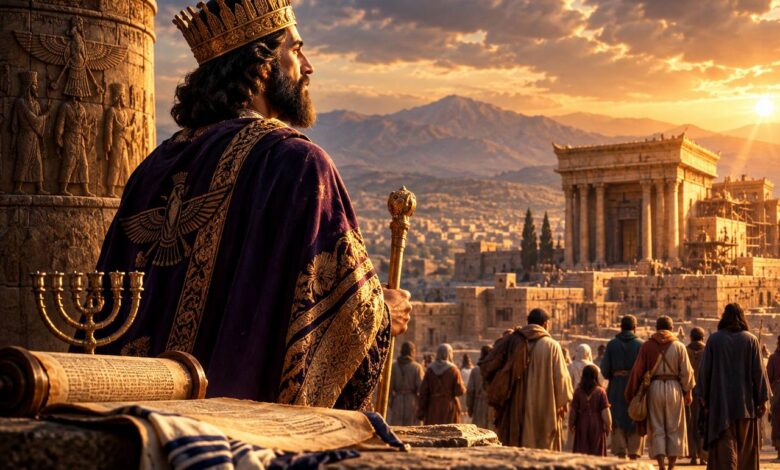
November 29th marks the commemoration of Cyrus the Great, an opportunity to revisit the legacy of one of the most influential kings in Iranian history and to examine his unprecedented place in the Holy Scripture; a monarch whom the Book of Isaiah calls “the Lord’s anointed” and whose name is intertwined with the liberation of Jewish exiles and the reconstruction of the Temple of Jerusalem.
November 29th is recognized by many Iranians as the day commemorating Cyrus the Great; a king who in the sixth century BCE laid the foundation of the Achaemenid Empire and became one of the enduring figures of ancient world history. The name of Cyrus holds a special place not only in Iranian history but also in the Holy Scripture; a matter that makes his historical legacy noteworthy for Christian readers as well.
The significance of Cyrus for Christians is not limited merely to his political power and the extent of his empire. What makes his name prominent in sacred texts is the role he played in the Biblical narrative of liberating the Jewish people from exile and creating the conditions for the reconstruction of the Temple of Jerusalem; a role that is explicitly linked to God’s will in the Book of Isaiah.
Cyrus, “God’s Anointed” in the Book of Isaiah
One of the most striking references to Cyrus in the Holy Scripture appears in Isaiah Chapter 45, Verse 1, where God speaks of Cyrus, the King of Persia, and calls him “His anointed one.” In Isaiah 44:28, Cyrus is also referred to as the “shepherd” of God; one who is to play a role in fulfilling God’s will, including the reconstruction of Jerusalem and the building of the Temple.
This description holds special significance from a Biblical perspective, because Cyrus was not a king from among the people of Israel, yet in Isaiah’s narrative he is chosen to fulfill an important mission in the history of the Jewish people. This text demonstrates that in the Biblical view, God can use rulers and nations outside the people of Israel to accomplish His will.
Of course, the title “God’s anointed” in this passage should not be equated with the status of Jesus Christ in Christian faith. This expression regarding Cyrus refers to his special mission in the narrative of the Book of Isaiah and does not mean introducing him as the Messiah or Savior in Christian belief.
Cyrus’s Edict and the Return of Jews from Exile
In the Book of Ezra, Chapter One, it is narrated that Cyrus issued an edict by which the exiled Jews were able to return to Jerusalem and rebuild the House of God. The Book of Ezra narrates this event within the framework of fulfilling God’s word and enabling the reconstruction of the Temple.
The conquest of Babylon by Cyrus in 539 BCE was a turning point in the history of the ancient Near East. His policies in administering diverse territories and his treatment of the nations under his rule are important aspects of the historical examination of the Achaemenid period. The Biblical narrative also presents, from this same era, a portrait of a king whose decisions made possible the return of a group of exiles and the reconstruction of their sacred place.
From this perspective, the name of Cyrus in the Holy Scripture is linked to concepts such as return, reconstruction, and the revitalization of religious life. This matter reminds the Christian reader of the importance of freedom of worship and the ability to live according to religious beliefs; values that in today’s world are also considered important topics of human rights and freedom of conscience.
Cyrus’s Legacy and the Values of Freedom and Tolerance
Cyrus the Great in the historical memory of Iranians is a symbol of the glory of ancient Iran and the formation of one of the greatest empires of the ancient world. In contemporary interpretations of his legacy, concepts such as tolerance, justice, and respect for diverse nations have also gained prominence.
Nevertheless, a fair historical examination requires distinguishing between Biblical narratives, ancient documents, and contemporary interpretations of Cyrus’s character. His historical fame and special place in the Holy Scripture provide a basis for discussion about modes of governance, the responsibility of power, and treatment of nations; without necessitating that all contemporary interpretations about him be considered as definitive historical facts.
For the Christian community, this occasion is also an opportunity to reflect once again on principles that hold importance in the Holy Scripture: justice, responsible treatment of people, and respect for their relationship with God. The narrative of Cyrus in Isaiah is a thought-provoking example of the presence of a non-Israelite king in the narrative of the fulfillment of God’s will.
Crown Prince Reza Pahlavi’s Message on the Occasion of Cyrus Day
Crown Prince Reza Pahlavi has also released a message on the occasion of November 29th, the day commemorating Cyrus the Great, in which he emphasizes Iran’s historical identity and values such as freedom, tolerance, and justice. The text of this message is as follows:
“November 29th, the day commemorating Cyrus the Great, is a day of honoring the glory of Iran and the lasting values of freedom, tolerance, and justice that our nation has kept alive through the centuries.
The name and legacy of Cyrus is not merely a reminder of past glory for us, but rather a solid rock and a launching pad for achieving a better future, a future that according to our glorious history, we deserve.
It was based on this national awakening and recognition of historical identity that tens of thousands of patriotic Iranians, a decade ago, gathered on Cyrus Day in Pasargadae and marked a turning point in the struggle to restore Iran, laying the foundations of the national revolution of the Lion and the Sun with the desire to liberate Iran from the clutches of the tyranny of the age.
The Iranian nation, heir to Cyrus the Great, will not bow before despotism and will rebuild its homeland as a free, prosperous, and dignified nation.
May Cyrus the Great’s day be blessed, and may Iran endure.”
Cyrus: A Link Between Iranian History and Biblical Narrative
The commemoration of Cyrus the Great is not merely an opportunity to recall Iran’s past, but also provides a basis for reflection on the responsibility of rulers, freedom of conscience, and the place of justice in the life of nations. The presence of his name in the Holy Scripture, particularly in the Book of Isaiah and the narrative of the Jews’ return in the Book of Ezra, elevates the status of this Persian king beyond the realm of political history and transforms it into a matter worthy of attention in the study of religious history as well.
The Biblical narrative about Cyrus reminds us of the point that in the view of this text, God can act in history through figures outside the people of Israel. For the Christian reader, this narrative is an invitation to reflect on justice, freedom, and the responsibility of power; values that, beyond national and political boundaries, remain important in today’s world.
November 29th, the day commemorating Cyrus the Great, is an opportunity to revisit the legacy of ancient Iran and to reflect on a narrative that links the name of the Persian king with the liberation of a people and the reconstruction of their sacred place.