Bill to Prohibit Recording and Broadcasting of Confessions from State Radio and Television: Legal Vacuum or Non-Enforcement of Law
One month after the submission of the bill titled “Prohibition of Recording and Broadcasting of Confessions from State Radio and Television,” the fate of this bill remains unclear. The bill, drafted by Mahmoud Sadeghi, representative of Tehran, has not yet been placed on the agenda of the Islamic Consultative Assembly.
Abdolsamad Khormashahi, a lawyer in Tehran, in an interview with the Iran Human Rights Campaign considered this bill as emphasizing the implementation of the principles of the Constitution in order to protect citizens’ rights and the defense rights of the accused, and welcomes it. Nemat Ahmadi, a lawyer in Tehran, however, in an interview with the Iran Human Rights Campaign said that if those who acted contrary to the Constitution and the Code of Criminal Procedure by obtaining and broadcasting confessions from the media had been prosecuted, there would be no need for such bills now.
On October 29, 2019, Mahmoud Sadeghi, representative of Tehran and member of the Hope faction, announced the submission of a two-urgent bill to the presidency of the Islamic Consultative Assembly. The bill stipulates that “recording of confessions of individuals and broadcasting them from the Islamic Republic’s radio and television and other mass media at any stage of pursuit and preliminary investigations is prohibited, and the perpetrator, including the producer and broadcaster, in addition to being required to restore the dignity of the accused, shall be sentenced to imprisonment of 6 months to 3 years.”
If approved by the Assembly and confirmed by the Guardian Council, this bill stipulates that “if the recording or broadcasting is carried out by or at the order of officials or personnel affiliated with government institutions and agencies, the said official or personnel, in addition to the above penalty, shall be sentenced to dismissal from service and deprivation from government positions for 1 to 5 years.”
However, this bill only prohibits the recording and broadcasting of confessions from state radio and television and other media, and remains silent on obtaining such confessions. Nemat Ahmadi, legal expert and lawyer in Tehran, in an interview with the campaign said about this bill: “In Iran, we do not lack laws and legal vacuums; we always have a problem with the executors regarding the fact that the law is not enforced. The Code of Criminal Procedure does not allow even the names of individuals and the course of the case to be disclosed before finality. This is why it was initially intended to refer to the accused’s name or names in abbreviated form, for example A.B., and refrained from mentioning the full names of individuals. But unfortunately, the law is applied selectively.”
Mr. Ahmadi said: “According to the Constitution and the Code of Criminal Procedure, not only recording and broadcasting of confessions is a crime; obtaining a confession in front of a camera is itself a crime. We have a stage of preliminary investigation, meaning I commit a crime, the prosecutor announces the crime, and the investigating judge begins the investigation. Investigation means discovering the truth, not placing me in front of a camera to speak against myself, which, aside from being contrary to the Code of Criminal Procedure, is considered a form of torture according to multiple principles of Chapter Three of the Constitution. All the restrictions of Chapter Three of the Constitution are under the principles 19 to 40, which prohibit torture in any form, including coerced confessions, defaming a party, and playing with a person’s dignity, and it is contrary to law.”
In Chapter Three of the Constitution, which Nemat Ahmadi refers to, Article 37 states: “The principle is innocence, and no one is considered guilty in the eyes of the law unless their crime is proven in a competent court.” According to Article 38: “Any torture is forbidden to obtain confessions or information. Forcing a person to testify, confess, or take an oath is not permissible, and such testimony, confession, and oath are void and without legal value. Violators of this article shall be punished according to law.”
Article 39 of the same law also states: “Violation of the dignity and honor of anyone who has been arrested, detained, imprisoned, or exiled by order of law, in any form whatsoever, is forbidden and subject to punishment.”
Nemat Ahmadi, regarding the bill submitted by Mahmoud Sadeghi to the campaign, said: “As someone whose profession is law, I believe that bills in general are raw, hastily created, and the Assembly’s bills and legislation should be characterized by maturity and coherence. Parliament members at the end of each legislative term submit two or three such bills that, before being beneficial to the public interest, are a kind of controversy; otherwise, we have multiple principles of the Constitution, we have Article 90, and representatives can issue reminders, they can summon the Minister of Justice. Since the head of radio and television is chosen by the leader, you cannot want him removed, but representatives can use their current tools to implement the principles of the Constitution in preventing the obtaining, recording, and broadcasting of confessions.”
According to Article 90 of the Constitution: “Anyone who has a complaint about the proceedings of the Assembly or the executive or judiciary can submit their complaint in writing to the Islamic Consultative Assembly. The Assembly is obliged to investigate these complaints and provide adequate response, and in cases where the complaint relates to the executive or judiciary, it shall request adequate investigation and response from them and announce the result within an appropriate period, and in cases that relate to the public, it shall inform the public opinion.”
Abdolsamad Khormashahi, legal expert and lawyer in Tehran, however, has a different view. In an interview with the campaign, he said that the bill submitted to prohibit recording and broadcasting of confessions of individuals from state radio and television and other media is “an emphasis on the implementation of the principles of the Constitution.” Mr. Khormashahi says: “When President Rouhani presents the Charter of Citizens’ Rights or the judiciary itself presents the Citizens’ Rights Circular, they have nothing newer or greater than the Constitution. This bill is the same way, and in fact, this bill is a reminder, a warning, and an emphasis that the principles of the Constitution and the Code of Criminal Procedure be observed.”
Mr. Khormashahi considers the approval and implementation of this bill as protection of citizens’ rights and said: “When an accusation is not proven in court, aside from the fact that recording and broadcasting the accused’s confessions violates their defense rights, it has no result. There was perhaps a time when broadcasting confessions had some echo, but now the public opinion of society has reached the conclusion that if a person is accused, they should be tried in an impartial court while taking into account their defense rights, and as long as that person or accused has not been tried in an impartial court, if they say something against themselves, it may be against their will. That is, no reasonable person confesses against themselves unless they are under pressure. Such confessions have no positive effect on public opinion, and the bill to prohibit recording and broadcasting such confessions is a step towards protecting the rights of the accused and emphasizing our Code of Criminal Procedure and Constitution, which has prohibited torture under any name, whether psychological or physical, and makes clear that accused persons should not be forced by physical and psychological coercion to confess and admit guilt. In particular, Article 91 of the Code of Criminal Procedure explicitly states that the publication of images and other characteristics related to the identity of the accused at all stages of preliminary investigations by media and administrative and judicial authorities is prohibited.”
In the preamble to his bill submitted to the presidency of the Assembly, Mahmoud Sadeghi wrote: “Pursuant to Article 39 of the Constitution, violating the dignity and honor of anyone arrested, detained, imprisoned, or exiled by order of law, in any form whatsoever, is forbidden and subject to punishment. On this basis, judicial authorities and law enforcement officers are obliged to respect the dignity and honor of persons who have in any way been suspected of accusation and subjected to interrogation and investigation. Unfortunately, it is sometimes seen that the Islamic Republic’s radio and television take the initiative to broadcast the confessions of individuals who are under suspicion of accusation or interrogation, which may later, after further investigations and judicial consideration, prove their innocence. This act, in addition to violating the dignity of individuals, causes serious damage to public trust and the credibility of government institutions in the eyes of public opinion. The present bill, in order to prevent and counter this action, has prohibited the recording and broadcasting of confessions and has established appropriate criminal enforcement guarantees similar to those in comparable criminal regulations.”
He clarified that this bill “has nothing to do with broadcasting open court sessions for investigating economic crimes; it relates to the confessions of the accused during the interrogation stage, that is, before the court stage, and its subject is usually political and security accusations. Such as the ‘Assassination Club’ documentary about the confessions of nuclear scientists’ assassins that was broadcast from the Islamic Republic of Iran’s television on August 15, 2012, and it was recently revealed that those accused were innocent and those confessions (apparently except for one case) were all false.”
In recent months, the arrest of several Iranian citizens accused of involvement in the murder of nuclear scientists in Iran in 2012 has become one of the crises of Iran’s intelligence agencies. Maziar Ebrahimimi, one of these individuals, on August 12 this year disclosed torture during his detention in front of the BBC Persian television camera. He, who now lives outside Iran, spoke in front of the television camera about prolonged torture and his forced confessions and those of other innocent citizens who were arrested by the Ministry of Intelligence officials as suspects in the nuclear scientists’ assassination case and were eventually released after several years. Following Maziar Ebrahimimi’s revelations, some Assembly members called for the Ministry of Intelligence to account for itself and apologize to the detainees.
The Islamic Republic of Iran’s Radio and Television Organization violates the rights of detainees, especially arrested protesters and political activists, in violation of Iran’s laws and international laws that guarantee due process, prohibition of coercion, and prohibition of torture. Detainees, usually under torture or threats to themselves or their relatives, are typically forced to “confess” to crimes, and radio and television films these forced confessions and usually broadcast them from their television networks for the purpose of intimidating and humiliating individuals. These “confessions” are part of a conscious effort to discredit and defame protesters, human rights defenders, and activists. Radio and television, working hand-in-hand with interrogators and security, intelligence, and judicial officials, conduct, film, and broadcast these false confessions that are continuously documented by victims and numerous witnesses. These forced confessions then become the primary “evidence” that is usually presented in courts to convict targeted individuals, usually to different crimes.
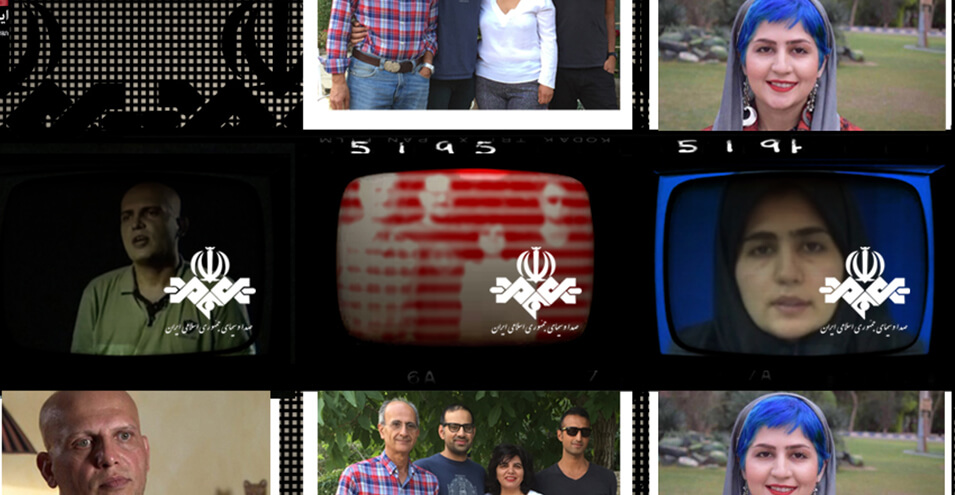
Following the submission of the bill prohibiting recording and broadcasting of confessions of individuals from radio and television in the Assembly, “confessions” of two detainees from radio and television have been broadcast in recent days. Ruhollah Zam, director and founder of the AmadNews website and channel, and Sahar Tabar, an Instagram personality. Both are prisoners whose forced confessions were broadcast by radio and television.
The radio and television program “Twenty and Thirty” broadcast Ruhollah Zam’s confessions on October 25 and 26, and the Islamic Revolutionary Guards announced his arrest on Monday, October 24. Nemat Ahmadi told the campaign: “We do not yet know what charges Mr. Ruhollah Zam faces and which legal articles he is subject to, but we see his confessions on radio and television, which violates multiple legal principles.”
“Confessions” of Fatima Kh, known as Sahar Tabar, an Instagram personality, were however broadcast on Tuesday, October 30, in the form of a report with the title “Frankly on Culture” from the “Twenty and Thirty” program of radio and television. Nemat Ahmadi told the campaign: “These programs and confessions have no impact on the case of these individuals. The nature of such case formation is inherently unique and special. They want to scare the domain of society through these kinds of confessions, but someone who manipulates their appearance—which of the laws of society have they violated? That someone goes and gets cosmetic surgery, and we also arrest them and place them in front of a camera asking why did you perform cosmetic surgery? Now this lady has come, she performed some form of cosmetic procedure—where does the law say it is a crime? Does the procedure itself have a problem? Whether in the direction of beautification or uglification. On the other hand, publishing content on social networks can be a crime only when it contains a criminal act, for example, publishing false information or causing disturbance. This lady’s work does not fall under any of these and does not correspond to any of them. And it seems that there is some kind of misapplication in applying the subject to law. And it seems to me that some people have been grabbed by the collar with a kind of poor taste in applying the subject to law.”
Nemat Ahmadi added that “from the beginning, there was no dealing with those who committed these acts, namely obtaining and broadcasting forced confessions, so it does not repeat. In the case of serial murders, they dealt with the person who broadcast the tape, not with the one who committed those tortures and obtained confessions in that manner. Since there is no dealing with these individuals, these acts are repeated.”
Source: Iran Human Rights Campaign