Halloween from a Christian Perspective: Why Many Christians Don’t Participate in the Festival of Darkness
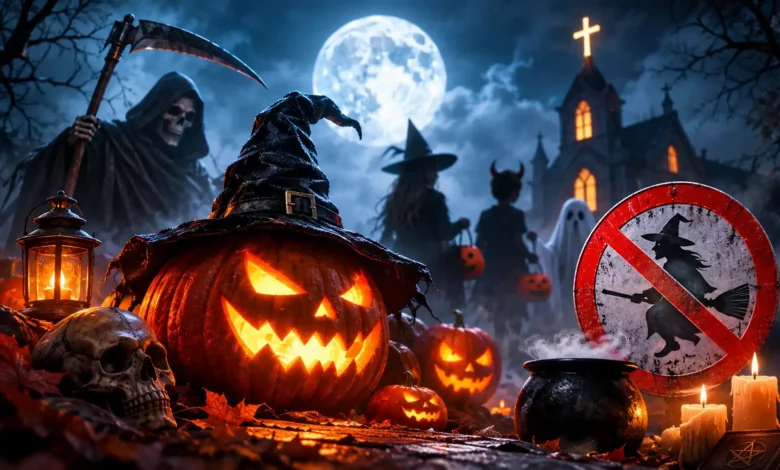
October 31st, known as Halloween in many countries around the world, is accompanied by frightening costumes, symbols of death, ghosts, witchcraft, and ceremonies centered on fear and supernatural matters. But where did this occasion come from, and why do many Christians prefer not to participate in it?
Halloween is celebrated every year on the night of October 31st in various countries around the world. On this night, children and adults dress up as frightening characters, imaginary creatures, witches, and ghosts, decorating homes and streets with symbols such as carved pumpkins, skeletons, ghosts, and images related to death. Children go from house to house in their neighborhoods and receive candy by saying “Trick or Treat” to their neighbors.
Although Halloween has become a cultural and commercial occasion in many countries today, a significant part of its common symbols and activities revolve around themes such as fear, death, ghosts, and witchcraft—topics that have raised serious questions for many Christians about their compatibility with Christian faith.
What is Halloween and where does its name come from?
The word “Halloween” is a shortened form of the English phrase “All Hallows’ Eve,” meaning “the night before All Saints’ Day.” In the tradition of the Western Church, November 1st is recognized as All Saints’ Day—a day to honor the saints and commemorate their lives and faith. For this reason, the night before it, October 31st, became known as “All Hallows’ Eve,” and gradually the word “Halloween” took shape.
On the other hand, in historical and cultural narratives, Halloween has been linked to the ancient Celtic festival of “Samhain,” particularly in Ireland and parts of Britain. This observance was associated with the end of the harvest season and the beginning of winter. In some folk traditions, there existed beliefs about the drawing near of the living and the dead and the presence of spirits on this night.
Nevertheless, scholars do not completely agree on the extent and manner of the direct influence of the Samhain festival on modern Halloween. What is clear is that today’s Halloween is a combination of historical traditions, folk beliefs, cultural elements, and commercial entertainment, and its present form cannot be attributed entirely to a single origin.
Why are many Christians opposed to Halloween celebrations?
For many Christians, the main issue is not simply wearing different costumes or attending a party; rather, it is the spiritual content and symbols that are highlighted in certain aspects of the Halloween celebration.
In Christian faith, God is the source of life, love, and light, and followers of Christ are called to distance themselves from darkness, evil, and anything that draws them away from God. For this reason, many Christians view participation in ceremonies that turn witchcraft, summoning spirits, communication with the dead, worship of dark forces, or glorification of evil into entertainment as incompatible with the teachings of the Bible.
In the Book of Deuteronomy, Chapter 18, Verses 10-12, God’s people are forbidden from practicing witchcraft, divination, and summoning spirits. Similarly, Ephesians 5:11 states: “Do not participate in the unfruitful deeds of darkness, but instead expose them.”
From the perspective of this group of Christians, belief in Jesus Christ is incompatible with normalizing or praising symbols of evil and darkness. They believe that followers of Christ should remain faithful to their faith values in their choice of activities and cultural participation.
Do all Christians boycott Halloween?
The answer to this question is no. The views of churches and Christian families regarding Halloween are not uniform. Some churches and Christians completely refrain from participating in its common celebrations; others distinguish between purely recreational aspects, such as wearing costumes or children’s games, and activities related to witchcraft and the supernatural.
In contrast, some churches organize events called “Light Parties” on the same night to provide a joyful and family-friendly atmosphere, but centered on God’s love, hope, and the message of Jesus Christ for children and families.
Nevertheless, a common thread among many of these approaches is the emphasis on the principle that no social custom or celebration should overshadow the place of faith and the teachings of Christ in the life of a believer.
What is Christianity’s message in the face of darkness?
At the heart of Christian faith lies the victory of light over darkness—a light that Christians recognize in the person of Jesus Christ. In the Gospel of John, Chapter 8, Verse 12, Jesus says: “I am the light of the world. Whoever follows me will never walk in darkness, but will have the light of life.”
This message reminds Christians that the faithful response to fear, death, and darkness is not to engage with them or to praise evil forces, but to trust in God, to live in the light of Christ, and to spread love, hope, and truth.
From this perspective, October 31st can be an opportunity to reflect anew on the meaning of everyday choices and faithfulness to one’s beliefs. Christians opposed to Halloween remind us that following Christ is not limited to verbal confession alone, but also manifests itself in the way of life, values, and even in the choice of entertainment.
In today’s world, Halloween is merely a recreational and cultural occasion for many people; but for many Christians, its symbols and certain aspects of its common practices do not align with the teachings of the Bible. They prefer to focus not on celebrating fear, death, and darkness, but on the light, life, and hope they have found in faith in Jesus Christ.
Christianity’s message is a call to live in the light—a light that, Christians believe, darkness will never overcome.
John 1:5: “The light shines in the darkness, and the darkness has not overcome it.”