Conflicting news about the impending execution of Mohammad Reza Haddadi
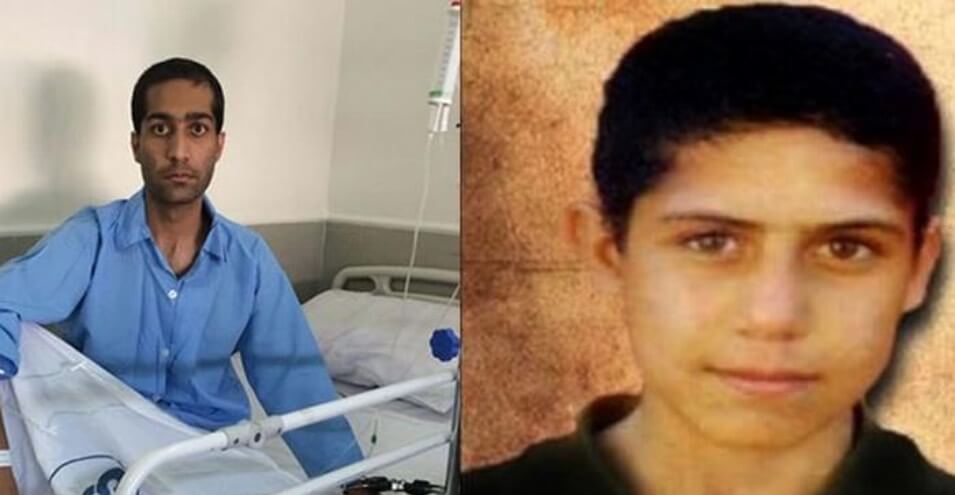
Mohammad Reza Haddadi's father has announced the imminent execution of his son. Amnesty International and Haddadi's lawyer, in an interview with Deutsche Welle, believe that Haddadi's case is still open after 17 years in prison and that the execution of the death sentence is unlikely.
Mohammad Reza Haddadi's father told Deutsche Welle on Monday, August 17: "My son called from prison and said he would be executed on Wednesday, August 19, and we could go see him for a farewell visit."
Mohammad Reza Haddadi is imprisoned in Adelabad Prison in Shiraz. He is accused of committing murder during a robbery in 2003. Haddadi was 15 years old at the time.
In his letter to the head of the judiciary on Monday, August 17, Mohammad Reza Haddadi wrote that at the age of 15, he was wrongly convicted of premeditated murder "due to his youth and naivety, and under the influence of economic problems and ignorance of the laws."
In part of his letter, he noted that after obtaining documents and evidence proving his innocence, he "requested assistance from the Supreme Court in accordance with the law, but his influence did not get him anywhere and remained fruitless."
Haddadi continued in his letter by mentioning that he had also delivered audio and video conversations and a notarized letter from the defendants in the case, who were tormented by conscience and confessed to telling the truth, "but hidden hands have cast a shadow over his case."
In his thesis, he called for the Chief of the Judiciary to intervene in his case, writing, "Before you carry out unjust retribution, the Chief of the Judiciary should personally intervene."
According to Iranian criminal law, it is possible to cancel a retribution sentence with the consent of the victim's parents, but Haddadi's efforts over the past 17 years to gain the consent of the victim's family have not been successful.
Given the defendant's young age (15 years old at the time of the crime), news about Haddadi's case has also been reported beyond Iran's borders, and international organizations, including the United Nations and Amnesty International, have repeatedly called on Iranian authorities to overturn his death sentence.
Raha Bahreini, a human rights lawyer and researcher on Iran at Amnesty International, told DW about the possibility of Haddadi's imminent execution: "As far as we know, Mohammad Reza Haddadi is not in imminent danger of execution. However, this young man has been on death row for 17 years for a crime he committed when he was under 18, and this shows the height of the cruelty of the juvenile and juvenile penal system in the Islamic Republic of Iran."
What does Haddadi's lawyer say?
Hossein Ahmadi Niaz, Mohammad Reza Haddadi's lawyer, also told Deutsche Welle that in 2017, he succeeded in stopping the execution of his client's death sentence through the then head of the judiciary.
According to the lawyer, the Fars Province Forensic Medicine Department has announced that through scientific medical examinations of Mohammad Reza Haddadi, they have concluded that he "lacked rationality and awareness of the importance of confessing to murder when he was young."
Despite this, Haddadi has been sentenced to death. What is the reason for that?
Ahmadiniaz says: "Unfortunately, only one of the judges of the branch, citing the forensic medical theory in the form of a minority theory, ruled to overturn the death sentence, and two others, citing the judge's knowledge, ruled to overturn the death sentence, saying that this verdict will be appealed again, which is currently being heard in one of the branches of the Supreme Court."
According to Mr. Ahmadi Niazi, one of the Iranian religious authorities has also requested a fatwa (request for a ruling) in accordance with Article 477 of the Criminal Procedure Code.
Haddadi's lawyer continued his speech to Deutsche Welle, saying that Haddadi's case has been referred to a team of judges in Fars Province for review and compliance by order of the Chief Justice, and that the case is in the process of being investigated, and that the execution of the death sentence is not correct. With today's follow-up by the team of lawyers in the case of Adel Abad Prison in Shiraz, the Fars Justice Department, and the Kazerun Prosecutor's Office, this news is completely denied and has no credibility.
Under international obligations under the Convention on the Rights of the Child, the imposition and execution of the death penalty for those who were under the age of 18 at the time of the crime is absolutely prohibited. Iran is among the last countries in the world that continues to issue sentences for juveniles.
Source: DW