Prosecutor's Insistence That Environmentalists in Prison Are Spies; Attempt to Influence Court's Verdict
A day after the Attorney General declared the eight imprisoned environmental activists to be “ definite ” of being spies, a source familiar with the case told the Campaign for Human Rights in Iran about the statement and the court proceedings so far : “It is shocking that the trial is still ongoing, no verdict has been issued, none of the charges have been proven, and many government agencies are speaking of the innocence of the detainees, while at the same time the Tehran prosecutor says these people are spies. Such statements are clearly political and are made to influence the court’s decision, but they have no credibility.”
He added: " The families of the prisoners seem to be in limbo. From yesterday until now, I think these words have been made in continuation of previous words to tell people that their arrest and detention for more than a year was the right and legal thing to do, and that some people's objections to their detention are wrong. "
The informed source said : " The families do not know anything about the progress of the cases. The children's lawyers only tell the families that everything will be fine, but we really do not know where this story will end and whether the lawyers have the necessary and adequate legal defense for their clients. Until the end of the trial, we will not really understand what is happening and why the authorities are so insistent on calling them spies when the trial has not yet ended and the defendants have not defended themselves ."
According to this source, some of the detainees require serious medical care in prison.
In a press conference on March 5, Attorney General Mohammad Jafar Montazeri said that the accusation of spying on environmental activists is " definite " and that they are awaiting the court's verdict .
The Attorney General of the country said in a brief statement : " As a prosecutor, considering the reasons and evidence, it is certain that they are spying." "And we are waiting for the court's investigation and verdict. " However, the Iranian prosecutor did not provide any explanation about the evidence and reasons that led to the certainty of espionage against these eight environmental activists.
So far, four closed court sessions have been held on February 10, 22, 23 and 24 for the reading of the indictment in Branch 15 of the Revolutionary Court, presided over by Judge Salavati. In her second court session, Ms. Bayani spoke of pressure and threats to force confessions. After that, two separate court sessions were held in closed court for Murad Tahbaz on February 25 and 26. And the first defense session of Niloufar Bayani on February 27 was not held due to the absence of the court advisor.
Previously, on December 28, 2018, Attorney General Montazeri had once again called the arrested environmental activists “agents of influence” and said that they were “agents of America and Israel.” However, at that time, he also claimed, without providing any evidence for his claim, that “evidence of their influence is fully available.” But he did not explain even a part of this evidence.
Four of the eight had their charges changed from espionage to the more serious charge of “ corruption on earth ” months after their arrest. On November 2, 2018, Tehran Prosecutor Abbas Jafari Dolatabadi responded to criticism from some officials, including members of parliament and the director of the Environmental Protection Organization, regarding the change in the title of the charge after nine months of temporary detention, saying that the judiciary and investigators can change the titles and charges at any time: “No one can criticize the prosecutor or investigators in this regard. ”
On November 2, Environmental Protection Agency head Issa Kalantari called the new accusation of corruption on earth against a number of arrested environmental activists an " allegation " that must be investigated.
While judicial authorities and hardline newspapers emphasize the espionage of these environmental activists, the Minister of Intelligence, the National Security Council, and the head of the Environmental Protection Agency have so far stated that there is no reason to accuse them of espionage and that they should be released.
In February 2018, MP Mahmoud Sadeghi announced in a tweet that the National Security Council had also not recognized the activities of these individuals as an example of espionage: "According to the information received, the Supreme National Security Council, after an expert review of the environmental defendants' case, has not recognized the activities of the defendants as an example of espionage."
Mahmoud Sadeghi had previously written on Twitter in April 2018 that the Minister of Intelligence had told them that they had found no reason to spy on the eight arrested environmental activists.
Also, Issa Kalantari, the head of the Environmental Protection Organization, said in June 2018: "Based on the determination of the four-member committee of the government board , the arrested activists should be released because there is no evidence to prove the accusations made against these individuals. "
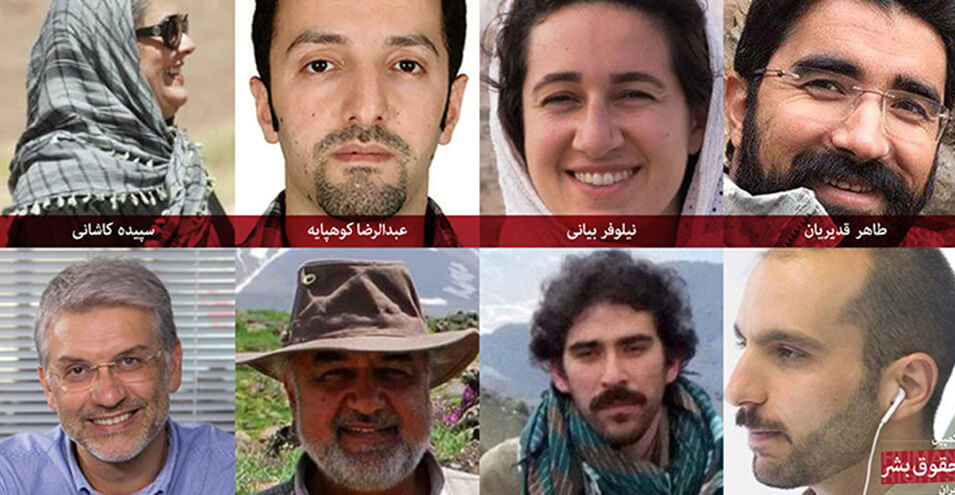
The late Kavous Seyed-Emami, Sam Rajabi, Hooman Jokar, Niloufar Bayani, Morad Tahbaz, Taher Ghadirian, Amir-Hossein Khaleghi, and Sepideh Kashani were employees and managers of the “Parsian Heritage Wildlife” Institute who were arrested on February 25 and 26, 2017. The Parsian Heritage Wildlife Office was also sealed after the arrest of Kavous Seyed-Emami and his colleagues on February 25. Kavous Seyed-Emami died in his cell in Evin Prison two weeks later, and prison officials ruled it a suicide, but no direct investigation into the death of this university professor and environmental activist in women was ever conducted. The rest of these individuals remain in detention and occasionally have phone calls with their families and in-person visits with prison officials.
Source: Human Rights Campaign