The image of Jesus Christ on burnt bread, a surprising discovery of everyday faith in early Christianity
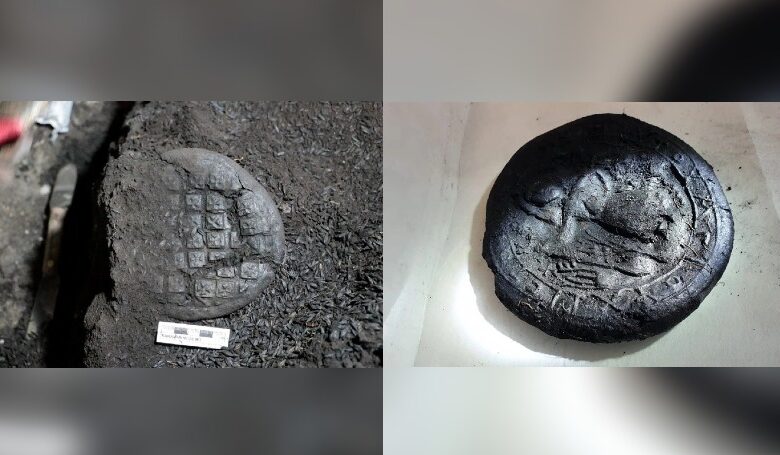
The discovery of burnt bread in Anatolia, with the image of Jesus Christ and the Greek phrase "Thanks be to the blessed Jesus," offers a new look at the connection between faith, work, and daily life in the early Christian era.
Archaeologists during recent excavations at the Toprak Tepe site in the ancient region of Isauria in southern Anatolia (present-day Turkey) have made an exceptional discovery: five burnt loaves of bread dating back to the 7th to 8th centuries AD.
One of these loaves features a striking image of Jesus Christ as a farmer or sower, a rare interpretation of Jesus' face that shows him not as a ruler but as a humble worker.
On the surface of this bread is engraved a Greek inscription that translates as: "With thanks to the blessed Jesus."
According to the archaeological team, this phrase is an indication of the ritual use of bread in early Christian worship. It is likely that these loaves were used as Eucharistic Bread or “prayer bread.” The other four loaves also bear the motif of a cross, consistent with the liturgical traditions of the Byzantine Church.
The extraordinary preservation of these charred loaves makes them among the rarest known examples of religious bread in the entire Mediterranean. Experts say the discovery could transform our understanding of the worship rituals, economic life and beliefs of Byzantine Christian villagers.
"The depiction of Christ as a sower is a metaphor for the connection of faith with work and the fertility of the land," says Dr. Alexandra Metsou, an expert on early Christian rituals from the University of Athens. "In the agricultural culture of that time, this image was a symbol of divine blessing for people's daily efforts."
The ancient site of Ernopolis, where the loaves were discovered, was an important ecclesiastical center under the control of Constantinople during the Byzantine era. However, little remains of the daily lives of its people. The discovery of the Topraktepe loaves now provides researchers with the first physical evidence of the domestic and rural worship of early medieval Christians.
Scholars believe that the bread was not simply food, but a sacred element of the Eucharist, a symbol of the body of Christ, used in Eastern churches with leavened bread (symbol of the resurrection) and in Western churches with unleavened bread. Some of the bread may also have been distributed to the faithful as antidoron, meaning blessed but unsanctified bread.
From a historical perspective, the survival of actual bread from the 7th or 8th century AD is extremely rare. Most previous knowledge of bread rituals in early Christianity came from texts and paintings. This discovery is the first material evidence of those rituals in a rural context.
Dr. Harun Demir, head of the excavation team, says: "These loaves show that for the Christians of that time, faith was not something separate from daily life, but rather the memory of God was revived in every bite of bread."
From the perspective of Christian experts, the discovery of bread bearing the image of Christ the worker and sower also has a clear message for our time: "Faith and work, prayer and effort, are twins of each other." In an era when bread and earth were the source of life, this image of Jesus Christ was not only a symbol of the salvation of the soul, but also a sign of blessing in daily work and toil.
The discovery of the Topraktepe loaves is a reminder that in the history of Christianity, faith was not only manifested in the altar of the church, but also in the hands of the farmer, in the smell of fresh bread, and in the simple lives of the village people. This rare find builds a bridge between faith, livelihood, worship, work, and Christ with the common people, a bridge that, after thirteen centuries, still rises from the ground to say, from the tongue of burnt bread, “Thanks be to the blessed Jesus.”