Iran protests IAEA Director General's visit to Israel; Khatibzadeh: Revival of JCPOA is "available and possible"
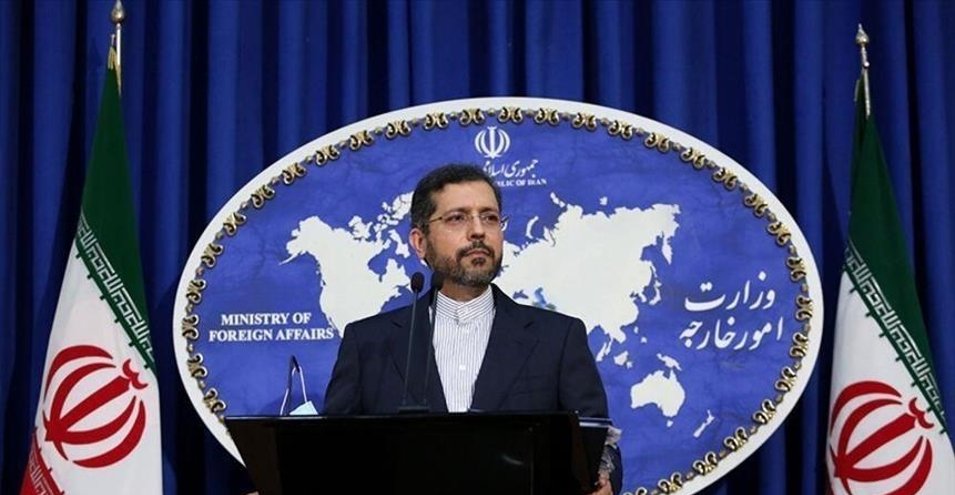
The spokesman for the Islamic Republic's Ministry of Foreign Affairs stated that the Board of Governors' resolution "created a disruption in the path defined between Iran and the Agency," describing it as a "political action" that Iran "certainly" could not leave unanswered.
On Monday, June 13, Saeed Khatibzadeh also referred to the visit of Rafael Grossi, Director General of the International Atomic Energy Agency, accusing him of "placing this structure at the disposal of Israel as an agent" and claimed that "the achievements in the field of safeguards have been discredited by the Director General of the Agency himself."
Khatibzadeh also accused Grossi of "changing his tone" and considered it a sign of "taking orders from a center," saying: "We certainly could not leave this non-technical political action of the agency unanswered. We took our actions within this framework."
Stating that "the actions taken by Iran were decisive and proportionate," he added: "Even if they say that the resolution was a formality and a recommendation, if there was no need to implement the resolution, they would definitely have had to take a different path."
The Iranian Foreign Ministry spokesman also emphasized that an agreement to revive the JCPOA is still "available and possible," and made it conditional on the United States doing two things, saying that if the United States "gets past the illusion of leverage" and agrees to fulfill its obligations "under the JCPOA and UN Security Council Resolution 2231," "we can go to Vienna tomorrow and finalize the agreement."
This week's media conference by Khatibzadeh also had another side effect, which some journalists interpreted as a "men's guidance patrol."
A reporter at the meeting criticized the presence of senior military officials of the Islamic Republic of Iran at the Russian embassy and their queuing to shake hands with the country's ambassador, and announced that the Ministry of Foreign Affairs security told him that he would not be allowed to enter the ministry building starting next week because he was wearing short-sleeved clothing.
Following last week's Board of Governors resolution condemning Iran for concealing the presence of uranium particles in undeclared locations, Iran announced last Thursday that it would disconnect and remove 27 of the Agency's "super-device" cameras from their installation sites.
According to Rafael Grossi, Director General of the International Atomic Energy Agency, these cameras, which are installed at various nuclear facilities, including "Tehran, Isfahan, Natanz, and other locations," and their disconnection would pose a "very serious challenge" to the ability of this United Nations monitoring body to verify Iran's compliance with its nuclear commitments, and would have consequences.
Israeli Prime Minister Naftali Bennett also said on Saturday that Iran is "dangerously" completing its nuclear weapons program and that if the West does not stand up to the "regime," the Islamic Republic will soon obtain a nuclear bomb.
Source: Voice of America