54 writers and artists inside and outside the country protest the prison sentences of three writers
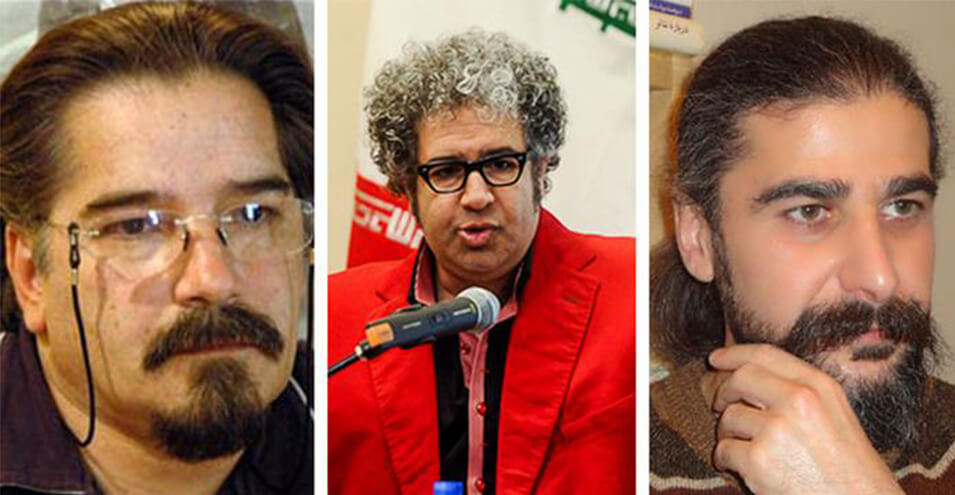
More than 50 writers and artists inside and outside the country have protested the prison sentences handed down to three Iranian writers. Reza Khandan (Mahabadi), Keyvan Bajan, and Bektash Abtin, members of the Iranian Writers' Association, have been sentenced to a total of 18 years in prison.
In continuation of the protests against the 18-year prison sentence for Reza Khandan (Mahabadi), Bektash Abtin, and Keyvan Bajan, 54 writers and artists from inside and outside the country have jointly protested against this sentence and, while condemning the "security clashes" with the writers, have demanded the cancellation of the prison sentences of these three members of the Iranian Writers' Association.
The Iranian Writers' Association has also published this statement on its Telegram channel and has posted an internet address for visiting and signing a protest petition.
Reza Khandan (Mahabadi), Keyvan Bajan, and Bektash Abtin are three writers who have each been sentenced to six years in prison. The verdict against these three writers by Branch 28 of the Tehran Revolutionary Court was communicated to their lawyers, Nasser Zarafshan and Razieh Zaidi, on May 15.
“Another sign of increasing threats and pressure”
The statement by 54 writers and artists, the text of which was published today, Wednesday, July 31, on the Telegram channel of the Iranian Writers' Association, states, among other things, about these sentences: "Although the issuance and execution of such sentences is not uncommon, examining the reasons for this new case is another sign of increasing threats and pressure on writers."
The authors of the statement added: "If publishing a magazine, writing a book, and visiting the graves of writers and artists are considered security crimes, as has been the case with these three writers, then at the discretion of the security and judicial institutions, a criminal will be "discovered" in every independent writer."
The protest statement further considers “securitizing the field of literature and art” as destroying the security of activists in this field and destroying “its little remaining strength and power,” and continues: “If this is not important to those in power, it is important to us, the writers and audiences of free literature; it is important that we do not have the sword of Damocles hanging over our heads, the sentence of imprisonment, detention, and exile; it is important that the creators of literature and art are people who enjoy freedom of expression; because creativity flourishes in the realm of freedom.”
54 writers and artists living inside and outside the country have finally joined these three writers and members of the Iranian Writers' Association in protesting the court's verdict, condemning the "security clashes" with the writers and demanding the cancellation of the sentences issued to Bektash Abtin, Keyvan Bajan, and Reza Khandan (Mahabadi).
Babak Ahmadi, Hassan Asghari, Ali Babachahi, Parviz Babaei, Mohammad Reza Bateni, Rakhshan Bani-Etemad, Bahram Beizaei, Khosrow Parsa, Jafar Panahi, Ahmad Puri, Alireza Jabbari, Shapour Jorkesh, Amir Hasan Cheheltan, Farkhunde Hajizadeh, Hassan Hessam, Mohsen Hakimi, Nasim Khaksar, Ismail Khoei, Khashayar Deyhimi, Mohammad Rasoulov, Ghasem Rubin, Fariborz Raisdana, Naser Zarafshan, Fereshteh Sari, Mohammad Ali Sajjadi, Jalal Sarfaraz, Faraj Sarkouhi, Enayat Samiei, Seyed Ali Salehi, Farzaneh Taheri, Abdol Ali Azimi, Mehdi Ghobraei, Morad Farhadpour, Mohammad Qaed, Azita Ghahraman, Iraj Kabuli, Mehrangiz Kar, Yurik Karim Masihi, Leili Golestan, Shahla Lahiji, Shams Langroodi, Javad Mojabi, Mohammad Mohammad Ali, Abbas Mokhbar, Akbar Masoombeigi, Shahab Moqrabin, Esfandiar Monfaredzadeh, Hafez Mousavi, Nemat Mirzazadeh (M.Azeram), Jamal Mirsadeghi, Mojtaba Mirtahmasb, Manijeh Najm Iraqi, Mohsen Yalfani, and Saeed Yousef are the signatories of this protest statement.
Wave of protests
Shortly after the three writers were sentenced to a total of 18 years in prison, a large group of 894 Iranian writers, poets, critics, and journalists wrote a letter to the officials of the Islamic Republic's executive and judicial systems, expressing their "explicit protest" against the "unfair practices of the judicial system and security measures against writers and writers" and calling for the cancellation of the "unjust and freedom-killing" sentences against three members of the Iranian Writers' Association.
The World PEN Association also expressed concern about the trial of these three members of the Iranian Writers' Association on May 4, before the court's verdict was issued. The international organization considered the trial of these writers to be "politically motivated" and called it a "clear violation of their right to freedom of expression."
Reza Khandan (Mahabadi), Keyvan Bazhan, and Bektash Abtin have each been sentenced to one year in prison on charges of “propaganda against the regime” and five years in prison on charges of “gathering and colluding with the intention of acting against the security of the country.” Of course, this is a verdict from the lower court, and the defendants have appealed the verdicts against them.
In an interview with Deutsche Welle Farsi on May 16, Reza Khandan (Mahabadi) described the rulings issued by Judge Mohammad Moghiseh, head of Branch 28 of the Tehran Revolutionary Court, as “even violating the laws of the Islamic Republic itself,” and attributed the issuance of such rulings to the “disgust and fear” of independent organizations by government officials. According to Mr. Khandan, the purpose of issuing these rulings is to “create fear and terror and intimidate others” and “counter protests and organizations” in Iran.
The author also said that the examples raised by the court regarding the charge of "propaganda against the system" were the publication of various statements by the Iranian Writers' Association throughout the life of the organization, as well as the very limited publication of a book titled "50 Years of the Iranian Writers' Association," of which only 30 volumes were published for internal use within the association.
According to Reza Khandan, the instance raised regarding "gathering and colluding with the intention of acting against the security of the country" was nothing more than participating in ceremonies such as the anniversary of the death of Ahmad Shamloo or the anniversary of the murder of Mohammad Mokhtari and Mohammad Jafar Poyandeh, two victims of political assassinations.
Mr. Khandan and Mr. Bazhan appeared before Branch 7 of the Evin Prosecutor’s Office in August of last year (2018) and were charged with “propaganda against the regime.” At that time, the two writers were summoned along with Bektash Abtin in connection with a case that the Ministry of Intelligence had opened against them in 2015. Then, in November of last year, the charge of “gathering and colluding with the intention of acting against the security of the country” was added to the previous charge.
On November 3, the investigator in the case of these three writers at Branch 7 of the Evin Prosecutor's Office increased the bail of Mr. Khandan, Bazhan, and Abtin from 50 million tomans to 100 million tomans, and the three were released on bail until the trial.
On February 2, 2018, Judge Moghiseh, while opposing their request to have their preferred lawyer present in court, changed the bail from 100 million tomans to 1 billion tomans for each of them. Thus, these three members of the Iranian Writers' Association were arrested and transferred to Evin due to their inability to provide bail. Ultimately, Reza Khandan, Bektash Abtin, and Keyvan Bazhan were released from Evin Prison on February 25, 26, and 29, respectively, after posting a bail of 1 billion tomans until the end of the trial.
Source: DW