Hundreds of telecommunications company employees strike in several Iranian cities
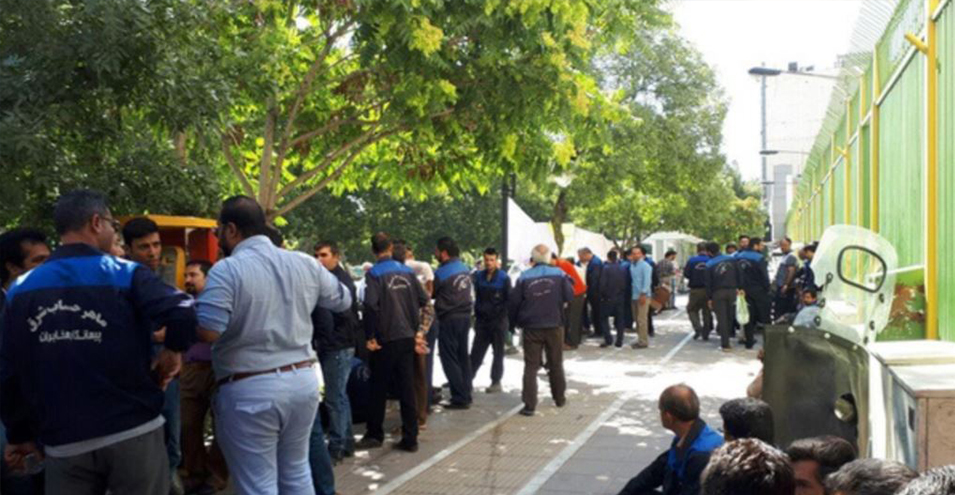
Hundreds of Iranian telecommunications company employees went on strike and gathered on Saturday and Sunday, July 10 and 11, in the cities of Mashhad, Hamedan, Shiraz, and several cities in Lorestan and Khuzestan provinces, demanding "the implementation of a job classification plan in telecommunications, the conclusion of direct contracts, and the provision of job security."
According to ILNA news agency, the strike and rally on Sunday in front of the telecommunications company buildings as well as the office of Ali Sari, a member of parliament in Ahvaz, was held in a situation where telecommunications company employees in Mashhad have been holding union protests for the past two weeks.
According to the report, the protesters, who are contractors with private companies and often work in the Kabul-based telecommunications network, said: "We will continue our protests until our demands are met."
According to ILNA, the protesters in front of the office of Ali Sari, a member of parliament in Ahvaz, announced the goal of the rally as "making more parliamentarians aware of the situation of telecommunications companies" and called on the representatives of the legislative branch to "roll up their sleeves and force the Iranian Telecommunication Company to implement the law."
In this regard, the Free Union of Iranian Workers reported that employees of the Mashhad air and land cable network gathered in front of the Khorasan Razavi Province Labor Department on Saturday.
According to the Ittehad website, which belongs to this labor organization, following the rally, representatives of the protesters, officials from the Telecommunications Department and the Labor Department of Khorasan Razavi Province negotiated, but the meeting ended without a clear result.
According to this report, officials from the Mashhad Department of Labor and Telecommunications attempted to end the strike by giving "verbal promises to the striking employees that they would cancel the warnings given to them, cancel the dismissals, and pursue their demands," but the striking employees announced that they would not stop the strike until "the promises made to address their demands are put into writing."
This is not the first time that Iranian telecommunications company employees have protested. Previously, Iranian telecommunications company employees have gathered in front of the parliament five times since 2015.
The Free Union of Iranian Workers noted that since then, employees of the Iranian telecommunications company have "received nothing but empty verbal promises to fulfill their demands for guaranteed job security and direct contracts," and that their representatives at the telecommunications company in Mashhad have also been "fired" during this time.
Previously, according to the state-run IRNA news agency, Mahmoud Vaezi, Minister of Communications and Information Technology, had said on June 6, emphasizing that the Iranian Telecommunication Company was privatized a long time ago and that its personnel issues have nothing to do with the Ministry of Communications and Information Technology, saying: "The Ministry of Cooperatives, Labor and Social Welfare has full supervision over the personnel issues of this company."
The Iranian Telecommunication Company was transferred in November 2009 based on Article 44 of the Constitution, and 50 percent of the shareholders of the Iranian Telecommunication Company are from the private sector.
According to Mahmoud Vaezi, the Iranian Telecommunication Company has a board of directors in which one of the five members is the government, and only 20 percent of its shares belong to the government.
In this regard, Salman Khodadadi, a member of parliament, told ILNA regarding these gatherings: "Based on the Civil Service Management Law, the government was supposed to assign its corporate employees by September 2016, but ultimately, after negotiations, it took a year to do this."
He pointed out that the government must submit a bill to the parliament by the end of September this year, specifying the duties of its contract and corporate workers, including telecommunications company employees.
The MP said: "It is not justifiable that in the same room, office, institution, organization, or ministry, two people do the same job; one is a contract worker and earns one million, while the other is an official and earns three or four million."
Source: Radio Farda