Haft Tappeh sugarcane workers' strike and march enters 38th day; still no one is held accountable
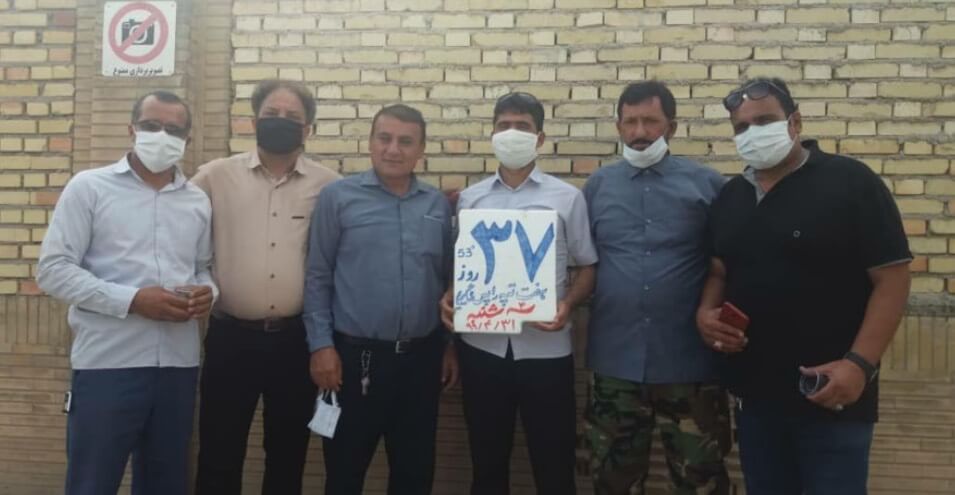
Workers at the Haft Tapeh sugar factory, who began their labor protests on June 16, have gone on strike for the 38th consecutive day.
According to published videos, they continued their strike on Wednesday, August 2, and marched in the city of Shush.
According to the Telegram channel of the Haft Tappeh Workers' Union, the protesting workers of the Haft Tappeh Sugarcane Factory held a protest rally in front of the Shush city governorate on Tuesday to protest the non-payment of four months of arrears and the failure to renew their medical records, and to demand the cancellation of privatization and the return to work of their dismissed colleagues, including Esmaeil Bakhshi and Mohammad Khanifer.
According to this report, despite the continuation of the protests, no response has been given by the authorities to the demands of the protesting workers of the Haft Tapeh sugar factory.
Once again, the Haft Tappeh Sugarcane Workers' Union has announced its support for the workers' demands and called for the demands of Haft Tappeh sugarcane workers to be addressed as soon as possible.
Previously, the Voice of America reported that on Tuesday, July 14, on the thirtieth day of the Haft Tappeh workers' protests, four protesting workers, named Yousef Bahmani, Muslim Cheshmkhavar, Ebrahim Abbasi Manjari, and Mohammad Khanifari, were arrested by the Susa Intelligence and Security Police. Despite the spread of the coronavirus in Iranian prisons, these individuals were transferred to Fajr Prison in Dezful and, based on available information, were released on Wednesday, July 15, after one day of detention.
The Islamic Republic's authorities have previously had security clashes with union protests, including those of Haft Tappeh workers, arresting some protesting workers and members of the Haft Tappeh workers' union, and sentencing some of these workers, such as labor activist Ali Nejati, to long prison terms.
Workers at the Haft Tappeh sugar factory went on strike for 21 days in November 2018 to protest the non-payment of their arrears of wages. The protesting workers believed that the private sector employer was incapable of managing the factory and that the workers' council could run the Haft Tappeh sugar factory better than the employer.
These protests continue to this day, with Omid Asadbeigi, the former CEO of Nishker Haft Tepe, currently the primary defendant in a case of disrupting the currency and monetary system, in which his indictment includes the charge of leading an organized disruption of the country's currency and monetary system through major currency smuggling and unauthorized transactions in state currencies.
As Iran faces an economic crisis and labor protests continue, a spokesman for the Iranian Foreign Ministry recently announced that the Islamic Republic will continue “its economic cooperation” with Syria. Iranian President Hassan Rouhani has also declared that one of his government’s main foreign policy goals is to return the Syrian people to a normal life.
The Islamic Republic continues to spend in Syria and other countries, while the Iranian people have repeatedly called on the authorities to address the precarious economic situation within Iran in their protests, with the slogan "Leave Syria alone, think about us."
The United States has repeatedly condemned Iran's security crackdown on workers. The US State Department's Persian Twitter account recently posted a message saying that "the Islamic Republic regime could have paid the salaries of workers in Iran with the money it spent in Syria."
Source: Voice of America