Publication of the Seventh Annual Report of the World Christian Organizations on the Situation of Christians in Iran
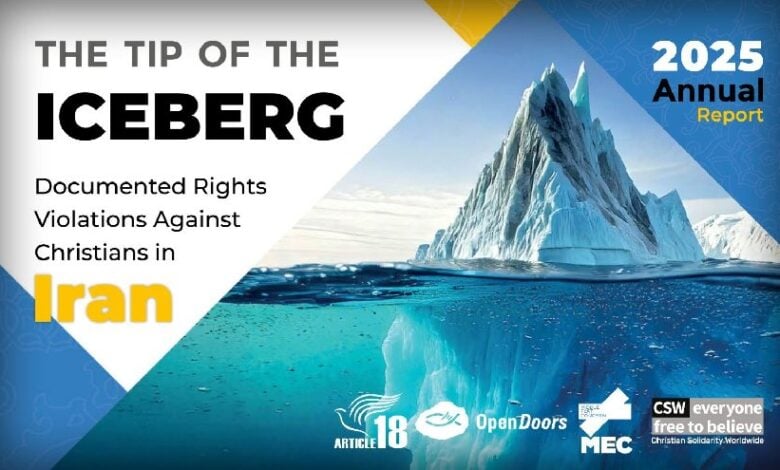
Global Christian organizations have published their seventh annual report on the situation of Christians in Iran.
On Monday, January 20, corresponding to 2 Bahman 1403, the Christian organizations "Open Doors", "World Christian Solidarity", "Middle East Watch", and "Article 18" published their seventh annual report, referring to "violations of the rights of Christians in Iran", under the title "Tip of the Iceberg".
The report prepared by the aforementioned organizations documents the violations of the rights of Christians in Iran and, due to cases that are not reported, shows only a small part of the violations of the rights of Christians. The 48-page report shows that Christians faced a six-fold increase in prison sentences in 2024.
According to the statistics published in the report, a total of 96 Christians were sentenced to 263 years in prison in 2024, which includes 22 Christians imprisoned last year, totaling 43 years and 6 months in prison. The number of people arrested for their Christian beliefs and peaceful religious activity in 2024 was also reported to be at least 139.
The published report states that at the end of 2024, at least 18 Christians were serving prison sentences, 80 were arrested, 77 were charged, and 96 Christians were sentenced to a total of 263 years in prison, 37 years of internal exile, and about $800,000 in fines. The relevant reports also contain information about physical torture of detainees.
According to reports from four global Christian organizations, it has been revealed that in the second half of 2024, the IRGC Intelligence Organization investigated the financial transactions of Christians and their lawyers. These investigations revealed that within two months, Christians in five different cities were arrested on suspicion of receiving funds from abroad and summoned to the IRGC Intelligence for interrogation.
Christian organizations stated in the relevant report: “The Iranian government appears to have intensified its efforts to isolate and financially weaken the Christian community, as part of a broader strategy to suppress their growth and influence.”
The financial donations that the IRGC has investigated and summoned Christians for receiving are donations that some charities provide to support church activities. This is normal for Christians around the world, but these activities and donations are considered a crime by Iran's revolutionary courts.
More than 70 percent of the charges brought against Christians in 2024 were filed under Article 500 of the Islamic Penal Code, and many Christians have been threatened with charges under Article 500 of the Islamic Penal Code. This article provides for a maximum of 10 years in prison for those who “propaganda against the holy religion of Islam” while receiving financial support from organizations abroad. Revolutionary courts have also used this article to issue long sentences against Christians, a law that the United Nations has also issued a resolution calling on the Islamic Republic to change.
The report also addresses the situation of Armenians and Assyrians, who are recognized minorities. They not only face structural and legal discrimination in Iran, but, contrary to the authorities' claims, are arrested and repressed if they go beyond the framework set by the government for holding their religious ceremonies or participate in meetings with Iranian Christians, including praying or reading the Bible. This includes Hakob Gochumian, an Armenian citizen living in Armenia who was sentenced to ten years in prison by the government, the report says.
In addition to publishing statistics and referring to Christians imprisoned in Iranian prisons, the report also refers to, examines, and analyzes documents published by the hacking group "Adalat Ali." According to the documents obtained by the aforementioned hacking group, 327 Christian citizens have been repressed by the government over a period of 15 years (from July 2008 to January 2013), of which 198 were men and 129 were women.
According to Article 18, 52 of these cases had been reported to the organization before the documents were released, indicating that many cases of repression and detention of Christians had gone unreported and hidden. The report states: “The detained Iranian Christians did not only include Christian converts, but the hacked documents also include the detention of 4 Armenian citizens and 9 Assyrian citizens, who were from different churches and beliefs, including Orthodox and Catholic.”
At the end of their reports, four global Christian organizations issued a series of requests and recommendations to the government of the Islamic Republic of Iran and the international community. Addressing the Iranian government, they stated in their report: “All Christian prisoners should be released, confiscated centers and buildings should be returned to them, and the Iranian government should cooperate with the UN Special Rapporteur on Human Rights and the Truth and Reconciliation Commission on the protests.”
The four organizations called on the international community to hold the Islamic Republic government accountable for failing to fulfill its obligations under international law.
``Global Christian organizations also called on countries hosting Iranian Christian refugees and asylum seekers to facilitate the residence and settlement of these persecuted individuals and not to return them to Iran, as they will face torture and imprisonment upon their return to Iran.