Iran News

Trial of 19 Behbahani protesters held "in 20 minutes"; Prosecutor's Office: It was to review "legal requirements"
According to reports, the court session of 19 people arrested during last year's Behbahan protests lasted only 20 minutes. Although Iranian judicial authorities initially denied this, after confirmation from defense lawyers, the Behbahan County Public and Revolutionary Prosecutor finally accepted the formation of such a court today, describing it as a review of "legal requirements."

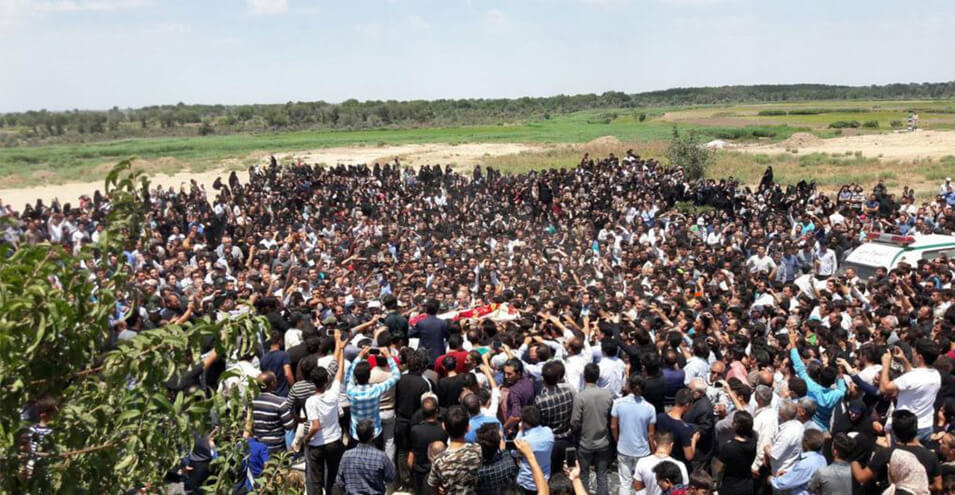
On the evening of July 16, 2020, a group of people from Behbahan held a protest rally in support of the three people arrested in the November 2019 protests who had been sentenced to death, which ultimately ended with military forces suppressing the protesters and mass arrests.

On Saturday, January 24, 2021, a court session to hear the charges against a number of citizens arrested in those protests was held in Branch 103 of Criminal Court 2 of Behbahan County, Khuzestan Province, presided over by Judge Rasoul Rasoulinejad.

Political activist Arash Sadeghi wrote in a tweet about the 20-minute session of the Behbahani Protesters' Court that Judge Rasoul Rasoulinejad only asked a few questions of the defendants during the 20-minute session (hearing the charges against 19 defendants). There was no prosecutor's representative in this trial, and the judge read the indictment in the role of the prosecutor's representative. Except for Ms. Farzaneh Ansarifar, Maryam, and Ali Kazemi, whose lawyer was Ms. Tabanian, the other defendants were deprived of having a lawyer.

Judicial officials, who initially denied the formation of such a court, finally reacted to what they called "news published on social media stating that the charges against 19 defendants were heard in 20 minutes," and the Behbahan County Public and Revolutionary Prosecutor announced in a statement that "the process related to the legal requirements for holding a court hearing was reviewed within 20 minutes."

Attorney Fereshteh Tabanian has provided an explanation in this regard that differs from the initial narrative of the judiciary: "I was the attorney for three of my friends. A meeting was held. For almost twenty minutes, the charges against more than fifteen people were examined. We were not allowed to speak. They just told us to write a bill."

Farzaneh Ansarifar, Arman Ansarifar, Mohammad Fatemi, Amin Salehizadeh, Mohammad Nazarian Tambi, Amin Moradi, Ali Atoun, Narges Darmgazin, Maryam Kazemi, Ali Kazemi, Payam Jehouni, Jalal Jafari, Zeinab Alipour, Meysam Akbari, Ebrahim Armesh, Masih Badragh, Milad Ramezani, Yasin Abbasi, Soghra Mutaman, and Mohammad Abolpour are among those detained during last year's Behbahan protests against whom the Islamic Republic's judiciary has declared crimes.

In previous months, other hearings were held for participants in last year's Behbahan protests on charges of "insulting the leadership," "participating in disrupting public order," "disrupting national security," and "gathering and colluding to commit crimes against internal security."

The Islamic Republic's judiciary has a history of holding show trials that violate judicial procedures and have always faced protests from human rights institutions and organizations; however, with the intensification of protest rallies in recent months, these courts have taken on a new form, and some political activists see it as a direct message from the government to the people to end the protests.

Source: Voice of America

Similar posts

Back to top button