Barry Rosen: I told Robert Malley that Shahab Dalili is also one of the hostages and should be released.
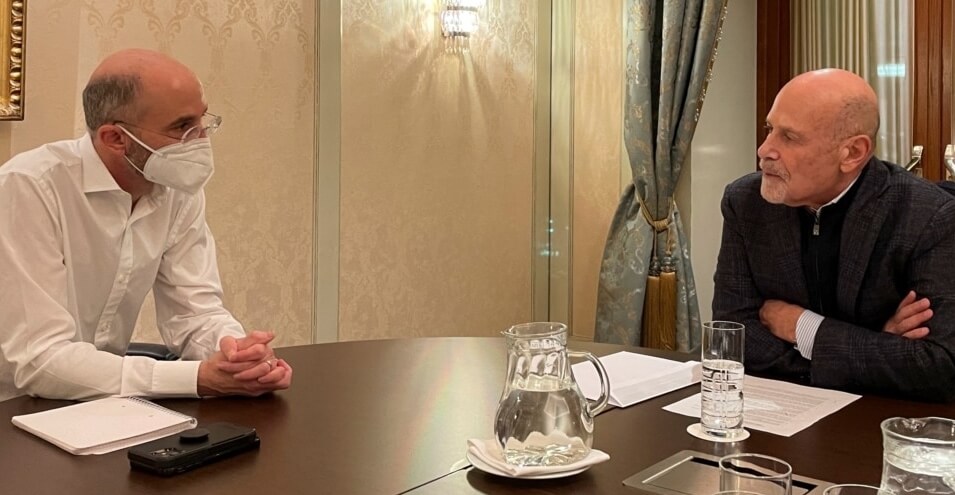
Barry Rosen, a former hostage at the US embassy in Iran, says that after learning about Shahab Dalili's condition, he wrote a letter to the US State Department's special representative requesting that his release be pursued.
Shahab Dalili, an Iranian citizen with permanent residency in the United States, has been imprisoned in Iran for about six years. He traveled to Iran in 2016 to attend his father’s funeral, but was arrested while leaving the country and later sentenced to 10 years in prison on charges of “collaborating with a hostile government.”
Mr. Rosen said in an exclusive interview with the Voice of America Persian Service on Friday, April 25, that Shahab Dalili's wife learned about this case in an interview with Nahid Dalili, adding: "I was very shocked that Shahab Dalili has been in prison for six years and very few people know about his case. This is bad news for America and the world. He has been imprisoned for more than six years and no one knows anything about his case."
He continued: "Nahid told me how sorry she was that Shahab's name was not mentioned in the public sphere, but I must say that I am confident that the US State Department's special representative for Iran, who is currently in Vienna, knows that Shahab is in prison for a reason."
Barry Rosen expressed his frustration at the lack of clear information and statistics on the number of prisoners, adding, "I'm also very surprised why we don't have real statistics on the number of citizens and permanent residents in prison. I think the world should know about that."
Emphasizing the need to pursue the case, he said, "He should not be left behind, and believe me, if that happens, it will be a disgrace to the United States."
Barry Rosen went to Vienna a few months ago and went on a hunger strike in front of the Coburg Hotel, where negotiations are underway to revive the Iran nuclear deal, known as the Joint Comprehensive Plan of Action (JCPOA). In a meeting with American and European negotiators, Mr. Rosen demanded that all hostages be released and that a mechanism be established so that the Islamic Republic of Iran would never do such a thing again. Barry Rosen was on a hunger strike for four days.
In response to the question of whether he still follows the position he took during his campaign in Vienna now that he has learned about Shahab Dalili's situation, Mr. Rosen added: "Absolutely. I just wrote a letter yesterday to Robert Malley, the US State Department's special representative for Iran, and I told him, look, Shahab Dalili is another hostage, leave no one behind among the people who are being held by the regime in Tehran. Make sure that everyone is released and make sure that there is no agreement unless and until all these hostages are released."
He also spoke about the family's silence and the need to focus on Shahab's situation, saying: "I think the reason is that the family, especially Nahid and her children, felt that some might be released but Shahab would not be among them. It's almost a 90-minute situation, but for whatever reason, and even though they may blame themselves for not doing something sooner, something has to be done now. He has been in prison for six years. He is as important as any other American hostage, and we must not forget him. His name must not be forgotten."
Barry Rosen emphasized that: "The US State Department's special representative for Iran should mention his name, like the Namazis, Morad Tahbaz, and Imad Sharghi, whose names have already been mentioned. Shahab Dalili should be a definitive part of any agreement for the release of American hostages."
Criticizing the European appeasement towards Tehran, Barry Rosen added: "The poor behavior of our European allies towards Tehran torments me. I hope that not only the American hostages, but also the Europeans will be released. I congratulate the British government for doing what it should have done many years ago, but I am deeply concerned that Europe and the Americans are leaving some behind."
Currently, individuals such as Emad Sharghi, Siamak Namazi, and his father Bagher Namazi (Iranian-American citizens), Ahmadreza Jalali (Iranian-Swedish researcher), Mehrdad Rauf (Iranian-British citizen), Fariba Adelkhah (Iranian-French citizen), Nahid Taghavi (German citizen of Iranian descent), and Benjamin Brier, a French tourist, are imprisoned in Iran.