Emphasis on fines for not wearing the hijab; warning about firing employees with "un-Islamic profile photos"
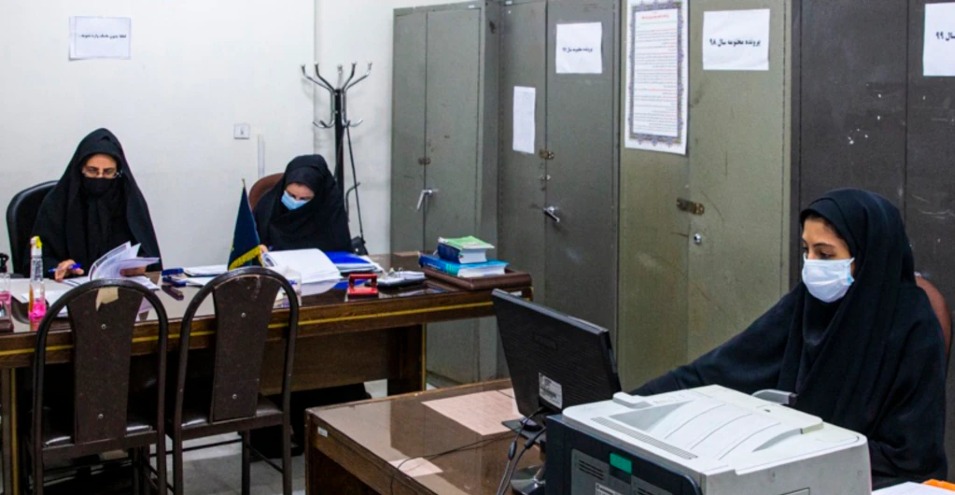
Following the intensification of government pressure on the hijab, the Amr-e-Ma'ruf Headquarters emphasized "cash fines for violators," and employees in Khorasan Razavi were threatened with dismissal if their profile pictures were "un-Islamic."
According to the Iranian Broadcasting Corporation, Mohammad Saleh Hashemi Golpayegani, secretary of the Amr Beh Maruf Campaign, emphasized at the National Conference on Chastity and Hijab that in the campaign's "Chastity and Hijab" plan, "a person who does not wear hijab is no longer a criminal but a violator, and instead of filing a case and receiving the punishments provided for in the law, the person will be fined."
Mr. Hashemi Golpayegani is referring to the 120-page "Hijab and Chastity" plan that the Headquarters for Encouraging Righteousness and Forbidding Wrong prepared in the winter of 1400 and communicated to government organizations.
This plan differs from previous government-approved plans and laws regarding the hijab and covering, including the substitution of "fines" for punishments such as "flogging" and "prison," and the annual budget required by this headquarters is to be financed from these fines.
Previously, fines for people who were "badly veiled, not veiled, and loosely veiled" were more applicable to cars, but in the new plan, the scope of this punishment has been increased and it has been called "costing for ill-veiled behavior in social interactions."
Examples of these financial penalties include "fixing fines for the license plates of houses visited by ill-dressed people," "fines for building and complex managers for residents' ill-dress," and "fines for managers of government agencies for failing to act in the best interests of their employees."
Although the amount of the fine for "violators" of the hijab is not explicitly stated in this plan, the "Cyberspace and Media" section addresses this issue in detail, and the Amr Be Maruf Headquarters has called for an article to be added to the Computer Crimes Law, according to which anyone who publishes content or images in cyberspace that "contradicts public decency" or "propaganda against the Islamic hijab" will be sentenced to "imprisonment from ninety-one days to two years or a fine of five million to forty million rials, or both."
The plan also states that "publishing images of Iranian women without the Islamic veil in cyberspace by themselves will result in the deprivation of one or more social rights and the deprivation of activity in cyberspace for a period of six months to one year."
Following the announcement of this plan to government organizations and departments in recent months, restrictions on women's hijab and clothing have increased significantly, not only in social settings but also in the workplace. For example, in mid-July, Bank Mellat issued a circular prohibiting "wearing high heels and thin socks" and "using female secretaries for managers."
But restrictions in public and administrative areas have been greater in religious cities, including the order of the mayor of Mashhad regarding a letter from the prosecutor's office to prevent women "not wearing a hijab" from entering the subway, as well as the ban on mothers of male children from entering the hall where they were competing in a karate competition in Mashhad last month.
Continuing the increasing trend of these restrictions, Mehdi Rezaei, Secretary of the Khorasan Razavi Headquarters for Encouraging Good and Forbidding Evil, on Sunday, August 14, pointed out the continuation of the process of separating male and female employees' rooms in this province and warned about employees' profile photos.
According to Mr. Rezaei, if employees whose profile pictures on social media do not show Islamic clothing, they will be referred to the disciplinary committee, where they can even be fired for violating the law.
Source: Radio Farda