Prince Reza Pahlavi emphasizes the separation of religion and government: Democracy is not possible without secularism
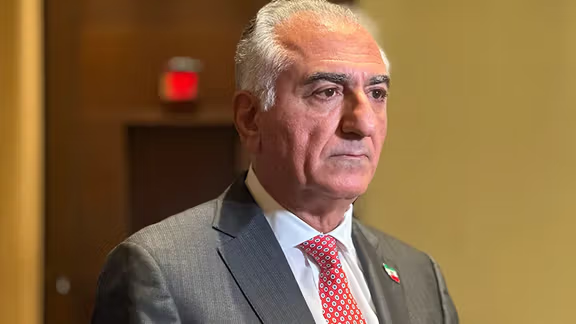
Prince Reza Pahlavi said in a speech: "The separation of religion from the state is the main condition for the transition to democracy, and without secularism, freedom and equality of citizens are not possible."
In Prince Reza Pahlavi’s latest political positions, he has once again emphasized the necessity of secularism and religious freedom as the main pillars of the future Iran, and has considered the separation of religion from the state an indispensable prerequisite for democracy. These positions come at a time when the Islamic Republic, relying on religious ideology, has turned not only civil liberties but also religion itself into an instrument of power and repression.
In a recent interview with an American journalist, Prince Reza Pahlavi described the situation in Iran not simply as a political crisis but as a popular struggle against “an occupying force” that, he said, was holding the country hostage and suppressing the demand for freedom through organized violence. He accused the Islamic Republic’s government of shooting unarmed citizens who are demanding freedom and liberation from tyranny with weapons of war in an unjust war.
The interview, released on Monday, February 9, paints a stark and stark picture of the current situation in Iran. The crown prince called the situation “a genocide in progress” and stressed that the only way to level the playing field for the brave Iranians fighting for their liberation is to receive assistance that can neutralize the tools the regime has used against its own citizens. This path, he said, is not possible without targeting the regime’s main apparatus of repression, including the Revolutionary Guard Corps and other elements associated with it.
In another part of the conversation, Prince Reza Pahlavi outlined a framework that he said could bring together Iran’s democratic and secular forces under a comprehensive coalition. This convergence is conditional on adherence to four fundamental principles:
- Iran's territorial integrity;
- Separation of religion and state as a prerequisite for democracy;
- Individual freedoms and equality of all citizens before the law;
- The right of the Iranian people to determine their future through free elections and the ballot box, which must be held during the transition period and by a transitional government.
These principles are, in fact, a direct response to the experience of four decades of ideological rule; a government that, by denying legal equality, has divided society into ranked citizens and has turned official religion into a criterion of political loyalty.
Prince Pahlavi went on to emphasize the need to include freedom of religion in a constitution based on the Universal Declaration of Human Rights, explaining that secularism does not mean eliminating or weakening faith. He clarified: “Freedom of religion is protected, but the separation of religion from the state is a prerequisite for democracy.”
According to him, the experience of the Islamic Republic has shown that the interference of religion in politics not only destroys freedom, but also erodes and discredits faith itself. Prince Reza Pahlavi recalled that opposition to the ideological government was not limited to secular forces, and there were serious critics of this structure among Shiite clerics as well as Sunni religious leaders, because the combination of power and religion has turned religion into a tool of coercion and repression.
Overall, Prince Reza Pahlavi's recent positions emphasize one key point: a future Iran without secularism will be neither democratic nor secure. A plural society with diverse religions, beliefs, and atheism can only achieve sustainable coexistence if the government distances itself from any religious ideology and guarantees the rights of all citizens without discrimination.
In a situation where the Islamic Republic continues to derive its legitimacy from forced rituals, bloody repression, and ideological interpretations of religion, emphasizing religious freedom and the separation of religion from the state is not a theoretical debate, but a political necessity to save Iran.